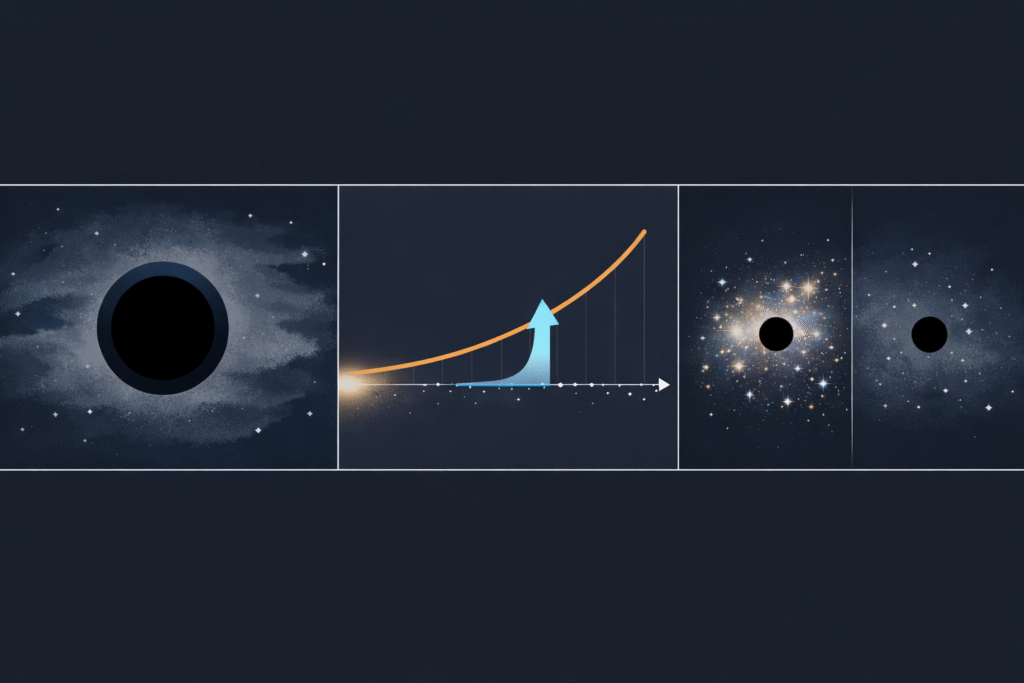
Reading through this report, I asked myself: “does this new black hole discovery mean that it formed from the materials left over from the earlier creation — breadcrumbs of the previous universe?”
No rational explanation, perhaps, exists for this. But, this probably has been that question of humans which remains unanswered — also asked by the composers of Rigveda who probed to know what was there before something got created.
This also leads me to the concept of time in philosophy. In my limited knowledge and reading of concepts, Indian, European, ancient, modern, eastern or western, I find just one fundamental difference between Indian and India-influenced philosophies, and the rest — and that is not the concept, but the nature of time. Indians have viewed time as cyclical while others have understood it as a linear dimension.
But let’s go back to the new discovery.
📌 What’s new
- A massive black hole has been identified in a galaxy with very low chemical enrichment
- The system dates to roughly 700 million years after the Big Bang
- The finding challenges standard models linking black hole growth to metal-rich, star-forming environments
🔬 The finding: A mismatch between mass and maturity
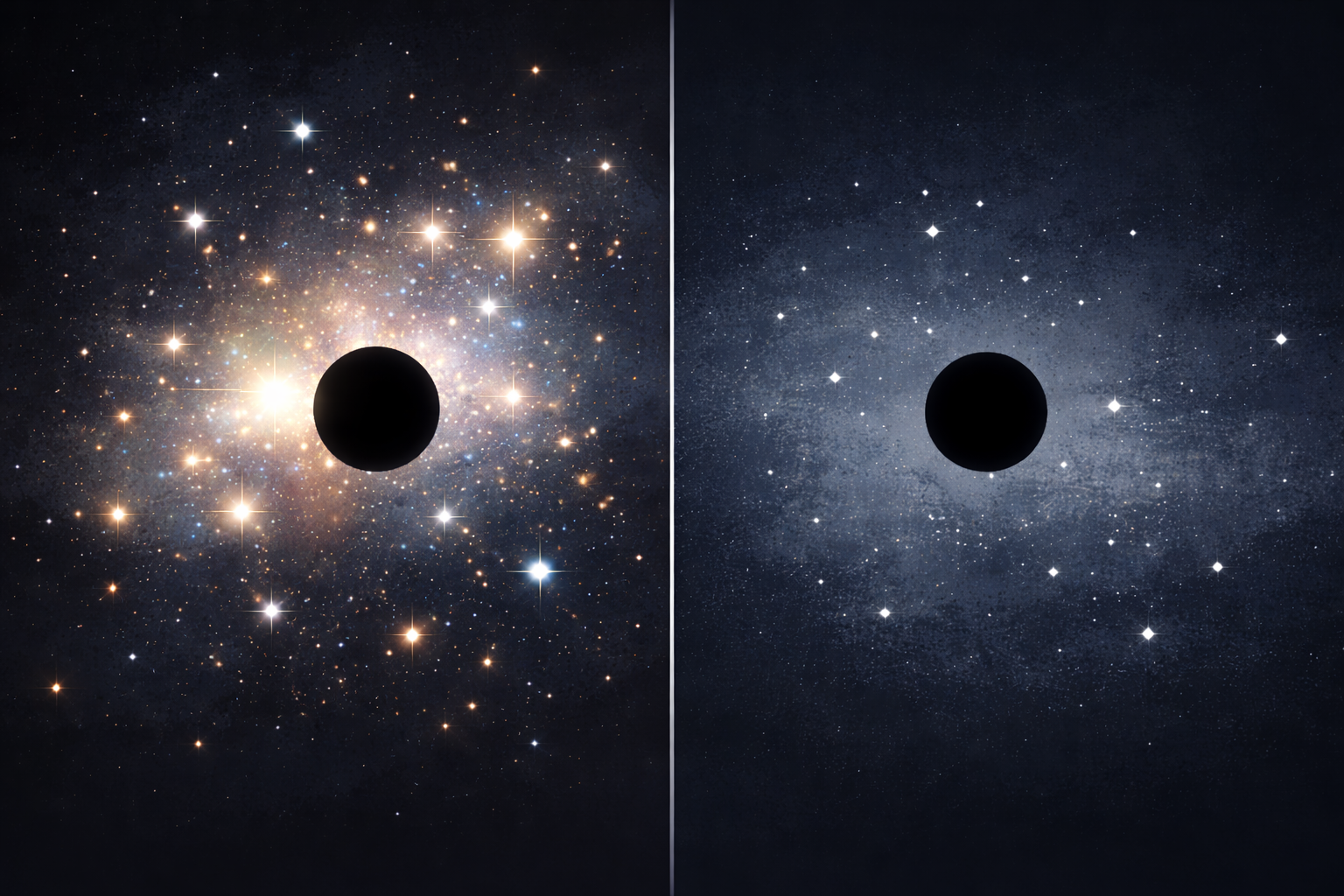
Astronomers expected early black holes to appear in busy, chemically evolved galaxies, where repeated star formation enriches gas with heavy elements.
Instead, this object sits in what is effectively a cosmic backwater:
- Minimal heavy elements (near “pristine” conditions)
- Limited evidence of prior star formation
- Yet hosts a substantially grown black hole
👉 The contradiction is stark:
A mature black hole inside an immature galaxy
⚠️ Why it challenges existing theory
1. The standard growth model doesn’t fit
Black holes are thought to grow via:
- Stellar collapse → seed black holes
- Gas accretion + mergers → gradual mass build-up
But that pathway typically requires:
- Time
- Metal-rich environments
Neither condition is clearly met here.
2. The timeline looks compressed
At ~700 million years post-Big Bang:
- The universe was still in an early phase of structure formation
- There should not have been enough time for such rapid growth under normal assumptions
3. The environment is “too clean”
Heavy elements (oxygen, iron, carbon) are produced by stars.
Their absence suggests:
- Limited stellar processing
- Yet paradoxically, advanced black hole evolution
🧩 Competing explanations
🔹 Direct collapse scenario
- Massive gas clouds collapse directly into black holes
- Skips the usual star formation stage
- Could explain both:
- Large initial mass
- Low metallicity surroundings
🔹 Primordial origins
- Hypothetical primordial black holes forming soon after the Big Bang
- Would not depend on stellar evolution
- Still speculative, but gaining renewed attention
🔹 Extreme early accretion
- A smaller seed grows at unusually high rates
- Problem:
- Requires sustained inflow of matter
- Typically leaves chemical signatures—which are missing
🌌 A broader pattern is emerging
This is not an isolated case. Observations—especially from modern infrared telescopes—are increasingly finding:
- Overmassive black holes at high redshift
- Galaxies that appear less evolved than their central black holes
👉 Together, they suggest a systemic gap in our models of:
- Early galaxy formation
- Black hole growth rates
- Matter distribution in the young universe
📊 What this could change
Cosmology
May shift timelines for structure formation in the early universe
Astrophysics
Forces revisions to black hole seed formation models
Fundamental physics
Reopens discussion on:
- Early-universe density fluctuations
- Exotic formation channels
🧠 The takeaway
This discovery sharpens a growing tension in astronomy: black holes in the early universe are appearing faster, larger, and in simpler environments than current theory comfortably allows.
The question is no longer whether models need refinement — but how fundamental that rethink must be.
You can watch the video here:
(Note: The story has been formatted using AI tools, which were also used for generating illustrations)