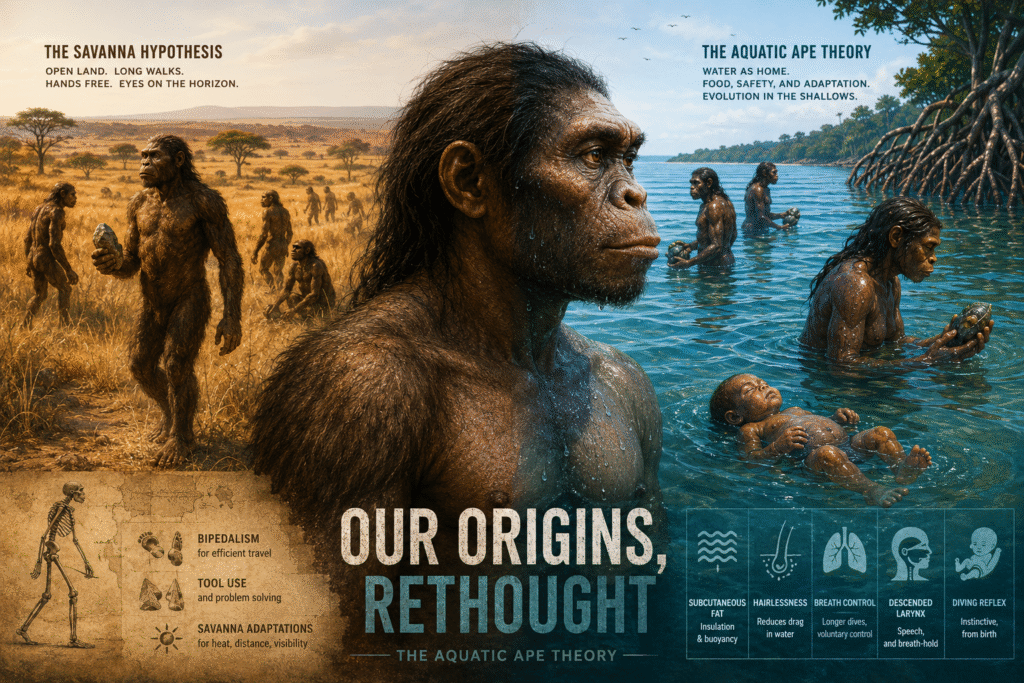
Picture the African savanna. Vast, sun-scorched grassland stretching to the horizon. A small group of upright primates moving through the heat, scanning for predators, scavenging for food. This is the image that dominates our understanding of human origins — the backdrop against which we became human.
This is the world imagined by the Aquatic Ape Theory — one of the most controversial, most compelling, and most persistently dismissed ideas in the history of paleoanthropology. It has been called a fringe theory, a distraction, even an embarrassment to serious science. It has also refused, for over sixty years, to go away.
The Aquatic Ape Theory has made a comeback on the internet, with a number of influencers from the world of science and not-so-science creating content on the hypothesis. We at The Free Pen decided to deconstruct the Aquatic Ape Theory sidelined by mainstream biology scientists. The evolution of humans has been one of the most debated and also contested ideas of the humankind and of the modern science as well.
Where the idea began
The story starts not with a scientist but with a marine biologist named Alister Hardy. In 1960, Hardy — by then a respected Oxford professor — published a short piece in New Scientist proposing something that had apparently been bothering him since 1930: that a critical phase of human evolution had taken place not on the savanna but in or around water.
Hardy had noticed a cluster of anatomical features that seemed to set humans apart from other great apes — features that, taken individually, might be explained away, but taken together suggested something systematic.
Humans are the only great apes with a substantial layer of subcutaneous fat distributed around the body like a wetsuit. We are the only great apes who are largely hairless. Our nostrils point downward rather than forward. We can consciously control our breathing in ways no other primate can.
We have a diving reflex — an involuntary slowing of the heart rate when the face is submerged in cold water — that we share with aquatic mammals. Our infants, placed in water in their first weeks of life, display instinctive swimming motions. And we walk upright, freeing our hands in ways that make sense if those hands were used to handle objects in shallow water.
Hardy’s proposal was modest: not that humans lived permanently in the sea, but that at some point in our evolutionary past, perhaps during a period when ancestral populations were cut off from the savanna by environmental change, our forebears spent enough time in water to acquire a distinct suite of aquatic adaptations.
Hardy was cautious. He sat on the idea for thirty years before publishing, worried about professional ridicule. He was right to worry. The academic response ranged from scepticism to dismissal. The theory was noted, critiqued, and largely set aside.
Enter Elaine Morgan
The idea might have died there, a footnote in the history of evolutionary speculation, had it not been taken up by a Welsh television writer named Elaine Morgan. In 1972, Morgan published The Descent of Woman, a feminist critique of the male-centred narratives dominating paleoanthropology — the idea that everything important about human evolution could be explained by male hunting, male aggression, and male tool use.
Morgan found in Hardy’s aquatic hypothesis something that the mainstream narrative lacked: an explanation that did not require human females to be passive bystanders to their own evolution.
Over the following decades, Morgan became the most energetic and prolific advocate for what she called the Aquatic Ape Theory, or AAT. She wrote five books on the subject. She read the scientific literature voraciously.
She argued, with increasing sophistication, that the cluster of features Hardy had identified — the fat layer, the hairlessness, the descended larynx, the breath control, and the bipedalism — were not adequately explained by savanna-based models of human evolution, and that an aquatic or semi-aquatic phase offered a more parsimonious account.
Morgan was not a scientist. This was used against her, repeatedly and sometimes contemptuously. But she was an exceptionally careful reader of scientific evidence, and some of her objections to mainstream accounts were genuinely pointed.
She asked: why would a primate evolving on an open savanna lose its fur, which protects against solar radiation and parasites? The standard answer — thermoregulation — requires explanation of why no other savanna mammal lost its fur in the same way.
She asked: why is human subcutaneous fat distributed the way it is, more like a marine mammal’s blubber than like the fat stores of any land-based primate?
She asked: why do human infants demonstrate a diving reflex and a capacity for swimming that disappears if not reinforced, rather than appearing later — which is the pattern you would expect if it were a learned behaviour rather than an evolved one?
These were not rhetorical questions. They were, and remain, real puzzles about human anatomy for which the mainstream evolutionary account offers incomplete answers.
The anatomy of an argument
Hairlessness
Humans are, among primates, uniquely and dramatically hairless — or rather, our body hair has become so fine as to be functionally negligible. We retain hair in areas that correspond roughly to areas that would protrude above the water surface during upright wading: the top of the head, the armpits, and the groin.
AAT proponents argue this pattern is consistent with aquatic adaptation. Mainstream paleoanthropology offers several alternatives: hair loss as a mechanism to reduce parasite load, to facilitate thermoregulation through sweating, or as a form of sexual selection. None of these explanations is individually watertight, and each raises follow-on questions.
Subcutaneous fat
Unlike other apes, humans store fat in a continuous layer just beneath the skin, distributed across the entire body. In other land mammals, fat is typically concentrated in depots around organs.
In marine mammals — dolphins, seals, and whales — fat is distributed as a subcutaneous layer, which serves both as insulation in water and as a buoyancy aid. Human infants are born with a particularly thick layer of subcutaneous fat, which is unusual for a primate and makes them more buoyant.
AAT sees this as strong evidence of aquatic heritage. Critics note that subcutaneous fat in humans may have evolved for thermoregulation in variable climates, or as an energy reserve during periods of food scarcity.
Bipedalism
Walking upright is the defining physical characteristic of our evolutionary lineage, predating even the expansion of brain size by millions of years. The savanna hypothesis explains it as an adaptation to moving across open ground — freeing the hands, increasing visual range, and making long-distance running more efficient.
AAT offers a different account: wading in shallow water selects strongly for upright posture, because bipedal wading keeps the head above water, allows the arms to carry food, and reduces the energy cost of movement in water compared with quadrupedal swimming.
Wading-driven bipedalism is not a fringe idea — it has been modelled biomechanically and found to be plausible.
Breath control
Human beings are the only primates capable of voluntarily controlling their breathing with sufficient precision to speak, sing, hold a breath for minutes, or synchronise breath with movement. This capacity for voluntary breath control is the physiological prerequisite for language.
In most mammals, breathing is involuntary and not accessible to conscious modification. In diving mammals — seals, dolphins, and otters — it is under at least partial voluntary control.
AAT argues that this capacity evolved in a context where breath-holding was regularly useful. Critics counter that voluntary breath control evolved as a prerequisite for speech, not for diving. But this risks circularity: it explains breath control through speech, then explains speech through brain evolution, without explaining why the breath control mechanism emerged first.
The descended larynx
In most mammals, including non-human primates, the larynx sits high in the throat, allowing the animal to breathe and swallow simultaneously — useful for drinking without interrupting breathing.
In adult humans, the larynx has descended, creating the longer vocal tract that enables the full range of human speech sounds, but also creating a risk of choking on food.
This is an evolutionary trade-off: we gave up the safety of separate swallowing and breathing pathways in exchange for the acoustic range to speak.
AAT notes that a descended larynx is also characteristic of some aquatic mammals — manatees and some seals — and suggests it may have evolved initially to allow a longer breath-hold before descending for a dive.
Most mainstream linguists and evolutionary biologists attribute the descended larynx entirely to the demands of speech, but the question of why speech required this particular anatomical modification remains partially open.
The diving reflex
When humans, especially infants, submerge their faces in cold water, their heart rate drops, peripheral blood vessels constrict, and blood flow is redirected to the brain and heart — the organs most sensitive to oxygen deprivation.
This is called the mammalian diving reflex, and it is present, in varying degrees, in virtually all mammals. But it is most strongly developed in aquatic species.
In human infants it is pronounced and automatic. AAT treats this as a retained ancestral adaptation. Mainstream physiology considers it a conserved primitive reflex with no special significance for human evolution.
The fossil problem
The most damaging critique of AAT has always been the fossil record. If a significant phase of human evolution took place in aquatic or coastal environments, we should expect to find early hominin fossils near ancient coastlines, lakeshores, or river deltas. Mostly, we find them in places that were, at the time, grasslands, woodland margins, and savanna.
The famous Lucy — Australopithecus afarensis, found in Ethiopia’s Afar region — lived approximately 3.2 million years ago and showed clear evidence of both bipedalism and tree-climbing. The Afar region was a mosaic of grassland, woodland, and lakeshores during her lifetime, but there is no specific evidence she was particularly aquatic.
The oldest known hominin fossils — from species like Sahelanthropus tchadensis and Ardipithecus — come from environments that were predominantly forested and savanna rather than coastal.
Morgan and her supporters argued that coastal environments are among the least likely to preserve fossils, because coastal zones are subject to erosion, sea level change, and geological disruption over millions of years. This is true. But it does not constitute positive evidence for the AAT — it is an argument from the absence of evidence.
The fossil record is also increasingly read against a savanna-only model of human evolution. The “East Side Story” hypothesis — which proposed that the uplift of the East African Rift separated forest-dwelling ape ancestors in the west from the drier east, forcing the eastern lineage toward savanna adaptation — has been substantially complicated by fossil discoveries in Chad, which is on the wrong side of the rift entirely.
The ‘Waterside’ hypothesis: a more modest reformulation
In 2017, a group of researchers published a substantial academic collection attempting to reformulate the AAT in more scientifically cautious terms, calling it the “Waterside” hypothesis.
Their argument was not that humans evolved in the sea, but that access to aquatic food sources — fish, shellfish, and aquatic plants — played a critical and underappreciated role in hominin cognitive evolution.
The logic runs as follows. The human brain is metabolically expensive — it accounts for roughly 20 per cent of our caloric intake despite being only about 2 per cent of our body mass.
Growing and sustaining such a brain requires reliable access to high-quality, calorie-dense nutrition. Shellfish, fish, and other aquatic foods provide precisely the fatty acids — particularly the long-chain omega-3s like DHA (docosahexaenoic acid) — that are disproportionately important for brain development and function.
The DHA argument has genuine support in nutritional neuroscience: DHA is a critical structural component of the brain, and it is found in high concentrations in seafood.
This version of the argument — that coastal and riparian food sources may have fuelled the brain expansion that distinguishes Homo sapiens from earlier hominins — has attracted more serious scientific attention than the broader AAT, precisely because it makes specific, testable claims about diet, neurochemistry, and the timing of cognitive evolution.
Archaeological evidence from Pinnacle Point in South Africa, dated to approximately 164,000 years ago, shows that early Homo sapiens were harvesting shellfish from coastal environments during a period of glacial cold — when inland food sources would have been severely diminished.
This suggests coastal resources were, at minimum, a critical refuge food. Whether they were more than that — whether they actively drove brain evolution — remains debated.
What the theory gets right
Elaine Morgan, who died in 2013, spent the last years of her life giving a TED Talk that has been watched millions of times. In it, she asked a simple question: how do mainstream paleoanthropologists explain bipedalism, hairlessness, subcutaneous fat, voluntary breath control, and the descended larynx together?
The honest answer is: imperfectly.
The savanna hypothesis — or its more modern reformulation as the “variability selection” hypothesis, which proposes that fluctuating environments rather than any single habitat drove human adaptation — does not offer a single, unified explanation for all the features that make humans anatomically unusual among primates.
It offers a collection of separate, partially overlapping explanations, each with its own difficulties.
What the AAT offers, whatever its evidential weaknesses, is a framework that could explain the package as a package. That is not a trivial intellectual contribution, even if the framework turns out to be wrong in its specifics.
The mainstream scientific community has, in recent years, moved toward a more nuanced position: that human evolution was shaped by a mosaic of environments, that water — rivers, lakes, and coastlines — played a more significant role than the savanna-centric model acknowledged, and that the cognitive benefits of aquatic food sources deserve serious study.
This is not the AAT as Morgan argued it. But it is not entirely the savanna hypothesis either.
Science rarely moves by wholesale acceptance of heterodox ideas. It moves by absorption — taking the most defensible elements of the challenge and incorporating them into an expanded mainstream.
The Aquatic Ape Theory, in this sense, may be in the process of being quietly, partially vindicated, even as it continues to be officially dismissed.
The sea, it seems, is not quite done with the story of how we became human.