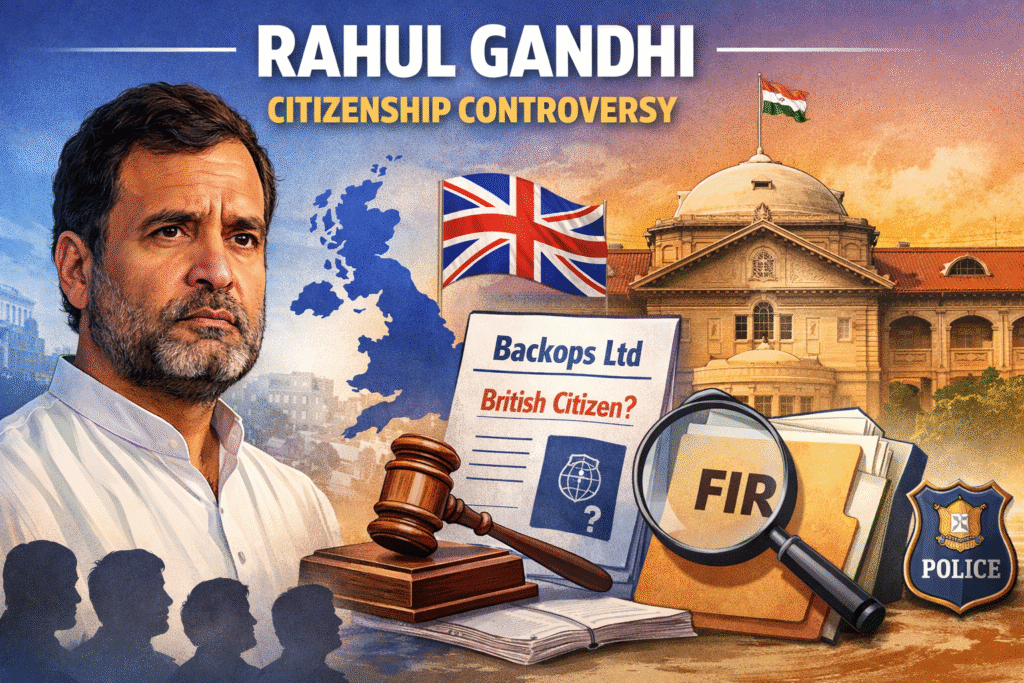
India’s citizenship laws are back in conversation in newsrooms, drawing rooms and on social media, thanks to the resurfacing of the allegation that Rahul Gandhi, the Congress leader, holds British citizenship. The latest trigger is a recent order from a bench of the Allahabad High Court in Uttar Pradesh directing the registration of an FIR for the proper investigation of the claim by the police or a central probe agency. The order came on a complaint filed by a Karnataka-based petitioner linked to the Bharatiya Janata Party.
The development does not answer the question one way or the other. It does something more limited, and more important in legal terms: it pushes the allegation into a formal investigative channel. To understand why this matters, it helps to begin with the law itself.
The legal position on citizenship
India’s citizenship framework is clear on one foundational point: the country does not recognise dual citizenship. A person can be an Indian citizen, or a citizen of another country, but not both at once. That principle is reflected in the Citizenship Act, 1955, which lays down the rules for acquisition and termination of citizenship.
The law recognises Indian citizenship by birth, descent, registration and naturalisation. It also provides that if an Indian citizen voluntarily acquires the citizenship of another country, Indian citizenship can be terminated. In other words, the question is not political sentiment or public perception; it is a matter of legal status.
This is why the allegation against Rahul Gandhi has drawn such sustained attention. If a person holding public office is found to have acquired foreign citizenship, it raises serious issues of eligibility, including the right to sit in Parliament. But the law also demands proof, not merely suspicion.
That is the crux of the matter. The claim has to be established through admissible evidence and official verification, not through repetition.
Where the allegation comes from
The controversy around Rahul Gandhi has its roots in filings linked to a United Kingdom-based company, Backops Ltd, from the early 2000s. Those documents allegedly described him as a British citizen. That interpretation has been disputed for years, and Rahul Gandhi has consistently denied holding any foreign citizenship. He has maintained that he is solely an Indian citizen.
This is why the issue has remained unresolved. On one side are documents that appear to raise questions. On the other is a categorical denial. Between the two lies the absence of a conclusive finding by any Indian authority.
That gap has allowed the matter to persist, particularly in a political environment where allegations often outlive the evidence on which they are based.
How the issue first became political
The citizenship question first entered the national conversation in a serious way in 2015, when Subramanian Swamy raised the matter publicly and wrote to the Ministry of Home Affairs seeking an inquiry. He relied on documents from UK corporate records to argue that Rahul Gandhi’s status required official examination.
The government then followed the usual administrative route. The Home Ministry sought a clarification. Rahul Gandhi denied the allegation. No prosecution followed, and no formal conclusion was announced.
That pattern set the tone for what came later. The issue would surface, attract attention, generate heat, and then recede without closure.
Why it keeps returning
The allegation did not disappear. It resurfaced during election cycles, when political scrutiny is naturally at its sharpest. Complaints were made to the Election Commission of India, and Rahul Gandhi’s nomination papers were examined. They were accepted, and no disqualification followed on citizenship grounds.
In 2019, fresh complaints led to another round of correspondence from the Home Ministry. Again, the matter ended without a conclusive finding.
For a few years after that, the issue stayed alive mostly as political ammunition rather than a live legal controversy. But it never fully went away. The reason is simple: in the absence of a final determination, a claim like this can be revived whenever it is politically useful.
The petitioner who revived the case
The present legal push comes from S. Vignesh Shishir, a Karnataka-based petitioner described as being linked to the BJP. He is not a national-level figure, nor is he the original source of the allegation. His significance lies elsewhere.
Shishir took the matter to court and sought the registration of an FIR. When a lower court in Lucknow declined to order one, citing jurisdictional limits, he challenged that decision. The matter then moved to the Allahabad High Court.
That step matters because it changed the forum. What had long existed in the realm of political allegation and bureaucratic correspondence has now entered the judicial and investigative track. That does not mean the allegation has been proved. It means the court has decided that the complaint is serious enough to warrant formal investigation.
What the High Court order means
The High Court’s direction to register an FIR should not be confused with a finding of guilt. Courts often make it plain that ordering an investigation is not the same as accepting the truth of the allegation. It simply means the complaint is not being dismissed at the threshold.
In practical terms, the order opens the door to evidence gathering. If the matter is taken up by the police or a central agency, investigators will have to examine records, correspondence and the basis of the citizenship allegation. They will need to determine whether the UK filings amount to proof, whether there was any formal acquisition of foreign citizenship, and whether the documents relied upon can stand up to legal scrutiny.
That is the stage the case has now reached. It has moved from accusation to process.
Why the issue remains unresolved
There are three reasons this question has never gone away.
First, the legal stakes are high. If the allegation were established, the consequences would be serious. Second, the evidence cited so far has been contested, and contested evidence rarely closes a case. Third, the issue sits at the intersection of law and politics, which gives it staying power far beyond the usual lifespan of a controversy.
The state has engaged with the matter before, but it has not conclusively settled it. That is why the allegation can still be revived years later. In the absence of a final official determination, every new petition, court order or political statement gives it fresh life.
Rahul Gandhi’s citizenship issue in a nutshell
Rahul Gandhi continues to deny holding British citizenship. No government agency has produced a conclusive public finding proving otherwise. Yet the matter is no longer confined to political debate. The High Court’s order has ensured that it will now be examined through a formal legal process.
That is the present position: an old allegation, repeatedly revived, now placed back into the machinery of investigation. What comes next will depend not on rhetoric, but on what the evidence shows.
Watch this on video: