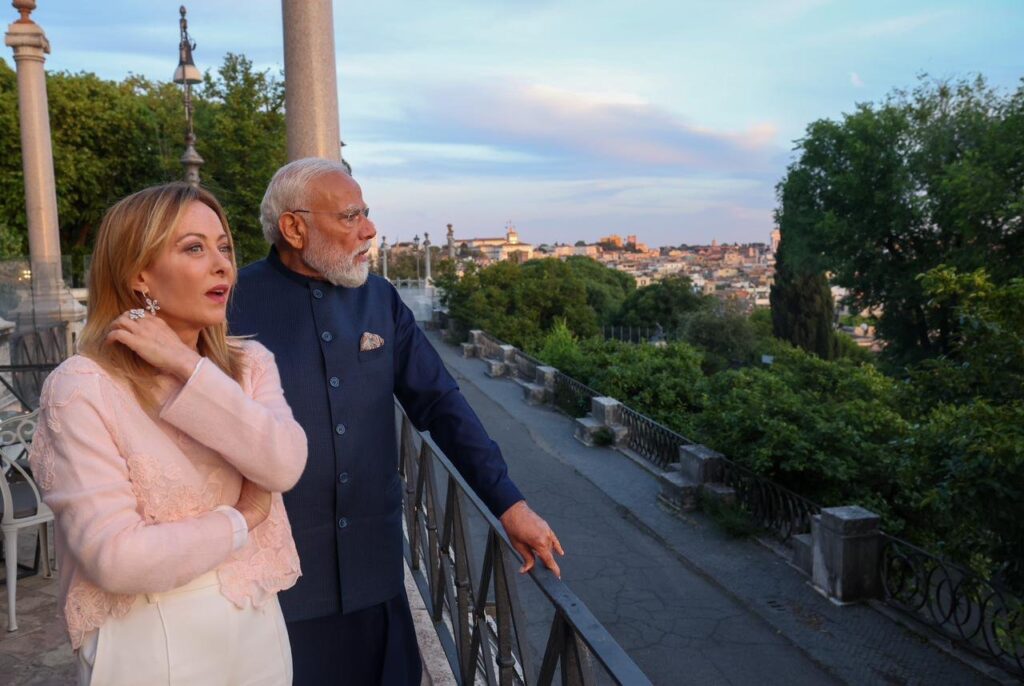
There is a photograph from the evening of May 19, that says more about the current state of global diplomacy than almost any communiqué or joint statement could. Two leaders — one the first woman Prime Minister of Italy, the other the Prime Minister of the world’s most populous democracy — are standing at the Colosseum in Rome, grinning at a smartphone camera, the ancient amphitheatre lit spectacularly behind them.
On the table earlier that evening, there had been a packet of Indian “Melody” toffees — a pun on their blended names — which the Italian prime minister had held up laughingly in a video posted online. A day later, their governments would announce a target of €20 billion in bilateral trade by 2029 and discuss defence, aerospace and strategic partnership.
It was the first bilateral visit by an Indian Prime Minister to Italy in 26 years. Yet what cut through the diplomatic noise was not the trade figures. It was the warmth. The ease. The entirely unforced theatre of it.
This is the Meloni method. And the world, whether it realises it or not, needs more of it.
A woman from Garbatella
To understand why Giorgia Meloni’s presence on the world stage is so distinctive, you have to understand where she came from — because it is precisely that origin that makes her self-presentation so deliberate and so effective.
Meloni was born on January 15, 1977, in Rome, and grew up in Garbatella, a working-class neighbourhood in central Rome. She was raised by her mother after her father left the family during her childhood.
There is no finishing school in her biography, no elite university, no banking career, no inherited political dynasty. From a young age she displayed an interest in politics and Italian national identity, and at 15 she joined the Italian Social Movement, a right-wing party with post-fascist associations.
She won her first local election at 21 and became Italy’s youngest minister at 31. Her political career began in the youth organisations of Italy’s post-fascist right in the early 1990s, and she rose through provincial politics, national youth movements and a ministerial appointment under Silvio Berlusconi before co-founding Brothers of Italy in 2012.
The party she co-founded was initially a marginal force in Italian politics. In the 2018 general election it won just 4 per cent of the vote. Four years later, under Meloni’s leadership, it won more than 26 per cent — one of the most dramatic electoral rises in modern Italian history — and she became the first woman ever to serve as Prime Minister of Italy.
The speech that perhaps defines her public persona came in 2019, when she told a rally in Rome: “I am Giorgia, I am a woman, I am a mother, I am Italian, I am Christian. And you can’t take that away from me!”
Critics mocked it. Supporters were galvanised by it. What is undeniable is that it worked — not merely as political rhetoric, but as an act of radical self-presentation.
Here was a woman refusing to disappear into the grey language of technocracy. She was loud, specific and entirely unashamed of all of it.
The Meloni-Modi moment and what it tells us
The Modi visit to Rome illustrates something analysts of grand strategy often overlook: the power of personal register in statecraft.
Narendra Modi arrived in Rome on May 19 in the final leg of a five-nation tour and was welcomed by Meloni with a post that quickly caught attention online. Sharing a picture with the Prime Minister, she wrote: “Welcome to Rome, my friend!”
The exclamation mark was doing real diplomatic work. This was not the stiff choreography of official protocol — it was a performance of genuine warmth that signalled to audiences on both sides that something different was happening.
They met over dinner before heading to the Colosseum, which was lit up in the background of their widely shared images. Meloni also thanked Modi for bringing a packet of “Melody” toffees — a play on their combined names — with the two seen laughing over the present in a video posted online.
None of this was accidental. Meloni is a communicator of the first order, and she understands that in the age of social media, bilateral relationships are not only built in formal meeting rooms but in the images that circulate before them.
The dinner, the Colosseum and the toffees each became carefully composed signals of personal investment that made the formal outcomes — including a target of €20 billion in bilateral trade by 2029 — resonate more strongly with the public.
Formal bilateral talks were held at Villa Doria Pamphili, a 17th-century villa west of Rome’s city centre. The choice of venue, too, was quintessentially Melonian: not a sterile government conference room, but a setting that deployed Italy’s historical grandeur as a backdrop for diplomacy.
Macron and the awkward hug
If the Modi encounter illustrates Meloni at her most assured, the Macron relationship reveals something equally important: flamboyance in leadership does not mean the absence of complexity, calculation or strategic restraint.
Macron is a centrist technocrat with an elite background. Meloni is a right-wing populist with roots in working-class nationalist politics and a hardline stance on immigration.
Relations between Italy and France deteriorated significantly after Meloni took office in 2022. There were repeated disagreements over migration, EU priorities and strategic influence inside Europe.
Their relationship hit multiple low points, including tensions over Ukraine diplomacy and disputes over language on reproductive rights at the G7 summit in 2024.
In June 2025, the first official bilateral summit between Macron and Meloni finally took place. It was described by Italian media as a “turning point summit”, with both leaders discussing economic competitiveness, industrial resilience, tariffs and security threats.
Then came the Strait of Hormuz crisis in 2026. At a Paris summit convened by Macron, Meloni aligned Italy with France and the United Kingdom on protecting maritime security — but imposed clear limits on Italy’s participation, insisting any mission remain defensive and subject to parliamentary approval.
It was a carefully calibrated display of support without surrendering strategic autonomy.
An awkward embrace between Macron and Meloni at the Elysée Palace later became symbolic of their complicated relationship: cooperation layered over visible tension.
The bridge builder who refused to disappear
Perhaps Meloni’s most significant diplomatic achievement is that she has managed to make herself indispensable to multiple camps simultaneously.
In May 2025, Meloni hosted a trilateral meeting in Rome involving US Vice President JD Vance and European Commission President Ursula von der Leyen. The meeting was widely viewed as a diplomatic success for Meloni, who had increasingly positioned herself as a bridge between Washington and Brussels.
Vance publicly praised her role as a “bridge builder” between Europe and the United States.
Meloni has cultivated what many analysts describe as a strategically ambiguous profile. Despite her right-wing nationalist roots, she has also developed strong working relationships with centrist European leaders.
The woman who once declared “I am Giorgia” at a Rome rally can walk into the Oval Office and be treated as a trusted ally, then sit across from Macron in Paris, then welcome Modi to the Colosseum — and in each setting remain recognisably herself.
That consistency of identity is not incidental. It is one of the foundations of her political appeal.
The other women who understood this
Meloni is not the first female leader to understand that theatricality and presence are instruments of political power.
Jacinda Ardern demonstrated emotional clarity and symbolic leadership after the Christchurch mosque shootings. Sanna Marin rejected demands that she suppress her personality to fit traditional expectations of political behaviour. Sanae Takaichi projected unapologetic ideological assertiveness in Japan’s male-dominated political culture. Yulia Tymoshenko transformed visual presentation into a symbol of Ukrainian political identity.
These leaders differed dramatically in ideology and policy. What united them was their refusal to disappear into conventional expectations of how women in power should behave.
Why this matters
Global politics today unfolds in an intensely visual and emotionally mediated information environment.
Leaders are no longer communicating only through formal speeches and diplomatic channels. They are simultaneously performing leadership for billions of people across digital platforms where image, authenticity and narrative matter enormously.
For decades, women entering high political office were often expected to minimise precisely those qualities that made them visually or emotionally distinctive. The ideal was restraint, caution and controlled neutrality.
Leaders such as Meloni, Ardern, Marin, Takaichi and Tymoshenko represent a different model.
They deploy visibility as power.
The warmth is not weakness. The theatrical gesture is not vanity. The refusal to be muted is not frivolity. In many cases, these become highly effective tools of political communication.
The limits of the argument
This analysis would be incomplete without acknowledging the controversies surrounding Meloni’s politics.
Her party, Brothers of Italy, traces its roots to the post-fascist movement that emerged after Mussolini. Her immigration policies have faced criticism from human rights organisations. Her positions on LGBTQ rights and reproductive freedoms remain deeply contentious.
The argument here is not that flamboyance equals virtue or that image substitutes for policy.
It is more specific than that: the ability to project a compelling, visible and confident presence has become a genuine political skill in modern leadership — and women who possess that ability should not be pressured into diminishing themselves to fit older expectations.
The world stage needs more of this
When Giorgia Meloni stood at the Colosseum beside Narendra Modi or posted “Welcome to Rome, my friend!”, she accomplished something that appears effortless but is in fact strategically sophisticated: she made diplomacy feel human.
Her ability to move between Trump-aligned conservatives, European centrists and leaders like Modi reflects a rare political flexibility built not on ideological surrender, but on clarity of self-presentation.
The world has spent decades asking female leaders to be quieter, flatter, safer and less visible.
The rise of figures such as Meloni, Ardern, Marin, Takaichi and Tymoshenko suggests the opposite lesson may now be true.
In an age of hyper-visual politics, being entirely, loudly and unmistakably oneself can become a geopolitical advantage.