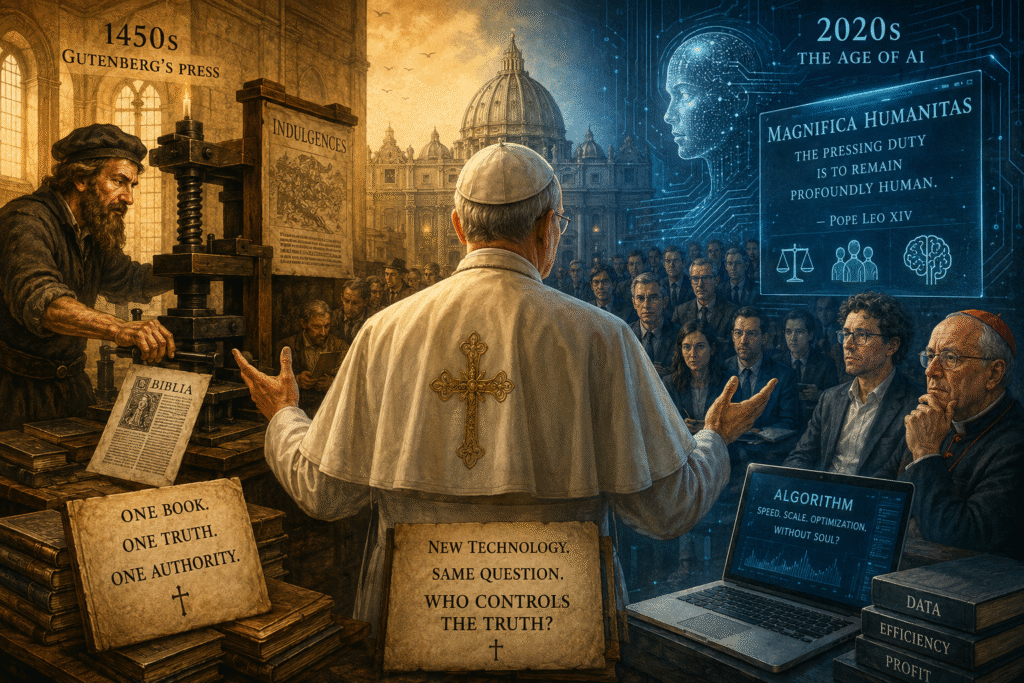
On the morning of May 25, in a hall at the Vatican, a pope sat before an audience that included one of the co-founders of the world’s most closely watched artificial intelligence company. Around them, journalists, theologians, cardinals, and scholars had gathered to hear the Catholic Church’s most sweeping statement on a technology in living memory.
Pope Leo XIV had released a 42,300-word encyclical titled “Magnifica Humanitas” — Magnificent Humanity — marking his most sweeping statement yet on the promise and dangers of AI.
The leader of the world’s roughly 1.4 billion Catholics warned that artificial intelligence risked making civilisation “less human,” hollowing out work, concentrating wealth, and reducing people to systems driven by data and efficiency rather than dignity and morality. “The pressing duty,” Leo wrote, “is to remain profoundly human.”
The man sitting in the audience, listening to all of this, was Christopher Olah. Olah, co-founder of US artificial intelligence company Anthropic, had been invited to attend the presentation of the encyclical. He welcomed input from outside actors like the Catholic Church to “push events in a better direction,” saying that “the questions raised by AI are bigger than the AI research community.”
It was, by any measure, an extraordinary scene: the head of the world’s oldest institutional religion, in the seat of its power, reading a moral indictment of a technology whose creators were seated in the front row. But the scene also contained a historical echo so precise it was almost eerie — the echo of another moment, nearly six centuries ago, when a new information technology arrived in Europe and found itself, simultaneously, in the service of the Church and pointed at its very foundations.
That technology was the printing press. And what happened to the Church in its wake may be the most instructive story in the history of technology and power.
The man who changed history in a Mainz workshop
Between 1452 and 1455, in his two workshops in Mainz, Germany, using mobile and reusable letters cast in metal and set in adjustable hand-moulds, Johannes Gutenberg printed the first printed book in the Western World and created between 180 and 200 copies of the Bible.
The world that Gutenberg’s press entered was one in which information — specifically religious information — was the exclusive property of an institution. Before Gutenberg’s invention, books were laboriously copied by hand, usually by monks in scriptoria.
This meant that Bibles were expensive, rare, and primarily available only to clergy and scholars. The relationship between a medieval Christian and the scripture was almost entirely mediated by the Church: a priest read the text, interpreted it, and delivered it. The layperson received doctrine at one remove from the source, always filtered through institutional authority.
The Bible was the most important book in the Middle Ages, and during this period in Europe, almost everybody was Catholic. Printing it was therefore not merely a commercial or technological decision — it was an act with vast ecclesiastical implications.
Gutenberg understood this. His first book was not a secular text but the Vulgate Bible, chosen precisely because it was the most reliable commercial bet in a world where virtually every literate person was Catholic and virtually every literate institution was the Church.
The early years of printing were, from Rome’s perspective, a gift. Gutenberg’s printing press printed indulgences for the Christian authority — special, official forms that “liberated” people from sins in exchange for monetary payment and acts of penance. Both these projects were highly profitable and provided the Church with considerable income, showing already at this early phase in the history of printing the tremendous commercial possibilities of this invention.
Here was a new technology arriving and immediately inserting itself into the Church’s revenue model. The printing press was, in its first decade, not a threat to institutional Christianity — it was a tool that made institutional Christianity more efficient, more profitable, and more legible to the literate population. The Church did not fear the press. It used it.
As more were printed, more people became readers, and readers demanded more books, thus spreading literacy. And even for the illiterate, the Bible became more accessible, because the pastor could read from, and preach about, a Bible that was more readily available. Christianity, the religion of the Book, was becoming universal in a new way. Religion did not have to end at the church door; thanks to the possession of Bibles, every household could become a training ground for faith.
The Church, in other words, looked at this new technology and saw an ally. It was not wrong — but it was looking at only half of what was happening.
The machine that devoured its patron
The Printing Press Revolution, from approximately 1450 to 1550, describes the transformation of European knowledge distribution following Gutenberg’s development of movable-type printing, which spread to Venice by 1469 and produced 20 million volumes in Europe’s first 50 years of printing — demolishing the Catholic Church’s monopoly on literate knowledge by making the Bible, Plato, Aristotle, Dante, and Machiavelli simultaneously accessible to anyone who could read.
The number deserves to be read twice: 20 million volumes in 50 years. In all the preceding two millennia of human writing, nothing approaching that quantity had been produced.
As one historian noted: “From 1450 to 1500, probably 20 million books were printed. That’s more than in the last 2,000 years.”
The consequences for the Church were catastrophic — not immediately, but inexorably. The printed Bible gave every literate person direct access to Christian scripture without priestly mediation.
The Church’s interpretive monopoly depended on controlling access to texts. The printing press demolished that monopoly. When the Bible could be read by anyone who could read — when the text of the faith no longer required a trained interpreter standing between the reader and God — the entire architecture of clerical authority became, in principle, optional.
The instrument of that demolition was a German priest who had lost faith in the institution he served.
Martin Luther was a German priest who had lost faith in the Catholic Church. He protested against many Catholic ideas, including only bishops and the Pope being allowed to read the Bible.
Luther believed in a “priesthood of all believers” — the idea that everyone had the same rights as a priest to read and understand the Bible. Martin Luther printed his new religious ideas, not in Latin, but in German.
When Luther posted his 95 Theses in 1517, the press distributed them across Germany within weeks, making his challenge to Church authority a continent-wide debate rather than a local dispute the Church could suppress. This is perhaps the most consequential act of viral distribution in history before the internet: a monk nailing a document to a church door, and a printing press ensuring that what he had written reached every literate person in the German-speaking world within a month.
The printing press meant that the Catholic Church’s previous monopoly over religious debate was broken. Protestant and Roman Catholic debate was printed for the public. No longer behind closed doors, religious debate was now available to anyone who could read. Pamphlets made spreading information a drastically quicker process.
The Church’s response, when it came, was the response of an institution that had recognised a threat too late to stop it. In 1496, Pope Alexander VI began to be restrictive, and in 1501 he issued a bull against unlicensed printing, which introduced the principle of censorship.
The Index Librorum Prohibitorum — the Index of Forbidden Books — was a changing list of publications deemed heretical or contrary to morality by the Sacred Congregation of the Index. Catholics were forbidden to print or read them, subject to the local bishop. The Index was active from 1560 to 1966. It banned thousands of books — including, over its four centuries of existence, some of the most consequential works of European science and philosophy.
The Index did not stop the Reformation. It did not stop Galileo’s ideas, despite banning his work. It did not stop Copernicus, Descartes, or Locke.
It was the gesture of an institution trying to control an information environment that had permanently escaped its jurisdiction, using tools — prohibition, censorship, institutional authority — that had functioned in a pre-press world but were structurally inadequate to the one that Gutenberg had created.
The Church, in other words, first embraced the press, then found itself undone by it, and then tried to suppress it — and failed at all three, in sequence.
Enter Leo XIV: The press, in a new key
The former Cardinal Robert Prevost took the name Leo upon his election to the papacy in May 2025 to signal continuity with his 19th-century predecessor, whose landmark encyclical set the foundation for the Church’s social teaching tradition.
The predecessor in question, Pope Leo XIII, had faced a different technological transformation — the first industrial revolution — and responded with a landmark encyclical called Rerum Novarum, published in 1891, which addressed workers’ rights, fair wages, and the human cost of industrial capitalism.
The document placed the dignity of work and of workers at the forefront of its reflection; affirmed the right to a fair wage for oneself and one’s family; recognised that persons have a fundamental value that takes precedence over capital and profit; and proposed forms of cooperation between the different components of society as an alternative to the mentality of class struggle.
Pius XI later defined it as the “Magna Carta” of Christian social action.
Leo XIV told the cardinals that he hoped to offer the Church’s social teaching in response “to another industrial revolution and to developments in the field of artificial intelligence.”
He signed his AI encyclical on May 15, 2026 — the same day that Rerum Novarum was released 135 years previously. The symbolism was calculated and precise: this is not a casual statement but a formal doctrinal intervention, of equivalent weight to the defining social teaching of the modern Church, directed at the defining technology of the present age.
The encyclical warned against “a race for ever more powerful algorithms and larger datasets,” driven by “the desire to secure geopolitical or commercial dominance.” Leo called for the “disarming” of artificial intelligence, warning that “new forms of slavery” are tied to its rise.
In “Magnifica Humanitas,” the Pope said humanity faces a defining choice in the age of AI: “either to construct a new Tower of Babel or to build the city in which God and humanity dwell together”.
The Tower of Babel reference is precise and deliberate — it is the biblical account of a human civilisation that built too high, reached too far, and was brought down by its own ambition. The implication is that AI, unconstrained, risks the same fate.
The encyclical, focused on safeguarding the human person in a rapidly digitalising world, presented AI not merely as a technological development but as a moral, political, and social challenge already reshaping daily life, labour, communication, and governance.
“Persons end up being reduced to a means of achieving results, a resource to be used and exploited, and are no longer recognised as a proper end in themselves who should never be instrumentalised,” the Pope wrote.
The Pope also declared that the “just war” theory — a four-pronged Christian doctrine stating what conditions justify war — is “now outdated,” saying that military force can only be used for “self-defence in the strictest sense.” He expressed particular concern about the impact of AI on the conduct of war, which he warned is changing dramatically.
Leo also linked technological transformation to widening social inequalities, warning against systems that exclude entire populations while promising unlimited progress for a privileged few, and called on governments, educators, scientists, workers, and faith communities to take shared responsibility in shaping the digital age around the common good rather than private interests.
The paradox at the heart of it all
There is an irony embedded in the Vatican’s warning about AI that deserves to be stated plainly: the Catholic Church is an institution that once sat at the commanding heights of the information environment. Its authority derived, in significant part, from its control over who could read which texts, who could interpret doctrine, and who could speak in God’s name.
The printing press did not destroy Christianity — but it permanently ended the Church’s monopoly over the terms of Christian belief.
The question that Leo XIV’s encyclical quietly raises, without quite asking it, is whether AI poses the same double-edged risk: a technology that the Church might learn to use, that might spread its reach and amplify its message, but that also carries within it the seeds of a transformation of human consciousness that no institution can fully predict or control.
The Church is not wrong to identify the dangers. The concerns it raises in Magnifica Humanitas — job displacement, concentrated power, the erosion of human dignity, the use of AI in warfare, the reduction of persons to data points — are real, serious, and shared by many who have no theological stake in the argument. Anthropic’s own Christopher Olah, sitting in that Vatican hall, said as much. He acknowledged that AI companies work “inside a set of incentives and constraints that can sometimes conflict with doing the right thing,” and welcomed input from outside actors, including the Catholic Church, to “push events in a better direction”.
But the historical record offers a cautionary note about the Church’s capacity to govern technology by moral suasion alone.
The Index Librorum Prohibitorum lasted 406 years and banned some of the most important intellectual works in human history. It did not prevent a single significant idea from circulating.
What it did was ensure that the Church appeared, to successive generations of European intellectuals, as an institution that feared knowledge — an association that proved far more damaging than any individual book it banned.
The danger in Leo XIV’s posture, eloquent and morally serious as it is, is a version of the same one. If the Church’s primary public stance on AI is prohibitive — if it is heard as warning, restricting, and lamenting, rather than engaging, shaping, and redirecting — it risks repeating the strategic error of Pope Alexander VI’s 1501 bull against unlicensed printing. That bull did not stop printing. It simply ensured that printing proceeded without the Church at the table.
What Gutenberg’s machine actually did — and what AI might
The printing press did not simply spread Christianity. It transformed it, irrevocably, into something the institutional Church had not authorised and could not contain. Catholic and Protestant missionaries alike used printed materials to spread Christianity in the New World, Asia, and Africa. The availability of Bibles and religious texts in local languages made evangelisation more effective.
The press, in this sense, was a genuine boon for the Christian faith in its broadest definition — it carried the word of God further and faster than any previous human technology.
But it also produced the Reformation. It produced a fracture that divided Christendom permanently into two great branches, each claiming the authority of the same scripture, each armed with a printing press. It produced a century of religious warfare across Europe. It produced, eventually, the Enlightenment — an intellectual movement that placed human reason rather than divine revelation at the centre of knowledge — and the subsequent secularisation of European public life.
None of this was what Gutenberg intended. He was a businessman who needed to print something valuable enough to sell. None of this was what the Church intended when it bought printed indulgences and distributed copies of the Vulgate.
Technology, at sufficient scale, tends to produce consequences that no single actor — not the inventor, not the institution that adopts it, not the institution that tries to ban it — has the power to fully anticipate or direct.
Gutenberg’s decision to print the Bible fuelled the spread of Christianity and gave wings to the ideas that informed the Reformation in the 16th century, followed by the scientific revolution that took place during the 16th and 17th centuries. A single technology, simultaneously spreading faith and dismantling the institution that housed it. This is the paradox that Leo XIV’s encyclical is reaching for, without quite naming it.
The deeper question the Pope is raising
What makes “Magnifica Humanitas” genuinely significant — beyond the political theatre of a pope warning about algorithms — is the tradition it is inserting itself into, and the seriousness of the moral claim it is making.
Magnifica Humanitas is presented as an encyclical addressing the challenges of society in times of AI, not as an encyclical on artificial intelligence itself — an era described by some as the fourth industrial revolution.
If Rerum Novarum marks the beginning of the systematisation of the Social Doctrine of the Church, then the social, labour, relational, and cultural change that humanity is experiencing with the irruption of AI is the key to reading Leo XIV’s first encyclical.
The parallel to Leo XIII and the first industrial revolution is instructive here too. Rerum Novarum did not try to ban industrial machinery. It accepted the industrial revolution as a fact of the world and asked, urgently, what obligations followed from it — towards workers, towards the poor, towards the dignity of the human person in a world being reorganised around machines.
That document became, 135 years later, a foundational text of modern Catholic social teaching precisely because it engaged with the world as it was rather than lamenting the world as it had been.
Leo XIV is attempting the same move for a world reorganising itself around data, algorithms, and automation. Whether the encyclical achieves the same durability as Rerum Novarum will depend not on whether its warnings are heeded immediately — Rerum Novarum was not heeded immediately either — but on whether it articulates a moral framework sufficiently rigorous and humane to speak to the questions that AI is generating across coming decades.
The encyclical acknowledges familiar concerns about AI, including job insecurity, manipulation of information, privacy violations, ideological bias, autonomous weapons, and a futuristic vision of an “enhanced human being”.
But Pope Leo XIV identifies a deeper danger: that human beings may begin to see themselves and others as primarily instrumental — as functions rather than persons, as data rather than souls.
That deeper fear is not a theological one in any narrow sense. It is a fear that any humanist tradition, secular or religious, can recognise: that a technology optimised for efficiency may gradually reshape how we understand ourselves, until the categories of dignity, interiority, and moral personhood begin to seem like inefficiencies rather than the point.
The Anthropic question the encyclical does not ask
There is a detail in the story of Leo XIV’s encyclical launch that is too pointed to ignore. The Pope spoke with Christopher Olah — co-founder of US artificial intelligence company Anthropic — at the end of the presentation of Magnifica Humanitas.
Anthropic makes Claude — the AI assistant whose name appears on millions of conversations every day. The company was founded on the explicit premise that AI development posed existential risks to humanity and that those risks needed to be studied and mitigated from the inside. Its emphasis on AI safety is, in the language of the secular technology world, a version of the same concern that Leo XIV is articulating in the language of Catholic social teaching: that a technology this powerful demands moral governance, not merely market optimisation.
That Olah sat in the Vatican and heard a pope describe his company’s product as a potential “new form of slavery,” and then said publicly that the Church was right to be at this table, is itself a significant moment. It suggests that the most serious people working on AI — not the evangelists or the dismissers but the people who think hardest about what this technology actually does — share more with the Vatican’s moral framework than the public posture of the technology industry usually admits.
The analogy they share is, again, Gutenberg’s. Every serious person working on large-scale AI knows that what they are building will have consequences they cannot fully predict.
The question is whether those consequences are governed by ethics, regulated by states, shaped by moral traditions, and distributed equitably — or whether they are governed by profit, shaped by the interests of whoever can most rapidly scale their model, and distributed, as Leo XIV warns, only to the privileged few.
Two technologies, one institution, one question
In the end, the story of the Church and the printing press, and the story of the Church and artificial intelligence, are versions of the same story: an institution of extraordinary historical depth encountering a technology of extraordinary disruptive power, and trying to articulate what values must be preserved in the encounter.
The Church got the printing press wrong in critical ways. It used it for indulgences and then tried to ban it when it produced Luther — and neither move worked.
But it also, eventually, absorbed the world that the press created: Catholic missionaries used printed texts to evangelise across Asia, Africa, and the Americas; Catholic scholars filled printing houses with theology, philosophy, and science; Catholic universities became among the most important sites of print culture in early modern Europe. The institution that the press nearly destroyed also, in a different register, survived because of it.
Pope Leo XIV knows this history. He chose a name that invokes a predecessor who navigated the first industrial revolution with moral seriousness. He released his encyclical on its 135th anniversary. He invited an AI company co-founder to sit in his hall and listen. He called for the “disarming” of AI — disarmament being a posture not of rejection but of the removal of a weapon’s capacity for destruction while leaving the tool itself intact.
“In the era of artificial intelligence, when human dignity is threatened by new forms of dehumanisation, ours is the pressing duty to remain profoundly human,” he wrote.
“True progress always stems from a heart open to others, an intelligence directed toward the common good, and hands that build rather than destroy.”
Whether that call is answered, or whether AI follows the printing press into a transformation that no encyclical could have prevented, will not be determined by this document.
It will be determined by the choices made by governments, corporations, and individuals over the next several decades — choices about regulation, distribution, education, and the basic question of what technology is for.
But the fact that the oldest continuously functioning institution in the Western world has chosen, as its first major doctrinal statement of the 21st century, to confront that question head-on, in a 42,300-word text signed on the anniversary of its most consequential social document — with an AI company’s co-founder in the audience — suggests that the question, at least, has finally arrived where it belongs: at the level of civilisational seriousness that the printing press eventually demanded, and that AI already deserves.
Gutenberg changed the world in a workshop in Mainz in 1455. Nobody in that workshop knew what they had built. We are, this time, at least dimly aware of what we are building. Whether that awareness is enough is the question that Leo XIV — and Christopher Olah, and the rest of us — will spend the coming years trying to answer.