India’s nuclear power story is entering a new phase.
For decades, the country’s nuclear programme was largely associated with a small fleet of reactors, a highly controlled public-sector ecosystem and a long-term ambition to use India’s large thorium reserves.
Now, the government wants something much bigger.
India has set a target of 100 GW of nuclear power capacity by 2047.
The scale of that ambition becomes clearer when placed against where the country stands today. India has 24 nuclear power plants in commercial operation, with an installed capacity of 8.78 GW. Nuclear power accounted for about 3.1 per cent of India’s total electricity generation in 2025–26.
So the question is not simply why India wants more nuclear power.
It is this:
How does a country with 8.78 GW get to 100 GW in about two decades — and what role will nuclear power play alongside solar, wind and other sources?
Why nuclear power matters to India
India’s electricity demand is growing as its economy expands, cities become more electrified and industries increasingly depend on reliable power.
Solar and wind can add enormous amounts of low-carbon electricity, but their output varies with weather and time of day.
A nuclear reactor works differently.
A nuclear power plant uses controlled nuclear fission to produce heat. That heat produces steam, the steam drives a turbine, and the turbine generates electricity.
The important characteristic for the electricity system is that a nuclear plant can provide power continuously.
This makes nuclear particularly useful as a source of firm, low-carbon electricity that can complement variable renewable sources.
The Prism August 2026 report describes this as one reason nuclear is being placed at the centre of India’s long-term energy-security strategy. It also highlights nuclear’s applications beyond electricity, including healthcare, agriculture, food preservation, industry and scientific research.
That distinction matters.
India’s nuclear programme is not only about building more reactors.
It is also about developing technologies and capabilities that can support a wider industrial and scientific ecosystem.
The starting point: 8.78 GW
India currently has 24 nuclear power plants in commercial operation, excluding the 100 MW Rajasthan Atomic Power Station-1, with a combined capacity of 8,780 MW.
There is already a pipeline of new capacity.
As of March 2026, the government said 18 reactor units with a combined capacity of 13,600 MW were under implementation — including reactors under construction and others at the pre-project stage.
The official roadmap envisages nuclear capacity reaching roughly 22 GW by 2031–32.
Beyond that, the expansion becomes much more ambitious.
The government says NPCIL is expected to add another 32 GW beyond 2032, taking its capacity to about 54 GW by 2047. The remaining 46 GW is envisaged from other public-sector entities, state governments, private companies and joint ventures using different business models and reactor technologies.
That last figure is particularly important.
The 100-GW ambition is not simply an expansion of the existing government-owned nuclear fleet.
It implies a substantially larger nuclear industry.
Why is India returning to nuclear power now?
India’s renewed nuclear push is partly about the changing electricity system.
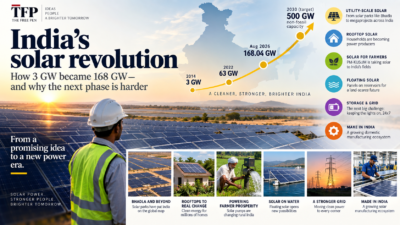
The country is adding renewable energy at enormous speed. Solar capacity alone reached 168.04 GW by August 2026.
But an electricity system cannot rely only on how much generation capacity exists. It must also ensure that electricity is available when people and industries need it.
That creates a role for sources that can provide electricity more continuously.
Nuclear can therefore complement renewables rather than necessarily compete with them.
The government’s stated objective is to increase nuclear’s contribution to the energy mix while supporting energy security and the country’s 2070 net-zero target.
But there is another reason for the renewed push:
technology.
India is no longer looking only at conventional large reactors.
It is developing fast breeder reactors and small modular reactors while continuing to work towards the long-term thorium-based part of its nuclear programme.
And that takes us to a programme that began more than 70 years ago.
India’s unusual three-stage nuclear programme
India’s nuclear strategy was shaped by a basic problem.
The country had relatively limited uranium resources but substantial thorium reserves.
In 1954, Homi J. Bhabha proposed a three-stage nuclear power programme designed around India’s available resources and long-term energy security.
The basic idea is surprisingly elegant.
Stage one: uranium
India’s Pressurised Heavy Water Reactors, or PHWRs, use natural uranium to generate electricity.
The spent fuel is then reprocessed to recover plutonium.
Stage two: plutonium and fast breeder reactors
The plutonium becomes fuel for fast breeder reactors.
These reactors are designed not merely to generate electricity but also to produce additional fissile material.
This is where India’s nuclear programme reached a significant milestone in April 2026.
The 500 MWe Prototype Fast Breeder Reactor (PFBR) at Kalpakkam achieved first criticality on 6 April 2026 — the point at which a controlled nuclear chain reaction was initiated.
The Prism report describes this as the beginning of the second stage of India’s three-stage programme.
Stage three: thorium
The eventual goal is to use India’s abundant thorium resources.
Thorium-232 is not itself fissile. But it can absorb a neutron and eventually be converted into uranium-233, which can sustain a nuclear chain reaction.
The idea is therefore to move from India’s uranium resources to plutonium-based breeder technology and ultimately towards a thorium-based fuel cycle.
This is why the PFBR milestone matters beyond one reactor.
It represents progress in the technological chain that India has been pursuing for decades.
What exactly happened at Kalpakkam?
“First criticality” can sound mysterious.
It does not mean that the reactor suddenly began producing electricity at full scale.
It means the reactor achieved a self-sustaining, controlled nuclear chain reaction.
The PFBR was indigenously designed by the Indira Gandhi Centre for Atomic Research and built by BHAVINI. It achieved first criticality on 6 April 2026 after regulatory clearance from the Atomic Energy Regulatory Board.
The government describes the reactor as a key milestone for the second stage of India’s nuclear programme.
The PFBR uses uranium-plutonium mixed oxide fuel and is designed to breed additional fissile material.
In simple terms, India is trying to develop a reactor technology that can help solve part of the fuel problem that has shaped its nuclear programme from the beginning.
The thorium promise — and the important caveat
Thorium is often presented as India’s great nuclear advantage.
There is a reason for that.
India has significant thorium resources, while its uranium resources are more limited and have historically required supplementation through imports. The Prism report identifies thorium as the long-term destination of India’s three-stage strategy.
But thorium should not be confused with a ready-made fuel supply.
Thorium-232 is fertile rather than fissile.
It has to be converted into a usable fissile material — uranium-233 — inside an appropriate nuclear system.
That requires advanced reactor technology and a functioning fuel cycle.
So India’s thorium story is fundamentally a long-term technological strategy, not a shortcut to immediately cheap nuclear electricity.
The new bet: small modular reactors
India is also looking at a different nuclear future: smaller reactors.
Small Modular Reactors, or SMRs, are generally designed to produce less electricity per unit than conventional large reactors and to use modular designs that can potentially simplify manufacturing and deployment.
The Prism report says SMRs typically generate up to 300 MWe and highlights three Indian development programmes: the 220 MWe Bharat Small Modular Reactor, or BSMR-200; the 55 MWe SMR-55; and a high-temperature gas-cooled reactor intended for hydrogen production.
The government has allocated ₹20,000 crore under the Nuclear Energy Mission for research, design, development and deployment of indigenous SMRs.
The stated target is to operationalise at least five indigenous SMRs by 2033.
Why would India want smaller reactors?
One possibility is deployment in places where a giant conventional reactor is not the most suitable option.
The government has identified potential uses including brownfield sites where fossil-fuel plants are being retired, captive power for energy-intensive industries and remote or off-grid applications.
If the technology can be developed and licensed successfully, SMRs could therefore open a different market for nuclear power.
Then came the SHANTI Act
Another major change concerns who can participate in India’s nuclear sector.
The Sustainable Harnessing and Advancement of Nuclear Energy for Transforming India Act, 2025, commonly known as the SHANTI Act, creates a framework for wider participation by the private sector in nuclear activities under licensing arrangements.
The government’s stated objective is to enable wider participation in nuclear power and support the 100-GW mission.
This is significant because India’s nuclear industry has historically been dominated by government entities.
The 100-GW target is sufficiently large that expanding the ecosystem — financing, manufacturing, engineering, construction and technology development — becomes essential.
In other words, India’s nuclear challenge is not just:
“Can we build more reactors?”
It is also:
“Can we build a much larger nuclear industry?”
Safety remains the unavoidable question
Any serious discussion about nuclear power has to address safety.
Nuclear plants are fundamentally different from conventional power stations because radioactive materials are involved. Accidents can have consequences that extend beyond the plant itself.
India’s nuclear programme uses multiple physical and engineered safety barriers, regulatory oversight and emergency-preparedness systems.
The Prism report describes the use of the Defence-in-Depth approach, multiple shutdown systems, cooling systems, containment structures and continuous radiation monitoring. It also describes emergency-response arrangements involving national, state, district and plant-level authorities.
India’s Atomic Energy Regulatory Board sets and monitors nuclear-safety requirements.
The government’s position is that nuclear plants are designed around multiple layers of protection and that safety reviews and upgrades have continued following the Fukushima accident.
For an explainer, however, one distinction is important:
having a safety framework is not the same as saying nuclear power has zero risk.
Every energy technology has risks. Nuclear energy’s distinctive challenge is that severe accidents, while rare, can have unusually serious consequences. That is why regulation, design, emergency preparedness and radioactive-waste management matter so much.
And what about nuclear waste?
Nuclear power does not eliminate waste.
It produces radioactive waste that has to be managed for very long periods.
India follows a closed nuclear fuel cycle in which spent fuel can be reprocessed to recover useful materials. The remaining high-level radioactive waste is immobilised and managed under a regulated system. The Prism report describes India’s use of vitrification technology, in which high-level radioactive waste is converted into stable glass blocks for long-term management.
This is an area where the public conversation often becomes too simplistic.
“Nuclear waste cannot be managed” is not an accurate description of how nuclear industries actually operate.
But neither is “the waste problem has disappeared”.
The waste remains radioactive and requires engineered containment, monitoring and long-term management.
Nuclear power is more than electricity
There is another part of India’s nuclear story that gets much less attention.
Atomic technology is already used outside power generation.
The Prism report highlights applications in cancer diagnosis and treatment, radiopharmaceuticals, medical-device sterilisation, crop improvement, food irradiation, mineral analysis and clean-hydrogen research.
In 2026, India also demonstrated nuclear-heat-based hydrogen production technology at Kalpakkam, according to the Indira Gandhi Centre for Atomic Research.
This matters because the nuclear programme is increasingly being presented not merely as an electricity programme but as a broader technology ecosystem.
Can India really reach 100 GW?
The official answer is yes — and the government has laid out a roadmap.
But the numbers show how large the task is.
India starts from 8.78 GW.
The official roadmap expects roughly 22 GW by 2031–32.
It then envisages around 54 GW from NPCIL by 2047, with another 46 GW expected from other public-sector entities, state governments, private companies and joint ventures.
That means the final jump is the hardest part.
It will require a much larger construction programme, more manufacturing capacity, financing, skilled personnel, suitable sites, regulatory capacity, fuel availability and public acceptance.
And nuclear projects tend to have long development timelines.
So the 100-GW target should be understood as a long-term national capacity ambition, not as a guarantee that exactly 100 GW will be operating on a particular day in 2047.
Nuclear versus solar? That’s the wrong question
India’s energy future is sometimes presented as a choice between nuclear and renewables.
The more useful question is how the technologies fit together.
Solar can produce very cheap electricity during sunny periods.
Wind adds another variable renewable source.
Hydropower can provide flexibility in parts of the system.
Storage can shift electricity across time.
Nuclear can provide firm low-carbon generation.
The eventual electricity system will probably need all of these technologies in different proportions.
India’s extraordinary solar expansion makes this even more relevant.
The country is building a power system in which solar will increasingly supply electricity during daylight hours. Nuclear can occupy a different part of that system by providing continuous generation.
The challenge is therefore not to find a single winner.
It is to make the pieces work together.
The bigger picture
India’s nuclear programme began with a problem: limited uranium resources and the need for long-term energy security.
That problem produced an unusually ambitious technological strategy.
The three-stage programme was conceived in the 1950s.
More than seven decades later, the PFBR at Kalpakkam has entered its criticality phase, bringing India into the second stage of that strategy.
At the same time, India is developing SMRs, expanding conventional reactors and opening the sector to wider participation.
The destination is ambitious: 100 GW of nuclear power capacity by 2047.
Whether India reaches that number will depend on much more than scientific capability.
It will depend on how quickly projects can be built, how much they cost, how financing is structured, how regulation evolves, how the private sector participates, how the fuel cycle develops and how nuclear power fits into an electricity system increasingly dominated by renewable energy.
The interesting part of India’s nuclear story, therefore, is not simply that the country wants more reactors.
It is that India is trying to reinvent nuclear power as part of a much larger energy, industrial and technological strategy.
And after decades of preparation, the first pieces of that next chapter are finally beginning to move.