For generations, the basic bargain of farming has been relatively simple.
Put something into the soil, nurture the crop, harvest it and begin again.
But the soil itself can gradually change.
Repeated cultivation, excessive or poorly balanced use of chemical inputs, declining organic matter, water stress and increasingly erratic weather can make farming more difficult and expensive. A crop may still grow, but maintaining the same level of production can require more inputs.
For a country as dependent on agriculture as India, that creates a problem that goes beyond one season’s harvest.
What happens when the land itself becomes less resilient?
This is where the idea of regenerative agriculture comes in.
The concept is increasingly finding a place in India’s agricultural policy conversation because it approaches farming not simply as a question of producing more from the land, but of restoring the ecological systems that make production possible in the first place.
India has a productivity problem — and also a soil problem
India’s agriculture and allied sectors recorded a decadal growth rate of 4.45 per cent during FY2016–FY2025, according to the August 2026 Prism report. That was the strongest decade of agricultural growth cited in the report.
But past growth does not automatically guarantee future productivity.
Farmers return to the same land season after season. In some areas, intensive cultivation, excessive chemical inputs and irregular rainfall can put increasing pressure on soils.
Heatwaves, prolonged dry spells and excessive rainfall can add another layer of uncertainty.
For small and marginal farmers in particular, deteriorating soil health can mean a difficult combination:
higher input costs + uncertain yields + greater exposure to weather shocks.
Regenerative agriculture is an attempt to change that equation.
Instead of treating soil simply as a medium in which plants grow, it treats soil as a living system that needs to be maintained and, where necessary, rebuilt.
So, what exactly is regenerative agriculture?
There is no single farming technique called regenerative agriculture.
It is better understood as a way of managing a farming system.
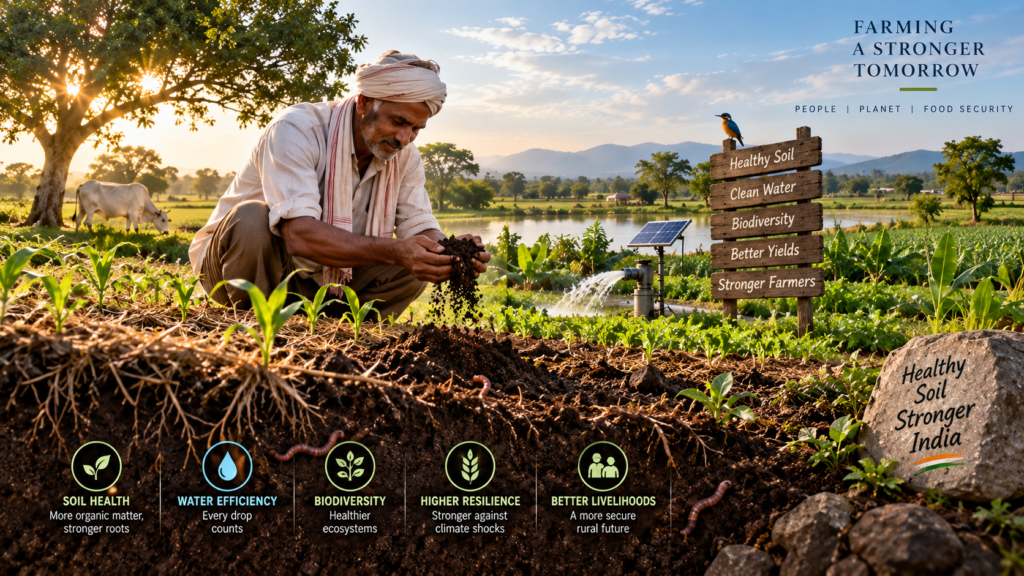
The central objective is to restore soil health while maintaining agricultural productivity and strengthening the farm’s ability to cope with environmental stress.
The Prism report identifies several principles:
- minimise soil disturbance;
- maintain soil cover;
- protect living roots of perennial crops;
- integrate livestock;
- limit chemical inputs; and
- enhance biodiversity.
The underlying idea is straightforward.
Healthy soil is not just dirt.
It contains organic matter, microorganisms, nutrients, water and air. Its structure affects how easily water enters and stays in the ground, how nutrients circulate and how plants establish their roots.
Improve those underlying conditions and the farm can become more resilient.
That is why regenerative agriculture is ultimately less about a particular product and more about what happens to the farm ecosystem over time.
Regenerative is not simply another word for sustainable
The terms are often used interchangeably, but the Prism report draws an important distinction.
Sustainable agriculture broadly seeks to maintain agricultural systems without exhausting their resources.
Regenerative agriculture goes a step further.
Its aim is to improve the condition of the resource itself — particularly soil health, biodiversity and ecosystem functions.
Think of it this way.
Sustainability asks:
How do we keep this system going?
Regeneration asks:
How do we leave the system healthier than we found it?
That difference is central to understanding why regenerative agriculture has attracted attention.
Soil is the starting point
Much of regenerative farming begins underground.
One of the approaches highlighted in Prism is soil-health management through practices such as green manuring, cover cropping and mulching.
Green manuring involves growing particular plants and incorporating them into the soil. The aim is to add organic matter and nutrients while improving soil structure.
Cover crops are grown primarily to keep the soil covered rather than for harvesting.
That cover can protect soil from erosion, help maintain soil organic carbon and support nutrient cycling.
Mulching involves covering the soil surface with organic material such as leaves or straw.
It can help conserve moisture, regulate soil temperature and suppress weeds while supporting microbial activity.
None of these ideas is particularly futuristic.
That is part of what makes regenerative agriculture interesting.
The approach often involves using biological processes more intelligently rather than simply adding more external inputs.
Why does keeping soil covered matter?
Imagine two fields during a heavy rainstorm.
One has exposed soil.
The other has vegetation or organic cover protecting its surface.
Rain hitting bare soil can cause erosion and runoff. Soil particles and nutrients can be carried away.
A protected soil surface can absorb and retain more water while reducing erosion.
This becomes increasingly important when rainfall itself becomes less predictable.
Regenerative agriculture therefore connects two problems that are often discussed separately:
soil degradation and climate resilience.
The healthier the soil, the better positioned the farming system may be to cope with periods of drought, heavy rain and changing weather patterns.
Natural farming is part of the film — but not the whole picture
One reason the term regenerative agriculture can become confusing is that it overlaps with several other approaches.
Natural farming is one of them.
According to the Prism report, natural farming clusters covered 8.80 lakh hectares and involved 18.19 lakh farmers as of March 2026.
Natural farming generally emphasises reducing dependence on external chemical inputs and using biological and ecological processes within the farm.
But regenerative agriculture is broader.
It can include natural farming, but it can also involve soil-health management, agroforestry, livestock integration, crop rotation, intercropping, micro-irrigation and other practices.
So it is better not to treat the two terms as exact synonyms.
Natural farming can be one pathway towards regeneration; regenerative agriculture is the broader framework.
The water question
India’s agricultural future is inseparable from water.
That makes water-use efficiency an important part of the regenerative-agriculture conversation.
Micro-irrigation — particularly drip and sprinkler systems — can deliver water more precisely to crops and reduce wastage.
The Prism report says about 109 lakh hectares had been brought under Per Drop More Crop as of May 2026.
The significance goes beyond saving water.
Better water management can improve crop productivity, reduce pressure during droughts and make farms more economically viable.
Regenerative agriculture therefore isn’t necessarily about returning to an imagined past.
It can combine ecological practices with modern technology.
That combination is important for a country trying to produce more food while facing constraints on water and land.
What happens when trees become part of the farm?
Another piece of the puzzle is agroforestry.
Agroforestry combines trees with crops and other agricultural activities.
Trees can provide additional sources of income while helping improve soil moisture, regulate local temperatures and store carbon, according to Prism.
The approach can be particularly relevant in rainfed areas.
Instead of depending entirely on a single annual crop, a farm can contain several layers of production — crops, trees, fruit, livestock or other activities.
That creates another potential benefit:
diversification.
If one crop fails because of drought, excessive rain or a pest outbreak, the entire livelihood does not necessarily have to fail with it.
What does an integrated farm look like?
Regenerative agriculture also challenges the idea that a farm must be organised around one crop alone.
The Prism report describes Integrated Farming Systems, or IFS, as an approach combining crops, livestock, fisheries and allied activities such as horticulture, agroforestry and apiculture.
Practices can include:
- intercropping;
- crop rotation;
- multi-cropping;
- mixed farming;
- livestock integration; and
- combining crops with trees.
The objective is to make better use of resources while spreading risk.
One activity can support another.
Crop residues may become livestock feed.
Livestock manure can contribute to soil fertility.
Trees can provide shade, biomass or additional products.
Different crops can occupy different ecological niches.
The result is a farming system rather than simply a field of one crop.
Regenerative agriculture is also about climate resilience
Climate-resilient agriculture is a closely related concept.
The Prism report describes Climate Resilient Agriculture as including balanced nutrient and fertiliser use, effective pest management, efficient water use, soil-moisture conservation and appropriate land preparation. It also mentions innovations such as water-sharing groups, seed and fodder systems, community nurseries and collective marketing.
The point is important.
A farm cannot become climate-resilient simply by changing one input.
Resilience can require changes at several levels:
soil → water → crops → livestock → technology → community → markets.
This is why regenerative agriculture is better understood as a systems approach.
Can healthier soil actually help farmers earn more?
This is where the environmental argument meets the economic one.
The Prism report identifies several potential economic benefits of regenerative agriculture.
Healthier soils can reduce dependence on synthetic fertilisers, pesticides and irrigation. That can lower input costs.
More resilient farming systems may be better able to withstand climate variability and market fluctuations.
Diversified farms can also create additional sources of income.
And new opportunities can emerge in agricultural advisory services, technology and ecological management.
But there is an important caveat.
A regenerative practice does not automatically make a farm more profitable.
The economics depend on the crop, region, water availability, labour requirements, access to markets, transition costs and whether farmers have adequate technical support.
That transition period matters.
Changing farming practices can involve uncertainty, and farmers cannot simply be expected to absorb that risk themselves.
India already has a massive soil-health database
One of the less visible pieces of India’s agricultural infrastructure is the Soil Health Card system.
The Prism report says that 25.89 crore Soil Health Cards had been generated since inception as of 13 March 2026. Around 7.17 lakh demonstrations had also been conducted to promote balanced fertiliser use, while 70,002 Krishi Sakhis had been trained to disseminate soil-health advisories.
The basic idea is to give farmers information about the condition of their soil and help guide nutrient management.
That sounds simple.
But it reflects a much larger change in agricultural thinking.
Instead of applying inputs uniformly, farming can increasingly become more precise and site-specific.
The question becomes not “How much fertiliser should every farmer use?” but “What does this particular soil need?”
What could regenerative agriculture change?
If widely adopted and appropriately adapted to local conditions, regenerative approaches could produce several overlapping benefits.
Healthier soils
More organic matter and better soil structure can improve fertility and water retention.
Better water management
Improved soil structure and efficient irrigation can reduce water losses and improve resilience to drought.
Greater biodiversity
Crop diversity, trees, livestock and healthier soils can create habitats for pollinators, beneficial insects and microorganisms.
Lower input dependence
Where practices successfully reduce the need for synthetic inputs, farmers may see lower costs.
Greater climate resilience
Farms with healthier soils and diversified production systems can be better positioned to absorb environmental shocks.
Potential carbon benefits
The Prism report says regenerative systems can absorb and store more carbon than they emit, contributing to climate mitigation.
But these benefits should be viewed as potential outcomes rather than guaranteed results.
The performance of regenerative practices varies by geography, crop and farming system.
So, is regenerative agriculture the future of Indian farming?
There probably isn’t one farming model that can be applied uniformly across India.
The country’s agricultural conditions are too diverse.
A rice farmer in a water-rich region does not face the same constraints as a dryland farmer growing millets. A small vegetable grower near a city has different market opportunities from a rainfed farmer in a remote district.
That means India’s regenerative-agriculture transition, if it expands, is likely to be highly local.
The common thread is not a particular crop or technique.
It is the principle of restoring the ecological foundations of production while keeping farmers economically viable.
The bigger picture
For decades, India’s agricultural policy conversation has understandably focused on one central question:
How do we produce enough food?
That question remains important.
But another question is becoming harder to ignore:
How do we keep the land capable of producing that food decades from now?
Regenerative agriculture offers one possible answer.
It says that productivity and ecological health do not necessarily have to be opposing goals.
Healthy soil can retain water.
Diverse farming systems can spread risk.
Trees can provide additional income and ecological benefits.
Better irrigation can save water.
Soil testing can make fertiliser use more precise.
And farming systems designed around resilience may be better equipped to cope with a climate that is becoming less predictable.
India’s agricultural challenge, therefore, may not simply be about producing more from its farms.
It may be about rebuilding the farms themselves — starting with the soil beneath them.