There was a time when solar power in India was little more than a promising idea.
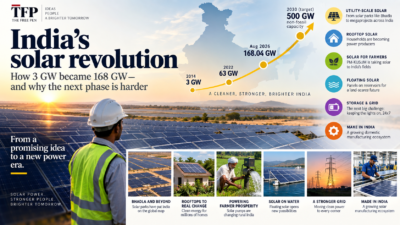
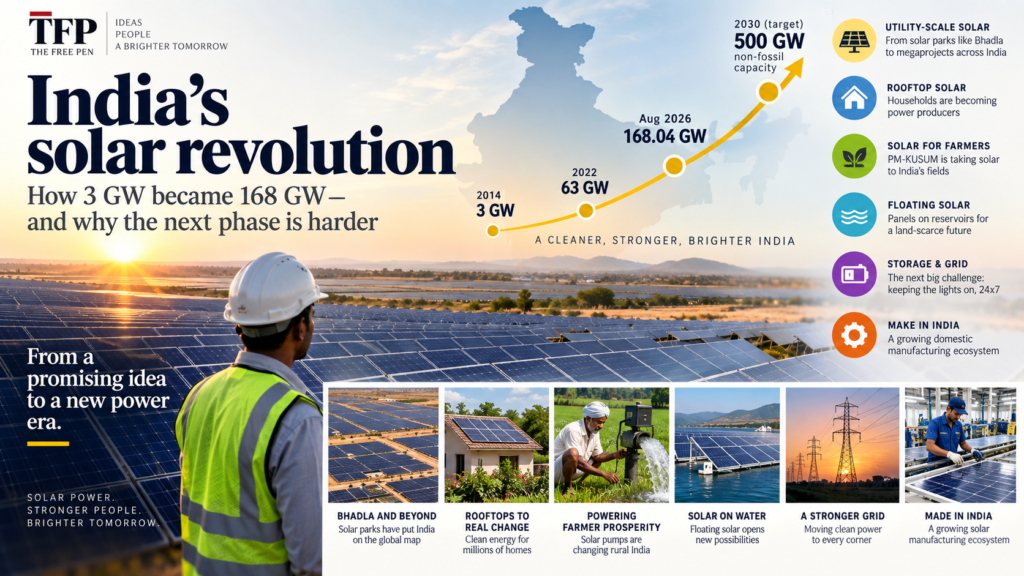
In 2014, India had roughly 3 GW of installed solar capacity. By 31 August 2026, that figure had reached 168.04 GW, according to the Ministry of New and Renewable Energy (MNRE). Solar has gone from being a small part of India’s electricity story to the largest component of its renewable-energy capacity.
The speed of that transformation is striking. In FY 2025–26 alone, India added 44.61 GW of solar capacity — almost twice the 23.83 GW added in the previous financial year. The August 2026 MNRE data show that another 17.78 GW was added between April and August 2026.
But the solar story is no longer simply about how many panels India can install.
The next question is harder: How does India make a power system built increasingly around sunshine work reliably around the clock?
That question takes us from Rajasthan’s enormous solar parks to rooftop panels, farm pumps, floating solar plants, batteries, transmission lines and India’s attempt to build a domestic solar-manufacturing industry.
From 3 GW to more than 168 GW
India’s solar expansion has been built over a little more than a decade.
The National Solar Mission, launched in 2010, provided an early policy push. The Solar Parks Scheme, competitive bidding, renewable-purchase obligations and investments in transmission infrastructure subsequently helped turn solar deployment into a much larger industry.
The Prism August 2026 report describes this as a combination of policy support, infrastructure development, manufacturing expansion and wider participation by households and farmers.
The numbers show how dramatic the change has been.
As of 31 August 2026, India’s total installed solar capacity stood at 168.04 GW. Of this, 123.99 GW was ground-mounted solar, 32.59 GW was grid-connected rooftop solar, 4.83 GW was the solar component of hybrid projects and 6.63 GW was off-grid solar.
In other words, India’s solar revolution is no longer one giant story about massive solar parks.
It is increasingly a story about many different kinds of solar power operating across the country.
How did solar become so cheap?
Perhaps the most important change was not technological but economic.
A decade ago, solar electricity was expensive enough to remain a relatively niche source of power. The Prism report notes that solar tariffs fell from around ₹18 per unit in 2010 to ₹2.44 per unit in a 2017 auction at Bhadla Solar Park in Rajasthan.
Competitive bidding played an important role.
In an e-reverse auction, developers compete to offer electricity at increasingly lower tariffs. Procurement agencies such as the Solar Energy Corporation of India helped create a mechanism through which developers could compete for projects.
More competition, falling technology costs and economies of scale helped transform the economics of solar.
The result was a feedback loop:
lower costs → more projects → larger industry → greater competition → still more deployment.
The Prism report cites a 2025 levelised cost of electricity for utility-scale solar PV in India of $35 per MWh, compared with a global average of $44 per MWh.
That does not mean every unit of electricity consumers receive from the grid costs ₹2.44. A generation tariff is only one part of the eventual electricity system cost. Transmission, distribution, balancing, financing and other expenses also matter.
But the fall in solar-generation costs fundamentally changed the conversation around renewable electricity.
Bhadla: where India’s solar economics became visible
To understand the solar boom, look at Bhadla.
The solar park in Rajasthan’s arid landscape covers nearly 5,700 hectares and has an installed capacity of 2,245 MW, according to Prism. Development began in 2015 and was completed in phases by 2020.
Its importance goes beyond its size.
Solar parks provide developers with common infrastructure, including land preparation and transmission facilities. That can reduce the time and complexity involved in developing individual projects.
The Solar Parks Scheme was initially designed around 20 GW of capacity and was subsequently expanded to 40 GW. By February 2026, 54 solar parks with a combined sanctioned capacity of 39,188 MW had been approved, according to the Prism report.
Bhadla therefore illustrates one of the central lessons of India’s solar expansion:
Building renewable power is not just about building solar panels. It is also about building the infrastructure around them.
And that brings us to the next challenge.
You cannot send sunlight through a power line at night
Solar power has one obvious limitation: the sun sets.
A solar plant can produce enormous amounts of electricity during sunny hours, but India’s electricity demand does not disappear after sunset.
That creates a fundamental challenge for a power system with a growing share of solar generation.
India therefore needs three things alongside more solar capacity:
storage, transmission and flexible sources of electricity.
Storage can shift electricity generated during sunny hours into periods when demand is higher.
Transmission allows electricity generated in renewable-rich regions to reach major centres of consumption.
And the broader power system has to become capable of responding to fluctuations in renewable generation.
This is why India’s solar story is increasingly becoming a grid story.
The invisible infrastructure: moving solar electricity
Consider Rajasthan.
A large solar park can generate electricity in a place where sunshine is abundant, but the people consuming that electricity may be hundreds of kilometres away.
The Green Energy Corridor programme is intended to address precisely this problem by strengthening transmission networks connecting renewable-energy-rich regions with demand centres.
According to Prism, the programme had enabled evacuation of 24,567.8 MW of renewable energy through strengthened transmission networks by February 2026, while projects across ten states were planned to support the evacuation of around 44 GW.
This is an easily overlooked part of the solar revolution.
A solar panel is visible.
A transmission line carrying its electricity across the country is not.
Yet both are necessary.
The rooftop revolution
India’s solar transition is also moving from giant power plants to individual homes.
The PM Surya Ghar: Muft Bijli Yojana, launched in February 2024 with an outlay of ₹75,021 crore, is designed to accelerate rooftop solar adoption among households.
The August 2026 government data say 51.58 lakh households were benefiting from rooftop solar installations as of 12 August 2026, with 14.8 GW of rooftop capacity commissioned under the scheme.
The Prism report had recorded more than 43 lakh solarised households as of June 2026.
The significance of rooftop solar is different from that of a giant solar park.
A large solar plant turns sunlight into electricity for the grid.
A rooftop system can allow a household to generate part of its own electricity.
That changes the relationship between consumers and the electricity system.
Instead of being only buyers of electricity, households can become small-scale electricity producers.
Farmers are becoming part of the solar system too
India’s agricultural electricity system presents another opportunity.
The PM-KUSUM programme supports decentralised solar power plants, standalone solar agricultural pumps and the solarisation of grid-connected agricultural pumps.
The idea is relatively simple: use solar energy to provide electricity for irrigation, reduce dependence on diesel and, where applicable, allow farmers to sell surplus electricity.
According to Prism, nearly 11.49 lakh off-grid solar agricultural pumps had been installed, more than 15.89 lakh agricultural pumps were covered through feeder-level solarisation and around 1,726 MW of decentralised solar capacity had been commissioned on farmers’ land. More than 21.77 lakh farmers had benefited.
This also illustrates another important change.
Solar is no longer merely an electricity-generation technology.
It is increasingly being connected to household economics, agriculture and rural livelihoods.
The next frontier may be floating solar
India’s latest solar push is moving beyond land.
The government approved the Pradhan Mantri Surya Sarovar Yojana in July 2026. It aims to support 5,000 MW of floating solar photovoltaic projects combined with energy-storage systems.
The scheme has an outlay of ₹5,070 crore and is scheduled to operate from FY 2026–27 to FY 2030–31. The storage component is designed for a minimum two-hour duration, equivalent to 10,000 MWh.
The attraction is obvious.
India needs enormous quantities of solar capacity, but land is not unlimited.
Floating solar allows photovoltaic panels to be installed on suitable reservoirs and water bodies rather than occupying additional land.
The government says the scheme is based on an assessment estimating floating-solar potential of about 102.18 GWp across suitable reservoirs and inland water bodies. Prism also says the programme is expected to increase India’s floating-solar capacity by 5,000 MW from a current level of around 700 MW.
But floating solar introduces its own engineering and environmental questions.
The technology has to work in different water conditions, withstand weather and wave stresses, coexist with existing uses of reservoirs and be connected economically to the grid.
So even here, the question is not simply whether India can put panels on water.
It is whether it can do so at scale and reliably.
India is trying to make the panels too
Another important part of the solar story is what happens before a panel reaches a solar park.
India has been trying to expand domestic manufacturing of solar modules and reduce dependence on imported equipment.
According to Prism, solar-module manufacturing capacity increased from 2.3 GW in 2014 to about 172 GW as of 31 March 2026. The government has used measures including the Production Linked Incentive scheme and the Approved List of Models and Manufacturers framework to strengthen domestic manufacturing.
The PLI scheme for high-efficiency solar PV modules was launched in 2021 with an initial outlay of ₹4,500 crore and expanded in 2022 with another ₹19,500 crore, according to the report.
That is significant because a solar boom creates a large industrial ecosystem.
It requires modules, cells, inverters, mounting structures, cables, transformers, batteries, glass, machinery and a supply chain capable of maintaining production at scale.
The solar revolution is therefore also becoming a manufacturing story.
But capacity is not the same thing as electricity
There is an important distinction that often gets lost in big solar numbers.
Installed capacity is not the same as electricity actually generated.
A 1 GW solar plant does not generate electricity at its maximum rated capacity every hour of the day. Solar output varies with daylight, weather and season.
This is why the next stage of India’s energy transition cannot be measured simply by adding more GW.
India will have to increasingly ask:
- How much electricity is solar actually generating?
- When is that electricity available?
- How much can the grid absorb?
- How much storage is available?
- How much transmission capacity exists?
- What happens when solar output falls sharply?
- Who pays for the infrastructure needed to balance the system?
These are much less visible questions than the number of solar panels installed.
They may, however, determine how successful the next phase of the solar transition becomes.
The bigger picture
India’s solar journey began as a climate and energy-policy experiment.
It has become something much larger.
Solar now sits at the intersection of energy security, industrial policy, household economics, agriculture, infrastructure, technology and climate policy.
The numbers tell the first half of the story.
From roughly 3 GW in 2014 to 168.04 GW by August 2026, the expansion has been extraordinary. India also crossed 300 GW of total non-fossil electricity capacity in July 2026, with solar accounting for 164.59 GW at that point.
But the second half of the story is only beginning.
India has become very good at adding solar capacity.
Now it has to build the system that can make the most of it.
That means more transmission. More storage. Smarter grids. More flexible electricity generation. Better forecasting. More distributed generation. And eventually, an industrial ecosystem capable of supplying the technology at competitive prices.
The solar revolution, in other words, is no longer about putting panels under the sun.
It is about redesigning the electricity system around them.