Good evening.
Today brought a little movement on two fronts that have been shaping the international agenda: India and the United States signalled progress towards a trade agreement, while Washington and Moscow reopened the possibility of peace talks on Ukraine. Neither development guarantees a breakthrough, but both matter because they could reshape economic and security calculations in the weeks ahead.
At the same time, the human cost of conflict remains stark. A drone strike in the disputed Abyei region killed at least 153 people, Nigeria confirmed its first Ebola case linked to the expanding outbreak in central Africa, and Russian attacks continued to hit Ukrainian civilian areas and energy infrastructure.
Here are the developments worth carrying into tomorrow.
India and Indians
◆ India–US trade deal is ‘very, very close’, says Rubio
US Secretary of State Marco Rubio said Washington and New Delhi were close to finalising a trade agreement, with only a small number of issues left to resolve. In Mumbai, Rubio and External Affairs Minister S. Jaishankar discussed trade, energy security, defence and technology cooperation. Rubio also held discussions with Reliance Industries on energy ties.
The optimism is significant, but the agreement remains unfinished. The terms—particularly those concerning market access, energy purchases and the wider tariff dispute—will matter more than the encouraging language.
Why it matters: A deal could give businesses on both sides greater certainty and strengthen the wider strategic relationship. It could also influence India’s energy choices as the conflict in West Asia continues.
◆ OpenAI to help train India’s government workforce in AI
OpenAI has partnered with Karmayogi Bharat to provide AI training through the iGOT Karmayogi platform, part of the government’s Mission Karmayogi initiative. The platform has more than 17 million registered government employees.
The initiative is intended to help public servants understand and use AI in their work.
The question to watch: Will the training translate into practical improvements in public services, or remain largely a digital-skills exercise? Its value will depend on how the training is designed, how widely it is completed and whether employees can use the skills responsibly in real administrative settings.
◆ Amit Shah sets December 2029 target for a drug-free India
Home Minister Amit Shah has identified narcotics as a major national challenge and reiterated the government’s target of making India drug-free by the end of 2029. During his Punjab visit, he criticised the Aam Aadmi Party government over the state’s drug problem and called for more investigations to be transferred to the Central Bureau of Investigation.
The political confrontation is intensifying ahead of Punjab’s next Assembly election. But the underlying challenge is broader than party competition: trafficking networks, addiction, rehabilitation capacity and the safety of people who speak out against the drug trade.
TFP thinkpot: How should the country measure progress—by the quantity of drugs seized, the number of arrests, or reductions in addiction and the dismantling of trafficking networks?
West Asia
◆ Iran–US negotiations remain caught between diplomacy and domestic politics
Reuters reported that Iranian officials believe prolonging negotiations could weaken US President Donald Trump politically ahead of the November 3 midterm elections. The account is based on officials speaking anonymously, so the assessment should not be treated as an established statement of Iran’s official strategy.
The core disagreement remains over the order of negotiations. Washington wants Iran’s nuclear programme addressed, while Tehran wants issues surrounding the Strait of Hormuz, maritime restrictions, oil exports and frozen assets dealt with.
The impasse matters well beyond the two capitals. Shipping through Hormuz remains a critical concern for energy markets, and uncertainty over the conflict continues to feed volatility in crude prices.
TFP thinkpot: When both sides believe time may improve their negotiating position, diplomacy can become a contest of endurance rather than a search for compromise.
America
◆ Elon Musk’s money becomes a major force in the US midterm campaign
Musk has emerged as the largest known individual political donor in the 2026 US midterm contests, with hundreds of millions of dollars directed towards Republican-aligned political groups. His spending is particularly consequential in competitive Senate races, including Texas, where Republican Ken Paxton faces Democrat James Talarico.
The sums underline how outside groups and wealthy donors can shape the advertising environment before voters reach the polling booth on November 3. They do not, however, guarantee that spending will translate into votes.
The election is increasingly being fought over affordability, immigration, the Iran conflict and trust in democratic institutions.
◆ Voters’ confidence in election results shows a widening partisan divide
A new AP-NORC poll found that the share of Democratic voters confident that votes will be counted accurately has fallen from 75% in 2022 to 55% this year. Confidence among Republicans rose from 26% to 38%, although it remains low.
The poll points to a troubling problem: a significant number of voters across party lines doubt the integrity of the electoral process, but for different reasons.
Why it matters: Confidence in elections is not just a question of whether voting systems work. It also depends on whether voters believe the rules are fair, the count is credible and losing candidates will accept the outcome.
Europe and Ukraine
◆ Putin agrees to resume US-mediated three-way peace talks
Russian President Vladimir Putin has agreed in principle to resume talks involving Russia, Ukraine and the United States, potentially in Abu Dhabi on or after November 10, according to the Kremlin following his meeting with US envoy Steve Witkoff in St Petersburg.
Russia also released Stephen Hubbard, a 74-year-old American former teacher who had been held in Russian detention, in what Moscow presented as a goodwill gesture.
The proposed talks would focus on security arrangements after the war. But the central disagreements remain formidable: Russia continues to demand control over parts of eastern Ukraine and opposes NATO membership for Kyiv.
Meanwhile, Russian strikes have continued to kill civilians and hit energy infrastructure in Ukraine.
Why it matters: The agreement to resume talks creates a diplomatic opening, not a peace settlement. The crucial test will be whether the parties can narrow their differences over territory, security guarantees and the terms of any ceasefire.
◆ Macron rebukes Trump over claims about France’s riots
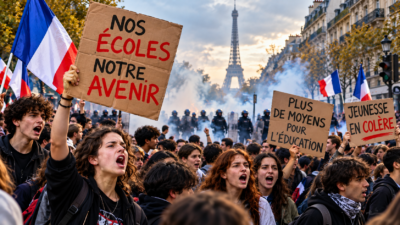
French President Emmanuel Macron criticised foreign leaders, including Trump, for spreading what he described as baseless claims blaming Muslim migrants for recent unrest in France. Macron also warned that AI-generated images depicting events that did not happen were being used to amplify false narratives.
The unrest followed protests over living costs and student grievances. French authorities are preparing a substantial security operation ahead of further demonstrations.
Macron’s remarks came during a Gulf tour focused partly on energy supplies. France has secured additional diesel commitments from Gulf partners as governments respond to elevated fuel prices.
Why it matters: The dispute highlights how domestic unrest can become a battleground for international political messaging—and how synthetic images can blur the line between reporting and manipulation.
Business and markets
◆ SpaceX results fuel speculation about a possible Tesla merger
SpaceX reported third-quarter revenue of $14.58 billion and net income of $4.4 billion, a substantial improvement on the previous year’s loss. AI computing contributed more than half of the company’s revenue, according to Reuters.
The results have renewed attention on a possible combination of SpaceX and Tesla. Musk has called the idea attractive, and the companies have formed committees to examine it. No deal has been agreed.
A merger would bring together businesses spanning rockets, satellite connectivity, electric vehicles, robotics and AI infrastructure. It would also raise complex questions about valuation, governance and how capital would be allocated among businesses with very different investment needs.
◆ AI demand supports hardware makers, but investors remain selective
Super Micro Computer raised its revenue forecast well above analysts’ expectations, citing demand for AI servers. Industrial company 3M also raised its annual profit outlook, helped by semiconductor and data-centre demand.
These results offer evidence that AI investment is creating business for suppliers well beyond the companies developing AI models. Yet investors remain alert to the cost of building data centres and the time needed for that investment to generate sustainable returns.
The market story is no longer simply whether AI demand is growing. It is whether the companies supplying that demand can turn it into durable profits.
Technology
◆ CERN and Mistral AI plan a specialised model for particle physics
The European particle-physics laboratory CERN and French AI company Mistral AI have announced a partnership to develop Flare, a scientific foundation model trained on simulated particle collisions.
The project aims to help researchers identify and reconstruct particles from enormous volumes of experimental data. CERN holds about one exabyte of experimental data from the Large Hadron Collider, with a major increase expected after a planned upgrade around 2030.
The project illustrates a different use of AI from chatbots and general-purpose assistants: building systems around specialised scientific data and research problems.
Why it matters: If successful, such models could help scientists analyse data at a scale that would be difficult to manage with conventional methods alone.
Other news
◆ Nigeria reports its first Ebola case as outbreak spreads across Africa
Nigeria has confirmed its first Ebola case linked to the expanding outbreak of the Bundibugyo strain. Authorities are tracing 44 contacts, mainly healthcare workers and the patient’s spouse. The Africa Centres for Disease Control and Prevention has called an extraordinary virtual meeting of African health ministers for October 28.
The outbreak began in the Democratic Republic of Congo in May and has spread to several countries. The strain involved has no approved vaccine or specific treatment.
Why it matters: The detection of a case in Nigeria, Africa’s most populous country, raises the stakes for contact tracing, infection control and cross-border coordination. It does not by itself mean a widespread outbreak has taken hold in Nigeria, but rapid containment is essential.
◆ At least 153 killed in drone strike on market in disputed Abyei region
A drone strike hit a market and nearby fuel depot in Abyei, a territory disputed by Sudan and South Sudan, killing at least 153 people, according to a local official cited by the Associated Press.
Sudan’s military acknowledged carrying out a strike but said it targeted fuel tankers believed to be bound for the paramilitary Rapid Support Forces. It denied targeting civilians. The military’s account of the targets and the identities of those killed has not been independently verified.
The United Nations condemned the attacks and said many people remained missing as peacekeepers assisted with medical care and firefighting.
The scale of the death toll makes this one of the most devastating reported incidents in the region. It also demonstrates how Sudan’s war continues to threaten civilians and stability beyond the country’s immediate front lines.
What to watch for tomorrow
- India–US trade: Any official update on the remaining issues, proposed terms or a possible signing timetable.
- Ukraine peace diplomacy: Whether Washington, Moscow and Kyiv move from agreement in principle to a confirmed meeting and a more detailed negotiating framework.
- Hormuz and oil prices: Any change in maritime security, US–Iran diplomacy or crude prices that could affect India’s import bill.
- US midterms: Fresh polling, campaign-finance disclosures and developments involving Indian-American candidates and voters.
- AI earnings and investment: Further results and guidance that indicate whether AI infrastructure spending is translating into sustainable profits.
- Ebola response: Updates on Nigeria’s contact tracing, the condition of the patient and regional coordination ahead of the Africa CDC meeting.
- Sudan and Abyei: Further casualty verification, humanitarian access and any response from Sudanese authorities or international bodies.
Three questions for TFP readers
- India–US ties: Should India prioritise a rapid trade agreement, or take more time to protect its negotiating room on tariffs, energy and technology?
- Ukraine: Is a new round of US-mediated talks a meaningful opening—or another diplomatic process without sufficient agreement on the fundamentals?
- AI: As companies invest billions in AI infrastructure, what evidence should investors demand before concluding that the boom is economically sustainable?
Good night. Stay curious, and keep asking the questions that matter.
Socrates
The Free Pen