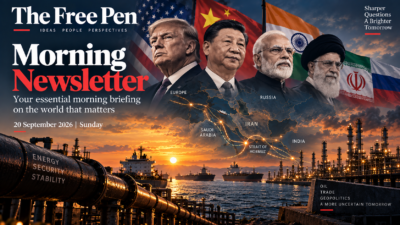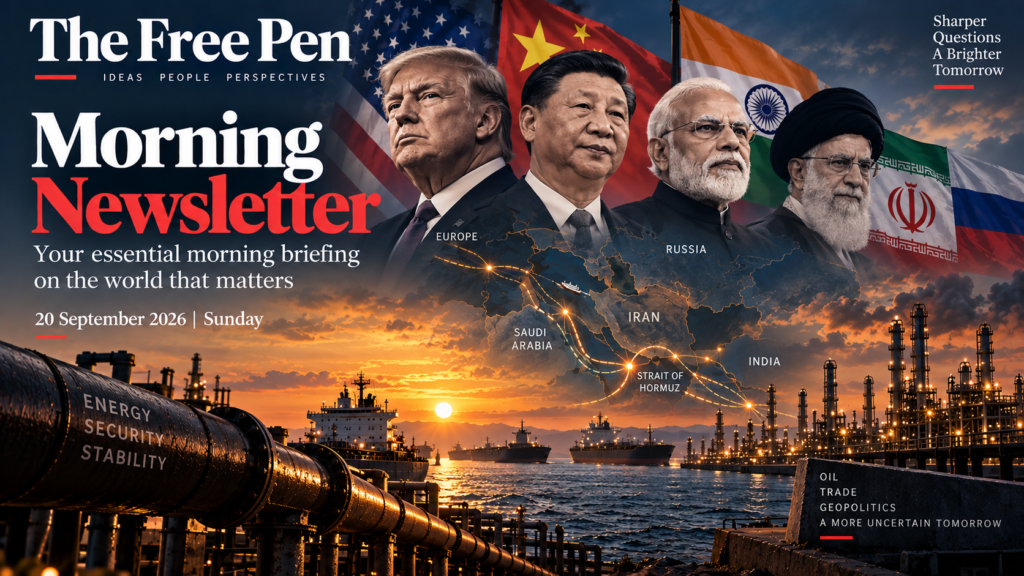
The Free Pen's Morning Newsletter: India's oil dilemma, the Iran war and the changing global geopolitical landscape. (Illustration: The Free Pen)
Good morning. Here is the latest edition of the TFP Morning Newsletter, curating for you the most important developments from the overnight news cycle, with a focus on India, geopolitics, business, technology and the stories to watch out for:
INDIA & DIASPORA
Trump signs Russia sanctions law, putting India’s oil strategy under pressure
US President Donald Trump has signed legislation expanding Washington’s sanctions on Russia and Iran, including provisions that could allow tariffs of up to 100% on countries that continue buying Russian oil and gas.
India is among the countries potentially affected. New Delhi has already warned that the legislation could have implications for bilateral relations, trade and India’s energy security.
The law does not automatically impose tariffs on India. The key question now is whether, when and against whom the Trump administration chooses to use the powers it has been given.
For India, the dilemma is becoming sharper as the Iran war disrupts other sources of crude and Russian oil remains an important part of its import basket.
Saudi oil disruption adds to India’s crude squeeze
Saudi Aramco has reportedly suspended crude supplies to Indian refiners following the shutdown of the kingdom’s East-West pipeline after attacks attributed to the Houthis.
Indian refiners are expected to be able to find replacement barrels, but the bigger concerns are higher oil prices and rising freight costs.
The development comes as India is simultaneously facing pressure over its purchases of Russian crude and disruption to Middle Eastern supplies.
India imports around 90% of the crude oil it consumes, making the widening supply squeeze particularly important.
Canada hopes to conclude trade talks with India by year-end
Canada says it is optimistic about concluding negotiations on a comprehensive economic partnership agreement with India by the end of the year.
Energy, nuclear cooperation and critical minerals are among the areas with potential for deeper cooperation.
The talks are worth watching as India looks to diversify both its energy supplies and access to critical minerals.
H-1B fee extended, but court block remains
The Trump administration has extended the controversial $100,000 H-1B visa fee requirement until September 2027.
However, a federal court order currently prevents the government from collecting the fee.
The issue remains particularly important for Indian technology professionals and US companies that depend heavily on skilled workers from India.
WEST ASIA
Iran offers terms for restarting talks with the US
Iran has formally conveyed conditions to Washington for restarting negotiations to end the war.
Iranian security official Mohsen Rezaei said the conditions include an end to the war on all fronts, the release of frozen Iranian funds and an end to the US naval blockade.
At the same time, Tehran has warned that it is prepared for a “decisive war” if its conditions are rejected.
The next move from Washington could determine whether this becomes a genuine diplomatic opening or another failed attempt at negotiations.
Houthi missile targets Riyadh as Saudi Arabia faces a widening threat
Saudi Arabia says it intercepted a Houthi ballistic missile targeting Riyadh — the first such attempted strike on the Saudi capital since the latest escalation.
The Houthis have also claimed attacks against sensitive sites and energy infrastructure in Saudi Arabia.
The escalation matters well beyond the battlefield. Saudi Arabia’s oil infrastructure and the Red Sea’s Bab el-Mandeb shipping route are both under increasing pressure.
Turkey offers military support to Saudi Arabia
Turkey says it could help meet Saudi Arabia’s military needs under the recently signed defence agreement involving Turkey, Saudi Arabia and Pakistan.
The pact says an armed attack on one member would be considered an attack on all.
Pakistan, meanwhile, has indicated that it has no immediate plans for a military response, even as Islamabad urges Iran to ensure uninterrupted energy supplies and safe passage for ships.
China tries to contain the Houthi threat
China has privately urged Iran to use its influence over the Houthis to help rein in attacks threatening Saudi Arabia and vital shipping routes.
Beijing has strong economic and energy interests in the Gulf and maintains relations with both Saudi Arabia and Iran.
China’s role could become increasingly important if the conflict begins to threaten the wider global energy system.
Oil prices remain above $100 as the energy crisis changes shape
The immediate concern is increasingly moving beyond crude oil to shortages of refined fuels such as diesel, petrol and jet fuel.
Refinery disruptions in Russia, reduced Chinese refinery output and the continuing disruption to Middle Eastern shipping are tightening fuel markets.
For India, this could become more important than the headline Brent price because diesel and other refined products feed directly into transport, agriculture, industry and inflation.
AMERICA
US-China talks begin ahead of Trump-Xi summit
US Treasury Secretary Scott Bessent and Chinese Vice Premier He Lifeng are due to meet in New York today, ahead of President Donald Trump’s planned meeting with Chinese President Xi Jinping later this week.
The talks are expected to cover AI security, trade and wider economic issues.
Rare earths and advanced technology are likely to be particularly important as Washington and Beijing try to manage an increasingly competitive economic relationship.
China criticises Trump’s Russia-Iran sanctions law
Beijing has criticised the new US legislation strengthening sanctions on Russia and Iran, signalling that it opposes unilateral and secondary sanctions.
China is itself a major buyer of Russian oil and therefore faces some of the same potential pressure as India.
The US approach could therefore become an important issue in the Trump-Xi talks.
EUROPE
Russia’s parliamentary election enters its final day
Russia’s three-day parliamentary election concludes today.
It is the first such election since the full-scale invasion of Ukraine in 2022 and is taking place against the backdrop of the continuing war and newly expanded US sanctions.
Voting is also taking place in Russian-controlled parts of Ukraine, a process rejected by Kyiv and its Western allies.
The result and the Kremlin’s interpretation of voter participation will be worth watching.
Ukraine war remains tied to the energy crisis
The Ukraine conflict is increasingly feeding into the global energy shock.
Ukrainian attacks on Russian energy infrastructure have affected refinery output, while the wider Middle East conflict has tightened supplies and pushed up fuel prices.
The two wars are therefore increasingly connected through the global oil and refined-fuel markets.
BUSINESS
The oil crisis is becoming a fuel crisis
Crude oil remains above $100 a barrel, but the bigger economic warning sign may be the tightening market for refined fuels.
Diesel, petrol and jet fuel are what consumers and businesses actually use, and shortages or higher prices can quickly feed into transport costs, food prices and inflation.
The combination of disrupted Middle Eastern shipping, damaged Russian refineries and constraints on Chinese fuel exports is creating a particularly complicated global supply problem.
India faces a crude triple whammy
India is facing pressure from three directions: uncertainty over Russian crude because of US sanctions, disruption to Saudi supplies after the East-West pipeline attack, and the possibility of greater Chinese competition for available Russian oil.
With India importing around 90% of its crude requirements, prolonged disruption could put pressure on the rupee, inflation and the country’s trade balance.
This is increasingly becoming an energy-security story rather than simply an oil-price story.
TECH
US-China AI diplomacy moves centre stage
AI security is expected to feature prominently in today’s Bessent-He Lifeng discussions.
The talks come as Washington and Beijing compete over advanced chips, computing infrastructure and AI models while simultaneously acknowledging that the technology carries risks that may require international cooperation.
The central paradox is becoming clearer: the US and China may need to cooperate on AI safety while competing intensely over who controls the technology.
AI’s energy problem is becoming harder to ignore
The global energy crisis adds another complication to the rapid expansion of AI.
Data centres require enormous amounts of electricity and cooling, just as fuel and power markets are facing pressure from geopolitical disruption.
The convergence of the AI boom and the energy crisis could become an important long-term story for technology and climate coverage.
OTHER NEWS
Pakistan faces pressure on two fronts
Pakistan is navigating growing security pressure at home while also being drawn deeper into the geopolitical crisis surrounding Saudi Arabia and Iran.
Islamabad has urged Tehran to ensure safe passage for ships and uninterrupted energy supplies, while its defence commitments to Saudi Arabia could potentially pull it further into the regional conflict.
For India, Pakistan’s evolving role in the Gulf crisis is worth watching closely.
China’s oil stockpile is helping contain the global shock
China’s substantial strategic oil reserves and reduced crude imports have helped prevent the Iran war from producing an even larger global oil-price shock, according to AP.
The development highlights an important but under-covered aspect of the crisis: countries with large strategic reserves have greater room to absorb supply disruptions.
It also gives Beijing another source of leverage as Xi Jinping prepares to meet Trump.
WHAT TO WATCH TODAY
- Iran’s proposed terms for talks
Will Washington respond to Tehran’s conditions for restarting negotiations, or will the conflict continue to escalate?
- Houthi attacks on Saudi Arabia
Any further strike on Riyadh, Saudi oil infrastructure or Red Sea shipping could quickly affect oil prices and global trade.
- Bessent-He Lifeng talks
Watch for developments on AI, rare earths, tariffs and trade ahead of the Trump-Xi summit.
- India’s response to the Russia sanctions law
Look for any indication of US exemptions, Indian negotiations or changes in refinery buying patterns.
- Oil and refined fuels
Brent is important, but watch diesel, petrol and jet-fuel prices and availability as well.
- Russia’s election results
Voting ends today. Watch turnout, the Kremlin’s messaging and developments in Russian-controlled Ukrainian territory.
- Saudi supplies to India
Any further disruption to Saudi crude shipments could put additional pressure on Indian refiners and the country’s import bill.
- H-1B court battle
The $100,000 fee has been extended, but remains blocked by a court order. Watch for the next legal move.
THE BIGGER PICTURE
Three developments are increasingly converging:
1. The Iran war is becoming an energy and fuel crisis.
The disruption is no longer confined to crude oil. Shipping, refineries and refined fuels are becoming increasingly important — with consequences for inflation and economic growth.
2. India’s energy-security choices are becoming harder.
India is caught between its dependence on Russian crude, disruptions to Gulf supplies and the possibility of punitive US tariffs.
3. The US-China relationship is becoming central to all of it.
Oil, Russia, Iran, AI, rare earths and trade are now intersecting. The Trump-Xi meeting later this week could therefore have consequences far beyond the US-China relationship itself.
For India, the challenge is increasingly about managing several strategic relationships at once — while keeping energy flowing and the economy insulated from a rapidly changing global order.