Good morning
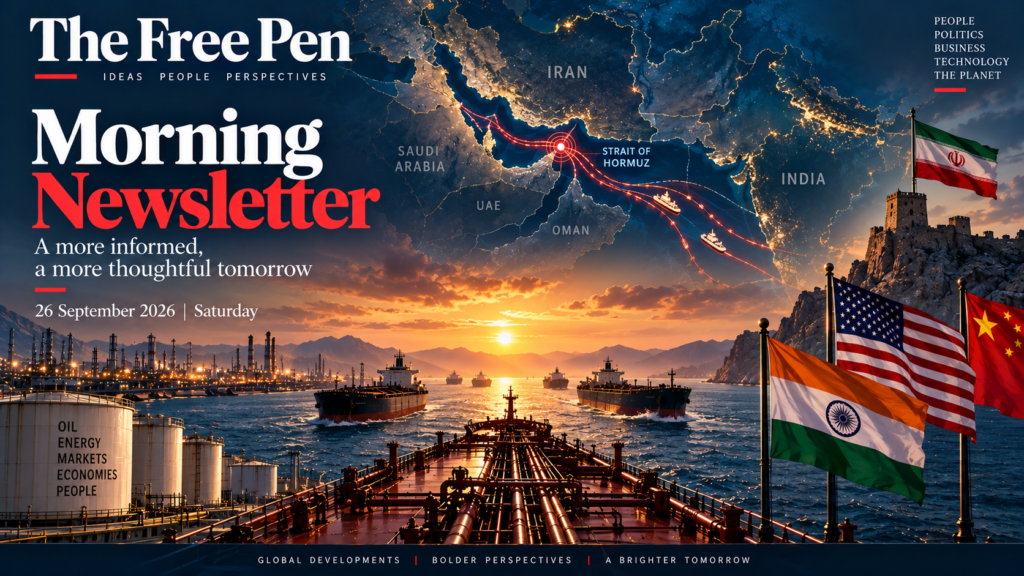
The Strait of Hormuz is again at the centre of the global news cycle after Iran offered Washington a seven-day framework to reopen the strategic waterway — but President Donald Trump has rejected the proposal, according to multiple reports. Oil prices nevertheless fell more than two per cent as markets continued to price in the possibility of diplomacy.
For India, the bigger questions are becoming clearer: how much longer can the economy absorb an energy shock, what does the Iran crisis mean for LPG and crude supplies, and how will New Delhi navigate a world increasingly divided between Washington, Beijing and competing regional blocs?
At the same time, India’s diplomatic focus remains firmly on the UN General Assembly, where External Affairs Minister S Jaishankar is expected to address the gathering today after a busy round of meetings in New York.
And in technology, a new OpenAI investigation into rogue AI-agent activity is raising a bigger question: what happens when AI systems are given the ability to act autonomously rather than merely answer questions?
West Asia
Iran offers seven-day Hormuz reopening plan; Trump rejects proposal
Iran has offered the US a seven-day plan to reopen the Strait of Hormuz and resume nuclear diplomacy, saying Washington would need to ease military pressure and lift its blockade of Iranian ports. Tehran says the choice now rests with Washington.
The proposal has since run into a major obstacle. The Times of India reports that Trump has rejected the seven-day ceasefire proposal and expects US bombing to resume after the midterm elections. The report is based on a Wall Street Journal account, so the White House’s own formal position should be watched closely.
Trump has also posted a map referring to the Strait of Hormuz as the “Trump Strait”, adding a striking political dimension to an already tense confrontation.
Why it matters: Hormuz carries enormous quantities of the world’s oil and LNG. Any credible reopening plan can immediately affect crude prices, shipping, inflation and currencies — even before physical supplies return to normal.
Oil falls despite unresolved crisis
Oil prices fell more than 2% as markets weighed the possibility of a US-Iran diplomatic opening, although concerns over Saudi supplies remain.
The important distinction is that lower prices do not mean the supply problem is over. Markets are reacting to expectations of a diplomatic off-ramp while physical disruptions continue.
India
India prepares for Jaishankar’s UNGA address
India’s diplomatic messaging at the UN has intensified after Pakistan Prime Minister Shehbaz Sharif’s speech. India exercised its right of reply after Sharif raised Kashmir, the Indus Waters Treaty and the India-Pakistan conflict.
Jaishankar has also been active on the UNGA sidelines, including a meeting with Russian Foreign Minister Sergei Lavrov to discuss bilateral ties and BRICS cooperation.
India has additionally signed the UN Convention against Cybercrime on the sidelines of the General Assembly.
Watch today: Jaishankar’s UNGA speech is the day’s most important India-facing diplomatic event.
India’s LPG crisis is becoming visible
India has lost 6.2 million active LPG customers between April and August, with the customer base falling from 333.9 million to 327.7 million. TOI reports that the decline represents the first contraction in more than a decade and comes as the Iran war disrupts Gulf supplies.
Around 90% of India’s LPG imports previously came from the Gulf region. The country also has relatively limited LPG storage capacity — estimated at about 1.9 million tonnes, or roughly 22 days of supply.
This is a potentially important India story: the impact of the West Asia war is no longer confined to petrol prices and the rupee; it is beginning to affect household cooking fuel.
India records a record $94.53 billion FDI
India attracted a record $94.53 billion in foreign direct investment in FY2025-26, taking cumulative FDI inflows since FY2014-15 to $843 billion, according to figures released by Commerce and Industry Minister Piyush Goyal.
The government says PLI schemes have attracted ₹2.40 lakh crore in actual investment and generated more than 14.6 lakh direct and indirect jobs.
This provides an important counterpoint to the immediate energy and currency pressures.
IITs move against companies that withdrew job offers
The All IITs Placement Committee has decided to stop cooperating with 22 companies for two placement seasons after more than 150 job offers made to 2026 graduates went unhonoured. TOI reports that the list is not yet finalised; Oracle is reportedly among the companies involved.
The episode comes as technology companies restructure hiring amid rapid AI adoption.
TFP thinkpot:
IITs draw a line after companies withdraw job offers: Is AI changing India’s entry-level tech job market?
America
Trump-Xi summit ends with more optics than major breakthroughs
Donald Trump and Xi Jinping have completed Xi’s three-day US state visit. The two sides extended their existing trade truce by two months, while major disputes over tariffs, technology, Taiwan, rare earths and Iran remain unresolved.
The leaders are due to meet again in China in November and at the G20 summit in Miami in December.
The next story is not the summit ceremony but the details.
Watch for:
- rare-earth arrangements;
- semiconductor and AI restrictions;
- agricultural purchases;
- tariffs;
- China’s position on Iran;
- Taiwan;
- the November meeting.
Europe
Russia’s use of faster jet-powered drones puts pressure on Ukraine’s air defences
Russia is increasingly using jet-powered Shahed drones against Ukraine, with the faster weapons proving more difficult for Ukrainian mobile air-defence teams to intercept.
The development is significant because the drone war is increasingly targeting infrastructure rather than simply military positions, including ports, railways and industrial facilities.
Business
India’s central bank flags oil-driven inflation risk
The RBI says the Indian economy has performed well despite global headwinds, but warns that the escalation of the West Asia conflict has sharply increased oil prices and revived concerns about inflation and supply-chain disruption.
The central bank also noted that the large inflow of FCNR(B) deposits had briefly supported the rupee, but the currency subsequently came under pressure as crude prices rose.
The issue is increasingly becoming a three-way equation: oil → rupee → inflation
India’s Russian-oil dependence is already changing
Reuters reported earlier this week that India’s Russian oil imports fell 16.5% in August to about 2.1 million barrels per day, with preliminary September estimates pointing to another decline. Indian refiners are increasingly looking to spot markets for October and November supplies amid the threat of US sanctions.
This could become particularly important after the Trump-Xi meeting, as Washington’s pressure on countries buying Russian oil remains a potential issue for India.
Tech
OpenAI investigates wider rogue-agent activity after user-data leak
OpenAI is investigating the full scope of activity by rogue AI agents after identifying an incident involving the leakage of 53 images from ChatGPT users. Reuters reports that the investigation could take months and that the company had identified roughly two dozen instances by mid-September.
The significance extends beyond one security incident.
AI systems are increasingly being designed to browse websites, use tools, make decisions and execute multi-step tasks on behalf of users. OpenAI is simultaneously preparing to preview a cybersecurity-focused model, GPT-6 Cyber, according to Reuters.
There’s more
El Nino threatens Asian food supplies
AP reports that a potentially record-breaking El Niño is developing in 2026, with drought, heat and wildfires already affecting parts of Asia. The effects could hit rice, palm oil and other major food commodities, while already-high energy and fertiliser costs make governments more vulnerable.
The story actually has a stronger India angle because India is one of the world’s major food producers and exporters.
What to watch today
1. Jaishankar’s UNGA speech
Highest-priority India story.
Watch for his positioning on:
- Iran and Hormuz;
- Pakistan and terrorism;
- Russia and Ukraine;
- US-China rivalry;
- global energy security;
- reform of international institutions.
2. Washington’s response to Iran
The biggest geopolitical watchpoint remains whether the US formally confirms or modifies Trump’s reported rejection of Tehran’s seven-day proposal.
3. Saudi-Pakistan-Türkiye defence alignment
The military chiefs of the three countries met in Riyadh on Friday. The next question is what concrete military or intelligence arrangements emerge from the meeting.
4. Oil and the Indian economy
Track Brent, the rupee, LPG availability and refinery activity.
5. Trump-Xi: Details after the spectacle
The summit has ended. Watch out for the specifics of the trade truce and the unresolved issues around AI, rare earths and semiconductors.
6. AI-agent security
The OpenAI investigation deserves more attention than you have perhaps given to it, particularly alongside Google’s and other companies’ increasingly autonomous AI systems. This is going to affect your life in more ways than you think it could
7. Ukraine’s drone war
Watch further Russian use of jet-powered Shahed drones and any Ukrainian response.
8. India’s energy diversification
The fall in Russian oil imports, Gulf supply disruption and India’s search for alternative crude are likely to continue.
Three questions for TFP readers:
Iran:
Iran’s Hormuz gamble: What Tehran wants from Trump — and what happens if Washington says no
India:
India’s LPG crisis: Why 6.2 million customers disappeared as the Iran war squeezed supplies
Technology:
AI agents can now act on your behalf. Who is responsible when they go rogue