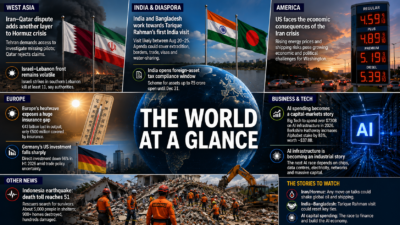
Good morning. Here is the first edition of the TFP Morning Newsletter, curating for you a bunch from the overnight news cycle, with a focus on India, geopolitics, business, technology and the stories to watch out for:
—
INDIA & DIASPORA
Trump signs Russia sanctions law, putting India in a new spot
US President Donald Trump has signed legislation expanding Washington’s sanctions on Russia and Iran, including provisions that could allow tariffs of up to 100% on countries buying Russian oil and gas.
India is among the countries potentially affected. New Delhi had already warned Washington that such measures could have implications for bilateral relations and India’s energy security.
Russian crude accounts for more than 40% of India’s overall oil supplies, according to Reuters. Indian refiners have already secured supplies for September and October, including Russian oil.
The immediate question is not whether the US has the power to impose such tariffs — the new law gives the administration that authority — but whether, when and against whom Washington will use it.
Why it matters: India now faces a difficult balancing act between maintaining access to relatively inexpensive Russian crude and protecting its large and strategically important trade relationship with the US.
—
India pitches itself as a global semiconductor hub
Prime Minister Narendra Modi has used SEMICON India 2026 to position India as a reliable destination for the global semiconductor industry.
US-based Applied Materials plans to invest $5 billion in India over the next decade, focusing on research, supply chains and workforce development.
India expects semiconductor consumption to reach about $110 billion by 2030, from $45-50 billion in 2025.
The bigger challenge, however, is moving beyond chip design, assembly and packaging to large-scale semiconductor fabrication.
—
Rice production may suffer its biggest fall in nearly two decades
India’s rice production could fall by about 10 million tonnes, or 6.5%, from last year’s record crop because of below-normal rainfall during crop maturation, Reuters reports.
There is an important buffer: government stocks stood at around 59.6 million tonnes on 1 September, far above the official target.
So this is not yet a shortage story. It is a story about climate variability, farm output, food prices and India’s long-term food security.
—
Modi and UAE President discuss West Asia
UAE President Sheikh Mohamed bin Zayed Al Nahyan spoke with Prime Minister Narendra Modi about the situation in West Asia, regional peace efforts and India-UAE relations.
The two also discussed cooperation in energy, defence, technology, investment and health.
The conversation comes as Gulf tensions intensify and India seeks to protect its energy supplies and the interests of its large expatriate community in the region.
—
WEST ASIA
Iran claims tanker strike in Strait of Hormuz
Iran’s Revolutionary Guard says it struck the Togo-flagged oil tanker Trend, accusing it of attempting an illegal passage through the Strait of Hormuz.
The claim has not been independently confirmed.
Any further attacks on commercial vessels would add to pressure on one of the world’s most important energy corridors, which is already operating under severe restrictions.
Oil remains around the $100-a-barrel mark despite falling for several consecutive sessions.
—
Pakistan warns Iran over Houthi attacks on Saudi Arabia
Pakistan’s army chief, Field Marshal Asim Munir, has urged Iran to rein in the Houthis, according to the Financial Times.
Islamabad has warned that it could be compelled to defend Saudi Arabia if Riyadh invokes the mutual-defence provisions of its security agreement with Pakistan.
That could pull Pakistan directly into the wider Iran-Saudi confrontation.
For India, the development matters because Pakistan’s involvement would add another layer of instability to India’s immediate neighbourhood, while millions of Indians live and work across the Gulf.
—
China enters the diplomatic effort
China has privately urged Iran to use its influence over the Houthis to curb attacks on Saudi Arabia, after Riyadh sought Beijing’s assistance.
The development highlights China’s unusual position in the crisis: Beijing maintains relations with both Saudi Arabia and Iran and has major economic and energy interests in the Gulf.
—
Iran looks for alternative land routes
Iran is activating overland routes through neighbouring countries to bypass the disruption to maritime trade caused by the conflict, according to the Financial Times.
A prolonged disruption of Gulf shipping could accelerate the use of alternative regional transport corridors.
—
AMERICA
Trump signs sweeping Russia sanctions legislation
The new law targets Russian officials and economic sectors and is intended to increase pressure on Moscow over the Ukraine war.
Its implications extend beyond Russia, however. The possibility of secondary tariffs against major buyers of Russian energy means countries such as India and China are now directly part of the sanctions equation.
—
US-China talks set the stage for Trump-Xi meeting
US Treasury Secretary Scott Bessent is due to meet Chinese Vice Premier He Lifeng in New York this weekend.
The discussions are expected to cover AI, trade and rare earths, ahead of the planned Trump-Xi summit on 24 September.
The talks could provide an early indication of how much room there is for progress on the increasingly contentious technology and trade relationship.
—
US prepares Medicaid drug-price announcement
The Trump administration is expected to announce a programme involving all 50 states aimed at lowering prescription-drug prices under Medicaid.
The administration says the programme could save billions, although experts have cautioned that the savings are difficult to assess because details of agreements with drugmakers have not been fully disclosed.
—
EUROPE
Russia begins parliamentary election
Russia’s three-day parliamentary election has begun.
It is the first parliamentary election since the full-scale invasion of Ukraine in 2022. Voting will determine all 450 seats in the State Duma.
The election is taking place against the backdrop of the Ukraine war, newly expanded US sanctions and continuing restrictions on political opposition inside Russia.
Voting is also taking place in Russian-controlled parts of Ukraine, which Kyiv rejects as illegal.
—
Russian strikes continue across Ukraine
Russian missile and drone attacks around Kyiv and surrounding areas have injured civilians, including children.
Ukraine has continued retaliatory strikes against targets inside Russia.
The International Atomic Energy Agency has also been informed that a drone struck a cooling tower at the Kursk Nuclear Power Plant. The reactor was reported to be operating normally and there was no fire.
Responsibility for the incident has not been independently established.
—
Russia places Nestle and Auchan assets under temporary administration
Russia has placed the Russian operations of Swiss food giant Nestlé and French retailer Auchan under temporary administration.
The move adds to pressure on Western companies that have continued operating in Russia despite the war in Ukraine.
—
BUSINESS
Oil remains above $100 despite recent falls
Brent crude remains above $100 a barrel as markets weigh signs that Saudi Arabia can partially reroute exports against the continuing risks to Gulf shipping.
Saudi Arabia is working to restore part of the capacity of its damaged East-West pipeline and is using ship-to-ship transfers near Oman’s Sohar port to maintain supplies to Asian customers.
But the Iranian tanker incident and continuing Houthi attacks mean the underlying risk has not disappeared.
For India, the oil story has become inseparable from the new US sanctions regime.
—
India’s bond market records fifth weekly loss
Indian government bonds have suffered a fifth consecutive weekly decline as higher US rates and tighter global financial conditions put pressure on emerging markets.
The developments underline the growing connection between the Middle East conflict, US monetary policy, oil prices and India’s financial markets.
—
TECH
AI becomes part of the US-China diplomatic contest
AI and rare earths are expected to feature in the US-China talks this weekend.
The two issues are increasingly connected: advanced AI requires sophisticated chips and enormous computing capacity, while the technology supply chain depends on minerals and components in which China has major influence.
The Trump-Xi meeting next week could therefore have implications well beyond conventional trade.
—
Europe confronts growing AI dependence
European policymakers are warning that the continent risks becoming increasingly dependent on foreign AI technology and computing infrastructure.
The issue is becoming part of a wider debate over technological sovereignty — whether Europe can remain competitive without developing more of its own computing capacity and AI ecosystem.
—
Anthropic moves deeper into biology
AI company Anthropic has established a wet laboratory in the San Francisco Bay Area as it expands its work into physical biology and drug research.
The development points to a broader shift in the AI industry: companies are increasingly looking beyond software and towards using AI to conduct or assist with real-world scientific research.
—
OTHER NEWS
Rice, climate and India’s food security
The projected decline in India’s rice harvest is an important reminder that climate variability is becoming an economic issue as much as an environmental one.
Large government stocks provide a substantial short-term cushion. The longer-term question is whether increasingly unpredictable rainfall can affect India’s ability to maintain both food security and its position as a major agricultural exporter.
—
Pakistan hit by deadly attack
A suicide attacker rammed an explosives-laden vehicle into a police facility in Kohat in north-west Pakistan, killing at least 16 people and injuring dozens, according to Reuters.
The attack comes as Pakistan faces growing security pressures at home while simultaneously navigating its sensitive relationships with Iran and Saudi Arabia.
—
WHAT TO WATCH TODAY
1. Will Trump actually use the new Russia-oil tariff powers?
The biggest India-US story to watch. Look for details from Washington on implementation, exemptions and possible targets.
2. Hormuz and Gulf shipping
Any new tanker attack, Iranian warning or disruption to Saudi exports could quickly push oil prices higher again.
3. Pakistan’s Saudi dilemma
Watch for any further indication that Riyadh could seek Pakistani military assistance.
4. Russia’s parliamentary election
Voting continues through Sunday. Watch turnout, the Kremlin’s messaging and developments in Russian-controlled Ukrainian territory.
5. US-China talks
AI, rare earths and trade are expected to dominate Bessent-He Lifeng discussions ahead of the Trump-Xi summit.
6. India’s semiconductor push
SEMICON India concludes today. Watch for concrete investment, fabrication and technology announcements rather than broad policy statements.
7. Ukraine
Further Russian attacks, Ukrainian strikes and any developments around the Kursk nuclear plant require close monitoring.
—
THE BIGGER PICTURE
Three stories increasingly intersect:
1.
The Iran war is disrupting energy and shipping.
Higher energy prices are complicating the global inflation and interest-rate outlook.
2.
The US is now using sanctions and trade policy to put pressure on countries that continue buying Russian energy.
3.
For India, these developments converge into a difficult strategic equation: energy security, relations with Russia, ties with the US and stability in the Gulf are becoming increasingly interconnected.