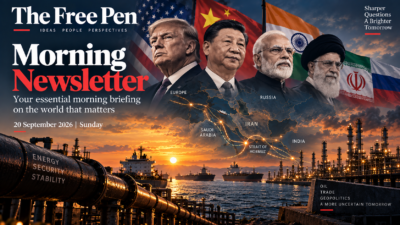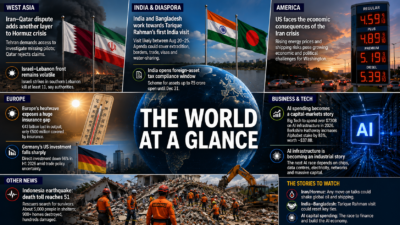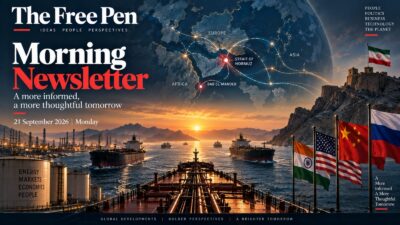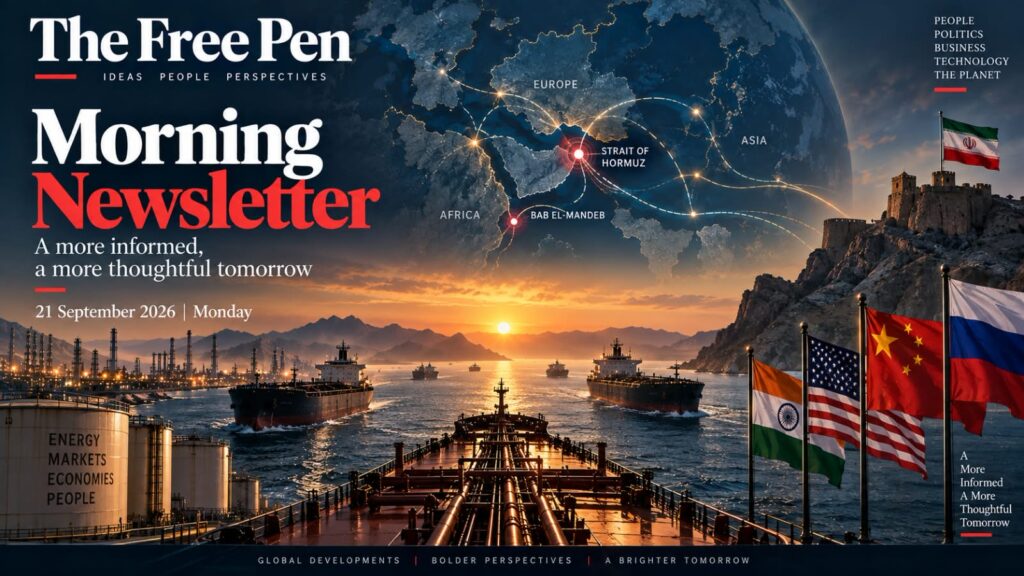
The latest TFP Newsletter edition, which highlights the key overnight developments for India, geopolitics, business, and technology.
Good morning, welcome to the latest TFP Newsletter edition. Moreover, it highlights the key overnight developments for India, geopolitics, business, and technology. Additionally, today’s round-up includes the stories to watch.
WEST ASIA
Iran ties the reopening of the Strait of Hormuz to US demands.
On the other hand, Iran has ruled out reopening the Strait of Hormuz. It will not return to the previous framework of negotiations with the US until Washington meets conditions set by Tehran.
The statement by Iranian Parliament Speaker Mohammad Bagher Ghalibaf comes as the strategic waterway remains at the centre of the conflict. Tehran warned that a major US or allied attack could trigger prolonged retaliation. It would strike at American interests and bases.
The significance goes well beyond shipping. Hormuz is now both an energy chokepoint and a bargaining instrument in the US-Iran confrontation.
Saudi Arabia faces renewed Houthi attacks
The Houthis claimed attacks on targets in Riyadh and on a Saudi Aramco facility in Yanbu. Saudi authorities said its air defences intercepted a ballistic missile headed towards Riyadh.
The attacks have added another layer to the regional energy and shipping crisis. China has privately urged Iran to restrain the Houthis after Saudi Arabia sought Beijing’s help.
The development matters because the threat now reaches beyond the Strait of Hormuz. It extends to the Bab el-Mandeb and the Red Sea, a key global shipping lane.
New diplomatic window opens at the UN
Abbas Araghchi, Iran’s Foreign Minister, heads to New York for the UN General Assembly, with a stop in Qatar. Tehran continues to relay negotiation terms through intermediaries.
The US has also approved visas for senior Iranian officials to attend the UN gathering.
The two sides remain at war. Senior officials in New York create a rare diplomacy chance, even as Washington and Tehran stay apart.
INDIA & DIASPORA
Additionally, India’s oil problem is becoming an economic problem.
Crude prices, the rupee and Indian markets remain under pressure as the Iran war threatens to prolong disruption to global energy supplies.
Brent crude has eased to around $101 a barrel after signs of recovering Saudi shipments, but the underlying risks remain. The rupee ended last week at around ₹95.87 to the dollar, while Indian equities suffered their sixth consecutive weekly decline.
For India, the issue is no longer simply the price of petrol and diesel. Higher crude prices can feed into inflation, the currency, government finances, interest rates and economic growth.
NSE IPO closes today
The National Stock Exchange’s roughly $2.3-billion initial public offering closes for subscription today.
It is among India’s largest-ever public offerings and comes at a difficult moment for Indian equities, which have endured six consecutive weekly declines.
The response from investors will therefore offer another indication of risk appetite in the Indian market.
India’s Russian-oil dilemma deepens
The US legislation authorising tariffs of up to 100 per cent on countries buying Russian oil has raised the stakes for New Delhi.
India remains one of the biggest buyers of Russian crude, making the issue an increasingly difficult intersection of energy security, trade and foreign policy.
The question now is not simply whether India can reduce its dependence on Russian oil, but how quickly it can do so without adding to an already severe global energy shock.
AMERICA
Trump-Xi talks bring AI into the US-China relationship
US Treasury Secretary Scott Bessent and Chinese Vice Premier He Lifeng have held talks in New York ahead of a planned meeting between Donald Trump and Xi Jinping.
Among the proposals under discussion is a mechanism through which Washington and Beijing could notify each other about AI incidents with national-security implications.
Trade, tariffs, rare earths and agricultural purchases remain major areas of disagreement, but the inclusion of AI safety adds a new dimension to the relationship between the world’s two biggest powers.
Iran war adds to US inflation concerns
Higher energy prices and increased investment in artificial intelligence are contributing to a difficult inflationary environment in the US.
The Iran war therefore carries a domestic economic cost for Washington as well as a foreign-policy one, particularly if elevated energy prices persist.
EUROPE
Russia’s ruling party dominates parliamentary election
Vladimir Putin’s United Russia party has dominated Russia’s parliamentary election, according to early results.
The vote was held against the backdrop of the Ukraine war and major Ukrainian drone attacks. Voting also took place in Ukrainian territories that Russia claims to have annexed, a move Kyiv rejects as illegitimate.
The election’s aftermath will be closely watched for signs of how Moscow intends to use the result amid the continuing war.
Ukraine launches major drone assault on Russia
Ukraine carried out one of its largest drone attacks on Russia, with strikes reported around Moscow.
The attacks reportedly killed three people and damaged the Moscow oil refinery. More than 1,600 drones were reported intercepted since Saturday, including hundreds heading towards the Moscow region.
The attacks matter beyond the battlefield: disruption to Russian refining capacity comes at a time when global oil and refined-fuel supplies are already under pressure.
Germany’s far right makes gains
The AfD emerged as the leading force in a German state election, prompting Chancellor Friedrich Merz to describe the result as a “disaster”.
The result adds pressure on Germany’s governing coalition and underlines the continuing strength of the far right in European politics.
BUSINESS
Oil eases, but the energy shock is not over
Asian markets have found some relief as oil prices eased following signs of increased Saudi exports and the reopening of some critical pipelines.
But inventories are falling and the market remains extremely sensitive to further attacks or disruption.
The bigger story may now be moving beyond crude. Disruptions to refining and shipping are tightening supplies of products such as diesel, while LNG buyers across Asia are reassessing their dependence on imported gas.
Asia rethinks its LNG dependence
The Hormuz disruption is prompting countries including India, Vietnam, Thailand and Pakistan to reconsider their dependence on imported LNG.
The crisis could therefore have a long-term consequence: accelerating investment in renewable energy, battery storage and other alternatives to imported gas.
Fertiliser prices remain a concern
Alternative suppliers have helped prevent a full-blown global fertiliser crisis despite a sharp fall in Gulf urea exports.
Prices remain elevated, however, and poorer countries are particularly exposed.
For India, the development matters because fertiliser costs, food prices and energy security are closely linked.
TECH
AI becomes part of US-China strategic diplomacy
The proposed US-China mechanism for notifying each other about AI incidents with national-security implications is one of the most significant technology developments in the overnight cycle.
It reflects how quickly artificial intelligence has moved beyond being primarily an economic or technology issue. AI is increasingly being treated as a question of national security and strategic stability.
China’s AI boom exposes an economic contradiction
A senior Chinese central-bank adviser has warned that artificial intelligence could worsen an existing weakness in China’s economy: strong production but weak domestic demand.
The AI boom is supporting exports and industrial investment, but policymakers remain concerned about household consumption and weak balance sheets.
China may therefore face an unusual challenge — expanding rapidly in AI while still struggling with the underlying problem of insufficient domestic demand.
OTHER NEWS
Russia’s oil infrastructure becomes part of the Ukraine battlefield
The reported damage to Moscow’s oil refinery highlights how the Ukraine war is increasingly intersecting with the global energy market.
The refinery processed millions of tonnes of crude last year, and attacks on Russian energy infrastructure have contributed to fuel shortages and higher domestic prices.
At a time when Middle Eastern supplies are already under pressure, further disruption to Russian refining capacity could have consequences far beyond the battlefield.
The second shipping, chokepoint to watch
The Strait of Hormuz is receiving most of the attention, but the Bab el-Mandeb and Red Sea could become an equally important part of the global shipping story.
The latest Houthi attacks underline the possibility that disruptions could affect two major maritime routes simultaneously.
That would increase pressure on shipping costs, insurance premiums, delivery times and energy supplies.
WHAT TO WATCH TODAY
1. Iran-US diplomacy at the UN
Watch for contacts involving Iranian officials, the US, Qatar, Oman and other intermediaries as the UN General Assembly gets under way.
2. Strait of Hormuz and oil prices
Any new attack, tanker disruption or change in Iranian policy could quickly reverse the recent easing in crude prices.
3. Indian markets and the rupee
Watch equities, the rupee and government bond yields for the market’s response to oil and geopolitical risks.
4. NSE IPO subscription
The closing day of the NSE IPO will provide an important test of investor appetite amid the recent market weakness.
5. India’s Russian-oil dilemma
Watch for any fresh signal from Washington or New Delhi on the potential consequences of the new US sanctions legislation.
6. Trump-Xi diplomacy
The US-China discussions on trade, rare earths and AI could set the tone for the planned Trump-Xi meeting.
7. Ukraine’s attacks on Russian energy infrastructure
Further strikes on refineries or pipelines could add another layer to an already tight global fuel market.
8. Saudi Arabia and the Houthis
Any escalation could turn the current two-chokepoint shipping risk into a much broader regional energy crisis
THE BIGGER PICTURE
The most important story this morning is not any single missile strike or oil-price move.
The Iran war is increasingly connecting four systems that are normally reported separately: energy, markets, diplomacy and technology.
The Strait of Hormuz is putting pressure on oil and shipping. That pressure is feeding into India’s currency and inflation outlook. The Russia sanctions question is complicating India’s foreign-policy choices. And at the same time, Washington and Beijing are discussing artificial intelligence as a matter of strategic security.
The result is a world in which energy security, geopolitics and technology policy are becoming increasingly difficult to separate.