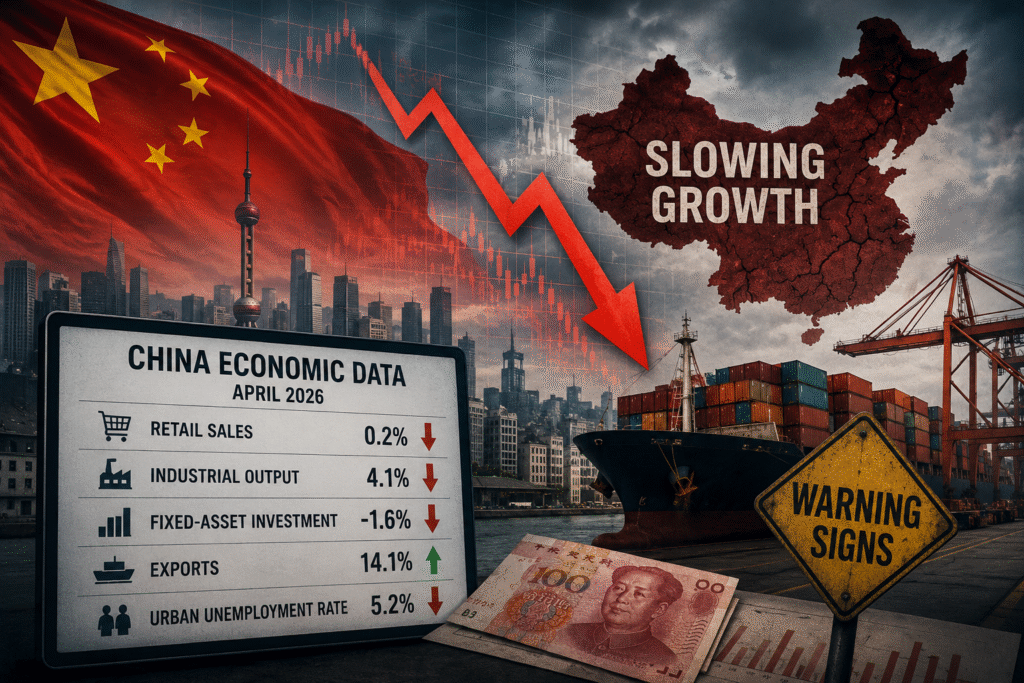
China’s April economic data, released by the National Bureau of Statistics on May 19, came in well below expectations across every major indicator — consumer spending, industrial output, and investment. The figures have reignited debate about the health of the world’s second-largest economy and prompted calls for Beijing to step in with fresh stimulus.
What the data shows
Retail sales — the broadest measure of consumer spending — grew just 0.2 per cent in April compared to a year earlier, sharply missing economists’ forecast of a 2 per cent rise and slowing from 1.7 per cent in March. That marked the weakest reading since December 2022, when China was beginning to loosen Covid restrictions.
The weakness was broad-based. Automobile sales fell 15.3 per cent, while home appliances dropped 15.1 per cent, building materials 13.8 per cent, and furniture 10.4 per cent. These are typically categories sensitive to consumer confidence and big-ticket spending decisions — and the declines are steep.
It was not only consumers pulling back. Industrial output grew 4.1 per cent in April from a year earlier, decelerating from 5.7 per cent in March and missing the 5.9 per cent forecast in a Reuters poll. Fixed-asset investment — which covers spending on property, infrastructure, and machinery — contracted 1.6 per cent in the first four months of 2026, compared with a 1.7 per cent rise in the January-March period. Economists had predicted 1.6 per cent growth.
What is driving the slowdown
The slowdown has been attributed in large part to the fallout from the Iran war, which has dampened momentum across the Chinese economy. Rising energy and commodity costs linked to the conflict are squeezing both consumers and manufacturers.
A war-driven surge in commodity costs pushed producer and consumer prices higher in April, with factory-gate prices ending a years-long deflationary streak to reach a three-year high.
Analysts have also cited slowing construction activity and weaker infrastructure investment as factors behind the fixed-asset investment decline.
The one bright spot
Not all of April’s data was grim. Chinese exports accelerated sharply, expanding 14.1 per cent — well ahead of estimates of 7.9 per cent growth — as factories scrambled to meet surging overseas demand from buyers stockpiling goods amid fears of higher input costs linked to the Iran war.
The urban unemployment rate edged down to 5.2 per cent in April, from 5.4 per cent in March. Strong exports are providing a buffer — but analysts caution it may not be enough to fully offset domestic weakness.
Why it matters
The figures are significant because they confirm that China’s domestic demand problem — long a structural concern — is being compounded by an external shock. When the world’s largest manufacturing economy sees consumers, factories, and investors all pulling back simultaneously, the ripple effects extend well beyond its borders.
Asian economies that depend on Chinese demand for exports and supply chains are not insulated.
Although China’s economy expanded 5 per cent in the first quarter of 2026, analysts warn that growth remains uneven, with industrial production continuing to outpace domestic consumption. Sustaining that headline growth rate through the rest of the year will require a meaningful recovery in domestic demand — which, for now, shows few signs of arriving.
What to watch
Beijing has signalled awareness of the problem. Policymakers have been under pressure to unveil additional stimulus measures, particularly targeted at household consumption.
The next critical data points will be May retail sales, loan growth figures, and any fiscal announcements from the State Council. Whether the government moves beyond signalling to concrete action will determine how deep this slowdown runs.