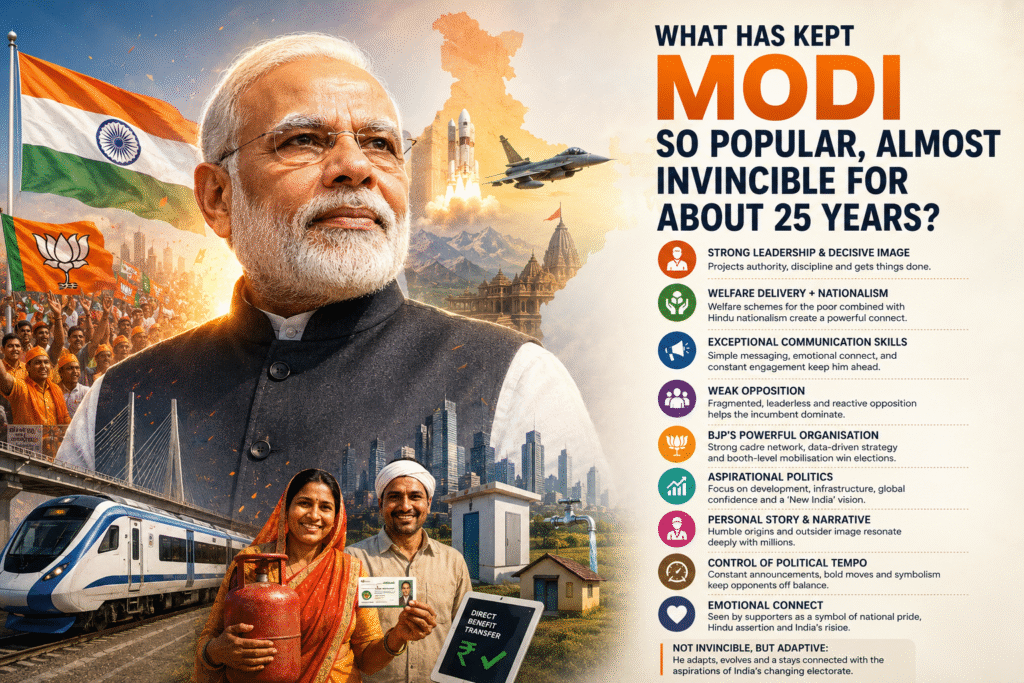
The political durability of Prime Minister Narendra Modi is unusual not just in India, but globally. Very few democratic leaders have remained electorally dominant for roughly a quarter-century — first in Gujarat and then nationally — while continuing to retain a powerful personal political brand.
There is no single explanation for Modi’s longevity. His dominance rests on a combination of political messaging, welfare delivery, ideological positioning, organisational strength, personal branding, and the weakness or fragmentation of the opposition.
The phenomenon resurfaced yet again after Modi’s recent interaction with the Indian diaspora during his visit to the Netherlands, where large crowds and emotionally charged public engagement once again highlighted how strongly his political appeal extends beyond India’s borders.
The event reinforced a pattern visible throughout Narendra Modi’s national career: the cultivation of a leader who is projected not merely as a politician, but as a symbol of national pride, aspiration, and global Indian identity.
Here are the major reasons why Modi has remained politically formidable for nearly 25 years.
The image artisan
Modi’s politics has long revolved around the projection of authority and decisiveness. Supporters often view him as a leader who takes bold decisions and acts with administrative control.
That perception has been reinforced through high-profile decisions and events, including the 2016 demonetisation drive, the Balakot airstrikes in 2019, the abrogation of Article 370, Covid-era national addresses, and visible diplomatic engagements on the global stage.
Even critics who disagree with his policies frequently acknowledge the effectiveness of his political projection and communication strategy.
The Indian diaspora is a living bridge of the India-Netherlands partnership. Our decision to extend OCI Card eligibility for the Surinamese Hindustani community from the fourth generation to the sixth generation has been enthusiastically received by the diaspora in the… pic.twitter.com/A1mu1pYLFg
— Narendra Modi (@narendramodi) May 16, 2026
Welfare nationalism
One of the key reasons Modi has outlasted many populist leaders is that his politics has not depended on rhetoric alone.
Under Modi, the Bharatiya Janata Party (BJP) fused welfare delivery with Hindu nationalism and aspirational development politics.
Government schemes linked to LPG connections, toilets, housing, tap water, food distribution, direct benefit transfers, electricity access, and health insurance were aggressively publicised and politically branded.
For many beneficiaries, especially poorer households and women, the state became more visible in everyday life. This created what political analysts often describe as delivery-based legitimacy.
At the same time, Hindu nationalist politics associated with the RSS ecosystem helped consolidate a large ideological base that sees Modi as a civilisational figure rather than merely an elected administrator.
The combination of welfare delivery and identity politics has proved electorally powerful.
The messanger
Modi is widely regarded as one of the most effective political communicators India has produced in recent decades.
His messaging style relies on simplicity, repetition, emotional framing, symbolism, and direct voter engagement. Programmes such as Mann Ki Baat, large public rallies, carefully choreographed visuals, and aggressive social media outreach helped him bypass traditional political gatekeepers.
His communication style often feels conversational rather than overly technocratic, helping him connect with large sections of the electorate.
A joyous moment for every Indian!
Chola Copper Plates dating back to the 11th Century will be repatriated to India from the Netherlands. Took part in the ceremony for the same in the presence of Prime Minister Rob Jetten.
The Chola Copper Plates are a set of 21 large plates… pic.twitter.com/Zwu0QFc2ZJ
— Narendra Modi (@narendramodi) May 16, 2026
Importantly, Modi has consistently shown the ability to control the political narrative and prevent opponents from defining the national conversation for extended periods.
Opposition offers Tina
Modi’s success cannot be understood without examining the condition of the opposition — creating that Tina (there’s no alternative) factor.
Many opposition parties have struggled with leadership crises, ideological incoherence, regional rivalries, corruption baggage, and weak organisational coordination.
The decline of the Congress as a dominant national force created a political vacuum that the BJP successfully occupied. While regional parties remain influential in several states, many lack a coherent pan-India narrative.
Several anti-BJP alliances have also appeared reactive rather than visionary, often united mainly by opposition to Modi rather than a compelling alternative programme.
The election machine
The BJP today operates as one of India’s most sophisticated electoral machines.
The party benefits from extensive cadre networks, booth-level mobilisation, ideological workers linked to the RSS ecosystem, fundraising strength, data-driven campaigning, and disciplined messaging.
Under Modi and Home Minister Amit Shah, the BJP became highly centralised and relentlessly election-focused. This organisational structure has repeatedly converted popularity into electoral victories.
The Indian diaspora is a living bridge of the India-Netherlands partnership. Our decision to extend OCI Card eligibility for the Surinamese Hindustani community from the fourth generation to the sixth generation has been enthusiastically received by the diaspora in the… pic.twitter.com/A1mu1pYLFg
— Narendra Modi (@narendramodi) May 16, 2026
Politics of aspiration
Modi’s rise coincided with major social and economic changes in post-1991 liberalisation India.
The growth of the middle class, urbanisation, migration, consumer ambition, and the desire for global recognition created fertile ground for aspirational politics.
Modi’s messaging often combines nationalism with economic ambition through themes such as infrastructure, digital governance, manufacturing, space achievements, and India’s emergence as a global power.
For many supporters, he symbolises national confidence and a more assertive India on the world stage.
The grassroots memory
One of the most remarkable aspects of Modi’s rise is that he did not emerge through a conventional electoral trajectory.
नीदरलैंड्स में भारतवंशियों का अपनी विरासत से गहरा लगाव बना हुआ है। हेग में कम्युनिटी प्रोग्राम के अवसर पर राजस्थान की संस्कृति और परंपरा का भी अद्भुत रंग देखने को मिला। इसमें लोकनृत्य की प्रस्तुति ने मंत्रमुग्ध कर दिया। pic.twitter.com/oT0VE3jzl4
— Narendra Modi (@narendramodi) May 16, 2026
Before becoming chief minister of Gujarat in late 2001, Modi had largely worked within the BJP-RSS organisational structure rather than building a career through repeated election contests. He was brought into the chief minister’s office during a politically difficult period for the BJP in Gujarat.
Yet over the next 12 years, Modi transformed himself into one of India’s most formidable electoral politicians. Under his leadership, the BJP repeatedly won elections in Gujarat, helping create the image of Modi as a politically unbeatable administrator focused on development, governance, and Hindu nationalist politics.
By the time the 2014 general election arrived, Modi had already spent more than a decade as Gujarat chief minister without losing an election. His national campaign that year was unusually presidential in style, heavily centred around his personal image, speeches, branding, and promises of economic transformation.
That momentum did not end after the election victory. One of the defining moments in constructing Modi’s global superstar political image came later in 2014 during his high-profile event at Madison Square Garden in New York. The packed diaspora gathering, complete with rock-concert-like energy, helped project Modi as a charismatic global Indian leader capable of drawing celebrity-style crowds abroad.
The Madison Square Garden event became politically significant because it fused diaspora nationalism, media spectacle, and strongman leadership imagery in a way rarely seen for an Indian prime minister. Similar diaspora events in later years — including his latest interaction with Indians in the Netherlands — have continued reinforcing that carefully cultivated international political persona.
Personal biography
Modi’s personal story has also played a major political role.
His rise from humble origins, outsider positioning, organisational struggle, and lack of dynastic privilege sharply differentiate him from many rivals associated with political families.
The BJP has consistently reinforced this contrast by presenting Modi as a self-made leader versus opponents portrayed as products of elite political dynasties.
Whether entirely organic or carefully curated, the narrative has resonated strongly with many voters.
Control over momentum
Another underappreciated aspect of Modi’s politics is his ability to control political tempo.
His government and party regularly generate fresh announcements, infrastructure inaugurations, diplomatic events, temple politics, welfare launches, and national-security narratives.
This rapid pace of political activity keeps public attention moving and often prevents opponents from sustaining a single damaging narrative for long.
Emotion of the heart
For many supporters, Modi represents more than a political leader.
Criticism of Modi is often interpreted by loyal supporters as criticism of India’s rise, Hindu identity, or the aspirations of ordinary Indians.
This emotional connection creates a durable political loyalty that can be difficult for opponents to counter through conventional political criticism alone.
He knows nothing lasts forever
Despite his dominance, Modi is not politically untouchable.
The BJP has lost important state elections, faced criticism over unemployment and inflation, confronted farmer protests, and experienced setbacks in certain electoral contests.
India’s electorate has historically shown a willingness to shift politically over time. Long-serving leaders eventually encounter anti-incumbency pressures, economic challenges, leadership succession debates, or coalition shifts.
What makes Modi exceptional is not that he cannot lose, but that he has repeatedly adapted before political decline could fully take hold.
That adaptability may ultimately be the biggest reason why Narendra Modi has remained one of the most politically dominant leaders in modern Indian history.