Ladies’ Night is not a conventional short story collection. It moves across genres — magic realism (yes, Rushdie), speculative fiction, and fable — while using a loose “ladies’ night” setting as a narrative thread rather than a rigid frame.
Sucheta Dasgupta uses a loose framing device—a bar-like “ladies’ night” setting where stories unfold—as a metaphor for freedom, conversation, and uninhibited expression. The premise is clever but not heavy-handed; it acts as a connective tissue rather than a rigid st
ructure.
I began reading Ladies’ Night on a slow evening at home, the kind where time stretches a little. My daughter had music playing in the background—90s and 2000s tracks drifting through the room on our Amazon Echo Dot—and there was something about that atmosphere that felt oddly aligned with the book I had just opened. It took me back to a time when I perhaps carried a more tender heart, one that was more willing to sit with stories, to let them linger on for some more time.
I am not a regular fiction reader. Not the sort that browses bookstalls looking for the next novel to disappear into. My reading habits have long leaned towards non-fiction, biographies, science, history, philosophy, reportage, analysis — basically what people call the hard edges of reality. So picking up Ladies’ Night—my first encounter with Sucheta Dasgupta—was, in a sense, stepping outside my usual lane.
Part of what nudged me there was circumstance. The book came to me not by chance, but through people I trust. It was sent by publisher Chitra Viraraghavan — courtesy a dear friend, Darpan Singh, himself charting a new path after roaming around in the world of hard news for two decades. That context matters, because it shaped the way I approached the book: not with scepticism, but with curiosity.
A collection that doesn’t behave
What struck me early on is that Ladies’ Night refuses to behave like a conventional short story collection. It moves between the real and the surreal, often without warning. Some stories feel grounded, others drift into fable or speculative terrain.
Dasgupta’s writing has a way of easing possibly all readers in. The stories often begin in recognisable emotional spaces — relationships, memory, longing — and only then stretch into something unfamiliar. That transition is where the book works best. It doesn’t demand belief in the fantastical. It invites you into it.
The under-current of women staking claim: Trespassing a non-fiction mind
With a non-fiction bias, I could have been less interested in plot while reading and more in what the stories were trying to say. In the prologue, it got me questioning the setting where the author declares — have you noticed how it is that it is almost always women who are stepping out into the extreme weather… — as my mind wandered into the construction sites across sprawling cities of India where men, some bare-chested, building high towers and writing the story of India the world talks about. But here, the book quietly asserts itself. And I didn’t complain later as pages flipped through my fingers.
There is a clear undercurrent of women claiming space — emotionally, socially, even imaginatively. But it is not loud or declarative. It unfolds through choices characters make, or sometimes refuse to make. That subtlety made it easier for me to stay engaged. It didn’t feel like I was being told something. It felt like I was being shown something.
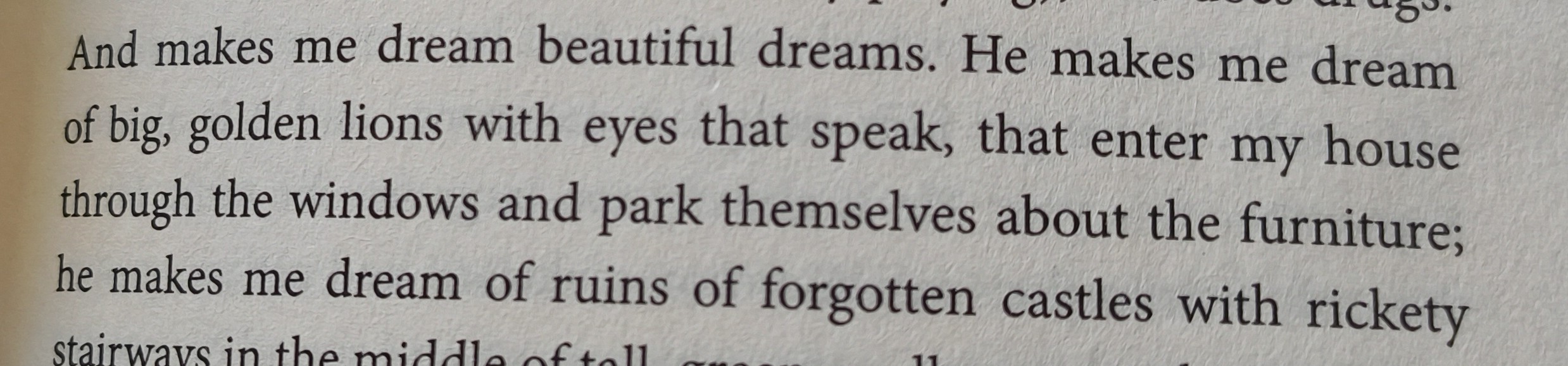
In one of the early pages, the first storyteller describes her love interest in a manner I haven’t read (haven’t even heard such description in a long time, not even in the movies or series I have rushed through during my binge-watch sessions over the years) for ages. Such as this: “He makes me dream of big, golden lions with eyes that speak, that enter my house through the windows and park themselves about the furniture…” This made lines of an old and virally popular Lata Mangeshkar song ring in my ears — khule the dil ke darwaaze, mohabbat bhi chali aayi [the doors of the heart were open ajar (and) that first love of mine crept in through among other things] from Woh bhooli daastaan lo phir yaad aa gayi].
At times, the prose leans towards the lyrical — occasionally to the point where it risks lingering too long. There were also passages where I caught myself drifting, wanting the story to move forward. But then, just as often, a line or an image would pull me back in.
The personal resonance
Perhaps what made this reading experience different for me was the setting in which I encountered it. The music in the background, the familiarity of home, the sense of time folding back into earlier and easier times.
There were moments when the stories seemed to echo that older emotional register — the “tender heart” I mentioned earlier. Not in a nostalgic or sentimental way, but in how they allow vulnerability to exist without judgement.
Not perfect, but persuasive
The collection is uneven. Some stories land with clarity and force; others feel more like experiments that don’t fully resolve. Though I have not completed the book fully. It takes me some time to finish books — partly because I read two or three books during any period of time. In that sense, I am not a one-book person.
I would say this book is different, and may not be trying to please every reader. It is more likely trying to explore, to push, to sit in ambiguity.
I would not call it a gripping read or a uniformly spread out plot, but it is imaginative, thoughtful at times and almost always exploring — with a different raw freshness.
(From the Facebook wall of Prabhash K Dutta)