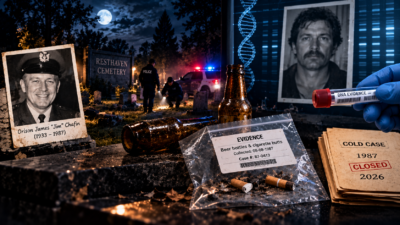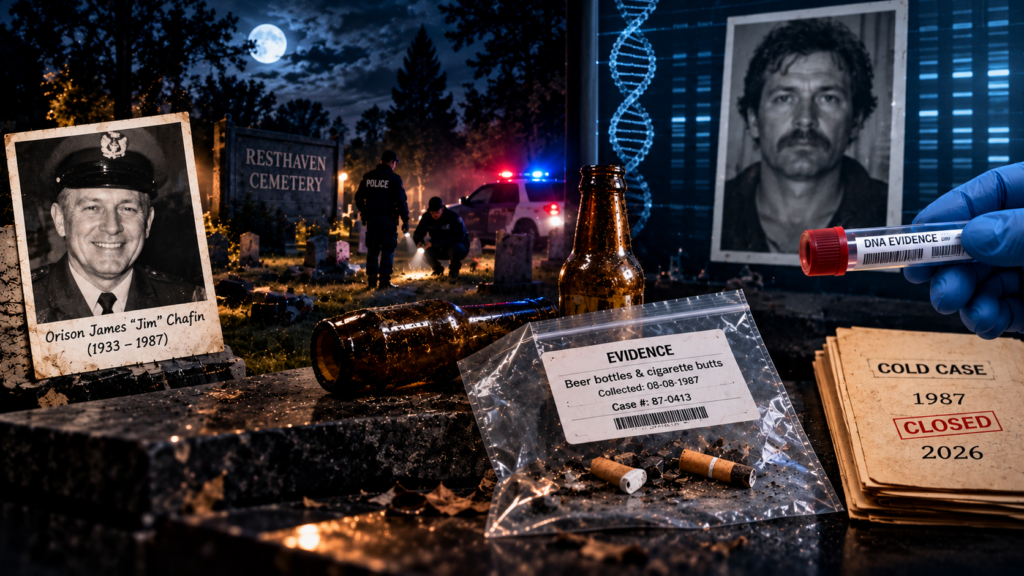
For 39 years, the murder of a Korean War veteran in an Arizona cemetery remained unsolved. Then investigators reopened the case, found a man who had never been questioned in 1987 and asked for his DNA. Five days later, he was dead. The laboratory result arrived weeks after that.
At 4.11 am on August 8, 1987, a group of young people driving through a cemetery in Glendale, Arizona, noticed something strange.
A car was stopped in the darkness.
Its headlights were on.
As they approached, the vehicle suddenly moved away.
Then they saw a body.
A man was lying in the roadway inside Resthaven Cemetery.
His throat had been cut.
He was wearing only socks.
The dead man was identified as Orison James “Jim” Chafin, a 54-year-old Korean War veteran who lived alone in a nearby trailer park.
For investigators, the scene raised immediate questions.
Who had killed him?
Why had he been taken to a cemetery?
And who was the man — or men — seen around the car before the vehicle disappeared?
The answers would remain elusive for nearly four decades.
Until investigators reopened the file.
And found something remarkable.
The man they eventually focused on had been in the original investigation all along.
He had simply never been interviewed.
The last night of Jim Chafin
Chafin had spent the evening of August 7, 1987, at Critters Lounge, a bar near 59th Avenue and Glendale Avenue.
Witnesses later told investigators that Chafin had been there with several people.
One of them was Gary Wayne Billups.
Two other men were also reportedly there.
Investigators knew this.
But Billups was never interviewed during the original investigation because police could not locate him, according to the Arizona Attorney General’s Office.
That detail would become enormously important 39 years later.
At the time, however, detectives had a murder with no identified killer.
They collected evidence.
They interviewed witnesses.
They followed leads.
But the case eventually went cold.
The evidence that refused to disappear
There was one thing the investigators did remarkably well.
They preserved evidence.
Among the material collected during the original investigation were beer bottles and cigarette butts.
Forensic examination later produced three male DNA profiles from the evidence.
The profiles were entered into the national CODIS database.
Nothing matched.
No name appeared.
No arrest followed.
For years, the DNA simply sat there.
The evidence could tell investigators something about the people who had left it behind.
But it could not tell them who those people were.
Then forensic technology improved.
And cold-case investigators returned.
Thirty-eight years later, someone made a tip
In 2025, a tip came from outside Arizona.
The information initially concerned another man who might have been involved in something in the state.
Investigators looked into him.
They ruled him out.
But the tip prompted something more valuable than the identity of the original person who had been reported.
It made detectives go back through the old case.
They began re-examining the original evidence.
They re-interviewed surviving witnesses.
And they went back through the names of people who had been around Chafin before his death.
That’s when Billups surfaced.
He had been at the bar.
Witnesses had placed him there.
He had lived in Glendale in 1987.
But the original investigation had never interviewed him.
Now detectives could find him.
He was living in Arizona’s West Valley.
The cold case suddenly had a living person connected to it.
The man who said he wasn’t there
Investigators first tried to contact Billups in March 2026.
He declined to meet them.
Then, on June 19, investigators located him.
Billups voluntarily went with them to the Surprise Police Department for an interview.
According to the Arizona Attorney General’s Office, he denied knowing Chafin.
He also denied living in Glendale in 1987.
But investigators had records that contradicted part of his account: arrest records showed Billups had been in Glendale in 1986 and 1987.
There was another question.
The DNA.
Would Billups agree to provide a sample?
He did.
The sample
On June 19, 2026, Gary Wayne Billups gave investigators a DNA sample.
He was then released.
At that moment, investigators had no laboratory result proving that the DNA from the 1987 crime scene belonged to him.
They were waiting.
Five days later, on June 24, Billups died by suicide.
The Maricopa County Sheriff’s Office investigated his death.
The murder investigation, however, continued.
The DNA sample had already been taken.
The laboratory work was still being completed.
And investigators had no idea yet what the result would show.
The answer arrived after his death
On August 6, the laboratory result came back.
Billups’ DNA profile matched DNA recovered from evidence associated with the 1987 murder, according to the Arizona Attorney General’s Office.
The evidence included the beer bottles and cigarette butts collected during the original investigation.
The result transformed the case.
For almost 40 years, investigators had known that unidentified male DNA was present in evidence from the murder.
Now they had a name.
Gary Wayne Billups.
And there was another connection.
Witnesses had already placed him with Chafin at the bar on the night of the murder.
The man investigators had been unable to find in 1987 had been identified nearly four decades later.
And the DNA had provided the forensic link.
But there would be no courtroom ending
This is where the story becomes unusual.
Normally, a DNA breakthrough in a cold case leads to an arrest.
Then comes a trial.
Then, potentially, a conviction.
That cannot happen here.
Billups was already dead when the DNA result came back.
Arizona authorities therefore announced that no criminal charges would be filed.
Two other people who had been investigated in connection with the case had also died.
There would be no prosecution.
No cross-examination.
No jury.
No verdict.
The evidence would never be tested in a courtroom.
Yet the Arizona Attorney General’s Office and Glendale Police Department said they consider the case closed.
Attorney General Kris Mayes said the evidence means investigators can now be reasonably certain about what happened to Chafin.
That is a very different kind of ending from a conviction.
What happened in that cemetery?
The DNA tells investigators that Billups’ biological material was present in evidence from the crime scene.
Witnesses placed him with Chafin earlier that evening.
But there are still questions.
Investigators have not been able to reconstruct every moment between Chafin leaving the bar and his body being discovered.
They do not have a courtroom-tested account from Billups.
And because he is dead, investigators cannot question him further.
That leaves an uncomfortable gap in the story.
The investigation has identified the suspect.
The forensic evidence links him to the crime.
But the precise sequence of events remains partly unknown.
That distinction matters.
A case can be closed without every question being answered.
The technology was not the most important thing
It would be easy to describe this as another story about modern DNA technology.
But there is a more interesting lesson here.
The DNA evidence wasn’t new.
It was almost 40 years old.
The beer bottles were old.
The cigarette butts were old.
The original witness statements were old.
Even the suspect was already in the historical record.
What changed was the decision to look again.
The cold-case investigators revisited the file.
They found a person who had slipped through the original investigation.
They located him.
They interviewed him.
They obtained his DNA.
And the evidence that had sat quietly in storage since 1987 finally answered the question detectives had been asking for decades.
The clue that survived 39 years
Victim: Orison James “Jim” Chafin
Age: 54
Location: Resthaven Cemetery, Glendale, Arizona
Date: August 8, 1987
Cause of death: Throat cut; ruled homicide
Last known location: Critters Lounge
Original evidence: Beer bottles and cigarette butts containing male DNA
Original DNA profiles: Three male profiles
Database search: No match
Cold case reopened: 2025
Key development: Investigators identified Gary Wayne Billups as a person who had been with Chafin before the killing but had never been interviewed in 1987
DNA sample obtained: June 19, 2026
Billups died: June 24, 2026
DNA match returned: August 6, 2026
Charges: None — suspect deceased
Current status: Arizona authorities consider the case closed.
CRIME SOLVED STATUS: SOLVED — NO TRIAL
Authorities say the DNA evidence identified Billups as the suspect and consider the case closed. But because he died before the DNA result was returned, there was no arrest, prosecution or conviction.
The veteran who was not forgotten
Jim Chafin died in a cemetery in 1987.
For decades, his murder remained one of the cases that investigators could not close.
His killer had no name.
The DNA had no match.
The witnesses had no definitive answer.
Then, almost 40 years later, investigators went back to the beginning.
They found the man who had been with Chafin on his final night but had never been questioned.
They found him living only a few miles — but nearly four decades — away from the original crime.
They asked for his DNA.
He gave it to them.
Five days later, he was dead.
Weeks after that, the laboratory supplied the answer.
The result could not produce a trial.
It could not produce a conviction.
But it could finally give investigators something the case had lacked since 1987:
a name attached to the evidence.
And sometimes, in a cold case, that is the final piece of the puzzle.
Not because the past has changed.
But because the evidence survived long enough for the future to understand it.