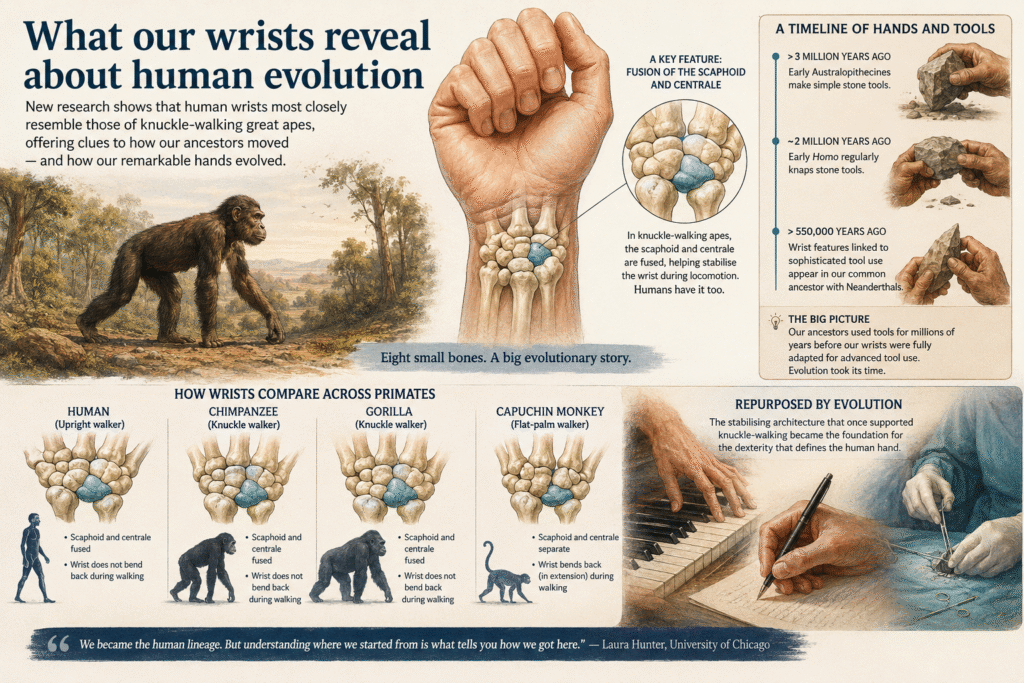
Look at your wrist. Flex it, rotate it, curl your fingers into a fist. What you are doing — effortlessly, instinctively — is the product of millions of years of evolution. The eight small bones packed into that joint are among the most intricate in the human body. They allow a surgeon to suture a wound, a musician to play a chord, a child to tie a shoelace.
But hidden inside their geometry is a far older story — one that may trace back to a time when our ancestors did not walk upright at all, but moved through the world on all fours, weight resting on the knuckles of their hands.
A major new study published in the Proceedings of the Royal Society B has now brought that story into sharper focus.
In the most comprehensive analysis of primate wrist bones ever conducted, a team of researchers has found that human wrists bear a striking resemblance to those of gorillas and chimpanzees — not to those of monkeys, not to other apes, but specifically to the great apes that knuckle walk. The finding lends significant new support to the hypothesis that, before our lineage evolved bipedalism — the ability to walk upright on two legs — our ancestors moved the way a chimpanzee does today.
It is a finding that quietly reframes something we take for granted about being human. We think of upright walking as our defining trait, the adaptation that set us apart. But our wrists, it turns out, may carry the memory of a very different posture.
The problem with studying wrists
To understand why this study matters, it helps to appreciate how difficult the question has been to answer.
Paleoanthropologists — scientists who study the fossil record of human ancestors — have long debated what our ancestors’ locomotion looked like before bipedalism. The two leading possibilities are that we evolved upright walking from a knuckle-walking ancestor, much like modern chimps and gorillas, or from a more generalised, tree-climbing ancestor that never passed through a knuckle-walking phase at all.
The wrist is, in theory, a perfect place to look for clues. Different modes of locomotion place different mechanical demands on the joint. Knuckle walkers and upright walkers share a crucial feature: neither bends the wrist backward during movement. Flat-palm walkers — like capuchin monkeys and macaques — do the opposite, loading the wrist in extension with every stride. Over evolutionary time, these mechanical pressures leave their mark on the bones themselves, in subtle grooves, ridges, and surface geometries that record how the joint was used.
The problem is that the wrist is not one bone — it is eight or nine, interlocking in complex ways. Previous studies had typically examined only one or two bones at a time, which left researchers with an incomplete and sometimes contradictory picture. It was a bit like trying to understand a machine by studying one cog in isolation.
Scanning 2,037 bones across species
Laura Hunter, a paleoanthropologist at the University of Chicago, set out to solve this. Along with her colleagues, she used CT scanning and 3D laser surface scanning to digitally reconstruct the exteriors of 2,037 wrist bones drawn from multiple living and extinct primate species — spanning monkeys, apes, and hominins. The dataset is unprecedented in its scope.
Each bone was then rendered as a high-resolution digital 3D figure, allowing the team to quantify the subtle surface features that record how the wrist bears weight during movement. The method was rigorous enough that Hunter could cross-check what she observed visually against the computational analysis — a level of verification that gives the findings additional credibility.
What emerged from all those scans was striking in its consistency. For nearly every bone examined, human wrist bones resembled the equivalent bones in knuckle-walking African apes — gorillas and chimpanzees — far more closely than those of any other primate group. This was not the case for one or two bones, or for a particular region of the wrist. It held across the board.
Among the specific features the study highlights is the fusion of the scaphoid and centrale, two bones on the thumb side of the wrist. In knuckle-walking apes, this fusion helps stabilise the wrist during locomotion. Humans have it too. The question the study raises is: why would we retain a feature that evolved to support a form of movement we no longer use?
Repurposed by evolution
Hunter’s answer is elegant. Evolution, she argues, did not discard these features when our ancestors stopped knuckle walking. It repurposed them.
“If these features remained in our lineage, it is surely not because we’re knuckle walking,” she says. The stabilising architecture that once steadied the wrist during locomotion became, over millions of years, the structural foundation for something entirely different — the extraordinary dexterity that defines the human hand. The ability to grip, pinch, rotate, and manipulate objects with precision; to fashion tools, string a bow, write a sentence.
This is one of evolution’s recurring patterns — structures co-opted from one function and redirected towards another. The bones in your ear that transmit sound evolved from jaw bones in our distant reptilian ancestors. The feathers of birds evolved in dinosaurs that could not fly. The wrist, this study suggests, may follow the same logic: built for one world, adapted for another.
But the timeline for that adaptation turns out to be more drawn out than expected.
Tools came early; the wrist caught up later
Stone tools first appear in the fossil record more than three million years ago, made by members of Australopithecus — the genus that includes the famous fossil known as Lucy. By two million years ago, early members of our own genus, Homo, were knapping simple stone tools with some regularity.
Yet the specific wrist features associated with more sophisticated tool manufacture — a suite of anatomical changes on the thumb side of the wrist that the study identifies as distinctly human — only became consistent much later. They are present in both modern humans and Neanderthals, which means they extend at least as far back as the common ancestor the two species shared, more than 550,000 years ago.
In other words, our ancestors were making stone tools for more than two and a half million years before the wrist anatomy we associate with advanced tool use became fully established. The hand was in use long before it was fully optimised. Evolution, characteristically, took its time.
This finding is significant because it suggests that the relationship between anatomy and behaviour in human evolution is not straightforward. Our ancestors did not simply develop the “right” wrist and then start making tools. The capacity for tool use developed alongside — and perhaps drove — the gradual anatomical changes that eventually produced the human wrist as it exists today.
The sceptics and what they say
As with any significant finding in paleoanthropology, the study has its critics — and their objections deserve attention.
Scott Simpson, a paleoanthropologist at Case Western Reserve University, flags a notable gap in the dataset: the absence of Ardipithecus ramidus. This is a 4.4-million-year-old hominin from eastern Africa whose hand bones were preserved well enough to reconstruct how it moved. That hand showed no clear signs of knuckle walking. Some researchers argue that bipedalism may have evolved from a more generalised ancestral form of locomotion — one that bypassed a knuckle-walking phase entirely.
Philip Reno, a developmental biologist at Pennsylvania State University, raises a more fundamental methodological caution. He notes that humans and African apes are, genetically, extremely closely related. Finding that their wrists look alike may simply reflect that close evolutionary kinship, rather than proving a shared mode of locomotion in our ancestry.
“Showing morphological similarity of humans with our closest relatives is kind of the null hypothesis you would expect,” he says. “You need differences to really tease out whether there has been actual selection.”
These are fair challenges, and Hunter’s team acknowledges them. The study is not the final word on whether humans have knuckle-walking ancestors — it is a data point, albeit a very large and carefully constructed one. Paleoanthropology rarely delivers clean, settled answers.
Why this matters beyond academia
It might be tempting to file this under “interesting but esoteric.” A study about wrist bones and ancient locomotion, published in an academic journal — why should a general reader care?
Because the question at the heart of it is one of the most compelling in all of science: where did we come from, and how did we get here?
Understanding human origins is not merely a matter of satisfying curiosity about the distant past. It shapes how we understand the biology we carry with us today — why certain joints fail under certain conditions, why some anatomical features that appear vestigial turn out to have critical functions, how development unfolds in the human foetus, and why our closest animal relatives move and behave the way they do.
There is also something worth pausing on in the image itself: that the same wrists a pianist uses to play a concerto, that a surgeon uses to perform a procedure, that a child uses to learn to write — those wrists may carry, encoded in their very structure, the ghost of an ancestor moving on all fours through an African forest millions of years ago.
Evolution does not erase the past. It builds on it.
What comes next
Hunter and her colleagues say future work should focus on mapping specific wrist movements to specific tool behaviours, which may help clarify exactly when and why each anatomical adaptation emerged. A more granular understanding of how the wrist changed during the transition from knuckle walking to bipedalism — and from simple to complex tool use — would significantly advance the field.
The inclusion of Ardipithecus and other early hominins in future datasets would also help address the gaps Simpson identifies. Fossil wrist bones are rare and fragile, but advances in imaging technology are making it increasingly possible to extract detailed information from specimens that were once too delicate to analyse.
For now, what this study offers is the most complete picture yet assembled of how the human wrist compares to those of our primate relatives — and what that comparison might tell us about the long, winding, knuckle-to-fingertip road that made us who we are.
As Hunter puts it: “We became the human lineage. But understanding where we started from is what tells you how we got here.”
Watch this story in video: