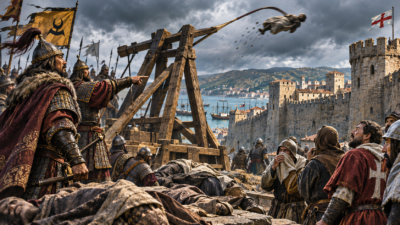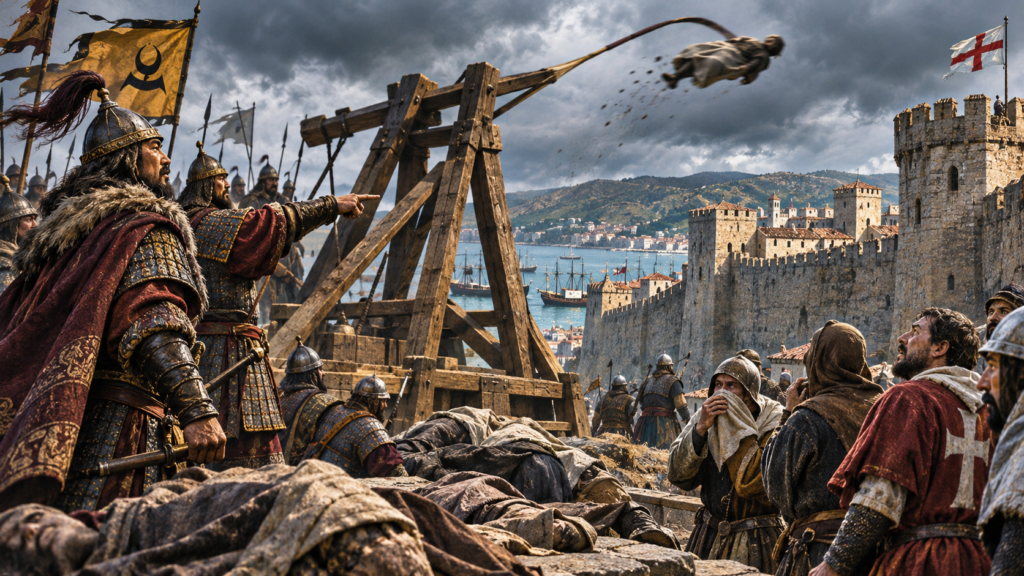
In 1346, a Mongol army besieging a Genoese trading city in Crimea was struck by a devastating epidemic A medieval account claims the attackers hurled plague-infected corpses over the city walls. The story has since become one of history’s most notorious examples of biological warfare. But the evidence is disputed, and the real story of how the Black Death reached Europe is considerably more complicated.
In the middle of the 14th century, a city on the northern shores of the Black Sea became the setting for one of history’s most disturbing stories.
Caffa, a wealthy Genoese trading settlement in Crimea, was under siege by the forces of the Mongol Golden Horde. Its attackers were led by Jani Beg, a powerful ruler whose empire stretched across much of the Eurasian steppe.
The siege was already a confrontation between two very different worlds: the commercial ambitions of the Italian maritime republics and the political and military power of the Mongol successor states.
Then an epidemic struck the besieging army.
Thousands were reportedly dying. According to an account written by an Italian notary a few years later, the Mongols responded by loading the bodies of plague victims into siege engines and hurling them over Caffa’s walls.
The defenders, the account claimed, were unable to escape the contamination.
It is an extraordinary story. It has also become one of the most frequently cited episodes in the history of biological warfare.
But there is a fundamental problem: the man who recorded the incident was not an eyewitness. Other contemporary accounts do not independently establish that the corpse bombardment happened.
More importantly, recent historical research has challenged the popular explanation of how the Black Death travelled from the Black Sea into Europe.
To understand what happened at Caffa, it is necessary to go beyond the siege itself and examine the empire, the trading networks and the political conflict that brought the two sides together.
Caffa: Where the Mongol world met European commerce
Caffa, known today as Feodosia, was situated on the Crimean coast of the Black Sea.
Its importance came from geography.
The Black Sea connected Mediterranean shipping routes with the enormous commercial networks of the Eurasian interior. Goods arriving at its ports could be transported northwards towards the Russian river systems, eastwards towards Central Asia and southwards towards Constantinople and the Mediterranean.
For Genoa, one of Europe’s leading maritime powers, controlling access to these routes was commercially invaluable.
The Genoese established Caffa in 1266 through an agreement with the ruler of the Golden Horde, one of the major political entities to emerge from the fragmentation of the Mongol Empire.
The Golden Horde, also known as the Ulus of Jochi, controlled extensive territories north of the Black and Caspian seas. Its rulers exercised authority over important commercial centres, caravan routes and river corridors.
Caffa was therefore not an isolated European outpost. It was a trading settlement operating within Mongol-controlled territory.
By the 14th century, it had developed into a prosperous commercial centre with a diverse population that included Genoese, Venetians, Greeks, Armenians, Jews, Mongols and Turkic communities.
Its port handled a wide range of commodities, including grain, textiles, spices and enslaved people.
The relationship between the Genoese merchants and their Mongol hosts was mutually beneficial, but it was never entirely comfortable. The merchants wanted commercial autonomy and access to lucrative routes. The Golden Horde wanted political authority, revenue and control over the activities taking place within its territory.
The tension would eventually turn into open conflict.
The Golden Horde and Jani Beg
The Golden Horde was not simply an army of nomadic warriors moving across the Eurasian plains.
By the 14th century, it had developed an elaborate political and commercial system. Its rulers controlled major urban settlements, collected taxes, maintained diplomatic relations and participated in international trade.
Jani Beg, who ruled from approximately 1342 to 1357, inherited this powerful state from his predecessor, Özbeg Khan.
His reign coincided with growing tensions involving the Italian commercial communities around the Black Sea.
Genoa and Venice, despite their own rivalry, had established settlements and trading privileges in the region. Their merchants operated under arrangements with the Mongol authorities, but competition over commercial influence frequently produced friction.
One of the most important settlements in this dispute was not Caffa but another trading centre called Tana.
Tana: The conflict that preceded the siege
Tana was located near the mouth of the Don River, close to the northern end of the Sea of Azov. It was an important Venetian trading settlement and a gateway to the commercial routes leading into the Eurasian interior.
In September 1343, a violent confrontation took place there involving Italian merchants and the local population.
Accounts differ over the precise sequence of events and responsibility for the violence. What followed, however, was a serious breakdown in relations.
Jani Beg ordered action against the Italian trading communities. Merchants were arrested, commercial privileges were disrupted and Italian residents fled Tana.
Many sought refuge in Caffa, which had stronger fortifications and access to the sea.
The dispute soon developed into a wider confrontation between the Golden Horde and the Italian maritime republics.
Venice and Genoa, normally competitors, temporarily found common ground in their opposition to Jani Beg’s actions. Commercial restrictions and embargoes followed, further aggravating the crisis.
The conflict was no longer simply a dispute between merchants. It had become a contest over political authority and control of Black Sea commerce.
Two sieges and an approaching disaster
The Mongol assault on Caffa was not a single, uninterrupted campaign.
Jani Beg’s forces first besieged the city in 1344. The Genoese defenders managed to withstand the assault, and the siege was eventually lifted.
The Mongol ruler renewed the attack in 1345. This second siege continued into 1346 and was still part of the wider military and commercial confrontation when plague began devastating the region.
The timing was disastrous.
The epidemic had already appeared in territories controlled by the Golden Horde. Contemporary accounts describe its devastating effects in settlements across the wider region.
The Mongol army outside Caffa was also affected.
The disease would become known to later generations as the Black Death, the most devastating pandemic in European history.
It was caused by Yersinia pestis, a bacterium that can produce different forms of plague, including bubonic and pneumonic plague.
For the besieging army, the epidemic created a crisis that military strength alone could not resolve.
The siege eventually ended, with plague and the wider military and commercial confrontation contributing to the withdrawal and subsequent negotiations.
But the most enduring account of what happened during this period would come from a man who was not there.
The notary who recorded the corpse bombardment
His name was Gabriele de’ Mussi.
He was an Italian notary from Piacenza, a town in northern Italy. His account of the plague, written in the late 1340s, contains the extraordinary description of the events at Caffa.
According to de’ Mussi, the Mongol army was suffering enormous losses. The soldiers, unable to overcome the epidemic, decided to use the bodies of those who had died as weapons against the defenders.
They placed the corpses in siege engines and hurled them into the city.
The defenders attempted to remove the bodies, but de’ Mussi claimed that the contamination had already spread.
His account also described the disease as travelling through the air, contaminating water and infecting people who came into contact with the sick.
Eventually, according to his narrative, Genoese ships carrying survivors left Caffa and transported the disease to Mediterranean ports.
The story is graphic and dramatic. It also appears to offer a straightforward explanation for how plague reached Europe.
But there is a significant qualification.
De’ Mussi was not an eyewitness to the siege.
Research by historian Hannah Barker and historian Nam Jongkuk has established that he was in Piacenza during the relevant period. Records of his notarial activities provide evidence of his presence there.
His narrative was therefore based on information he received from others.
That does not automatically invalidate everything he wrote. Medieval historians frequently relied on accounts transmitted by travellers, merchants and other witnesses.
But it does mean that the corpse-catapult story cannot be treated as a verified eyewitness account.
Was Caffa the site of history’s first biological warfare attack?
The story has understandably attracted considerable attention from historians of warfare and disease.
If the account is accurate, the Mongols deliberately used infected human remains to expose an enemy population to disease.
In modern terminology, this could be described as biological warfare.
The idea was not entirely beyond the military capabilities of the period. Medieval siege engines, particularly trebuchets, could throw heavy objects over fortified walls. Using dead bodies as projectiles was technically possible.
But the question is not merely whether it could have happened. It is whether it did.
In 2002, microbiologist Mark Wheelis published an influential study in the US Centers for Disease Control and Prevention’s journal Emerging Infectious Diseases, titled Biological Warfare at the 1346 Siege of Caffa.
Wheelis examined de’ Mussi’s account alongside other historical evidence.
His conclusion was that the attack was plausible and could have been responsible for introducing plague into Caffa. He also argued that the episode was probably insignificant in the subsequent spread of the Black Death across Europe.
However, Wheelis’s interpretation is not universally accepted.
Historian Nam Jongkuk’s 2021 critical examination of de’ Mussi’s account raised serious questions about its reliability.
Nam argued that the notary’s account was shaped by the religious beliefs, prejudices and limited medical understanding of his time.
De’ Mussi viewed the epidemic through a framework in which disease was associated with divine punishment, sin and the corruption of the environment.
He also expressed considerable hostility towards the Mongols.
Nam therefore questioned whether the corpse bombardment was a historical event or a story shaped by the fears and prejudices of its author.
There is another difficulty: no independent contemporary account conclusively confirms that the Mongols deliberately launched plague-infected corpses into Caffa.
The distinction is important.
The siege happened. The plague devastated the region. The corpse bombardment remains disputed.
What actually caused the Black Death to spread?
Perhaps the most important development in the historical understanding of Caffa comes from Hannah Barker’s research.
Her study, Laying the Corpses to Rest: Grain, Embargoes, and Yersinia pestis in the Black Sea, 1346–48, was published in the academic journal Speculum in 2021.
Barker examined a wider range of contemporary records, including documents produced by Genoese colonial administrators, Venetian diplomats, Byzantine chroniclers and Mamluk merchants.
Her research challenges the idea that the plague reached Europe principally through ships fleeing Caffa after the alleged corpse bombardment.
Instead, she reconstructs the movement of disease through the wider Black Sea trading system.
One of her most important findings concerns grain.
The Black Sea region was a major supplier of grain to Mediterranean markets. Grain was transported in large quantities by ship and through commercial networks connecting ports and inland settlements.
These shipments could also carry rats, fleas and the bacteria responsible for plague.
Barker argues that the commercial embargoes imposed during the conflict between the Italian republics and the Golden Horde temporarily interrupted the movement of commodities across the Black Sea.
People continued to travel, but the movement of goods was restricted.
When peace was restored and trade resumed in 1347, grain shipments began moving again.
The spread of plague resumed alongside them.
This is a particularly important finding because it connects the epidemic to the commercial and political realities of the time.
The movement of disease was not simply a consequence of soldiers carrying infected bodies or sailors fleeing an epidemic.
It was also connected to the movement of ordinary commodities through a vast trading network.
The Black Sea was not merely a geographical passage. It was an interconnected commercial ecosystem.
From the Black Sea to Constantinople and the Mediterranean
Barker’s reconstruction suggests that plague took more than a year to cross the Black Sea and reach Constantinople.
The disease was present in parts of the Golden Horde’s territories by 1346. Its movement towards Constantinople continued through 1347.
By August and September 1347, plague was reported in Constantinople.
From there, the disease reached the Mediterranean.
In October 1347, an outbreak was recorded at Messina in Sicily. Ships arriving from the eastern Mediterranean were associated with the epidemic.
By November and December, outbreaks were reported in Genoa and Marseille.
Venice was affected soon afterwards, followed by other Italian and European cities.
The disease continued moving through commercial ports, river routes and overland connections.
The scale of the disaster was extraordinary.
Between 1347 and 1353, the Black Death devastated Europe, the Middle East and parts of North Africa. Estimates of mortality vary considerably, but in many European regions the epidemic killed a substantial proportion of the population.
The effects extended far beyond immediate deaths.
Agricultural production, trade, labour relations, religious institutions and political structures were profoundly affected.
The shortage of labour changed the balance between landowners and workers. Wages and prices came under pressure, while traditional social relationships were disrupted.
The epidemic would leave a lasting mark on European society.
The role of trade in a medieval pandemic
There is a larger lesson in the story of the Black Death.
The 14th-century world was far more interconnected than is sometimes assumed.
The Mongol Empire and its successor states had facilitated extensive movement across Eurasia. Merchants, travellers, diplomats and religious figures moved between regions that had previously been separated by political and geographical barriers.
The commercial networks linking China, Central Asia, the Black Sea, the Middle East and Europe carried much more than valuable goods.
They also carried disease.
Italian maritime republics such as Genoa and Venice had developed extensive shipping networks. Their vessels connected distant ports and enabled commodities to move across enormous distances.
The same networks that created commercial prosperity also created opportunities for epidemics to spread.
The Black Death demonstrated how quickly a local outbreak could become a transcontinental disaster when people, animals and goods moved through interconnected routes.
Caffa was one important part of this system, but it was not the entire story.
So, did the Mongols really catapult plague corpses into Caffa?
The honest answer is that we cannot establish it conclusively.
The allegation comes primarily from Gabriele de’ Mussi, whose account was not based on his personal observation of the siege.
Mark Wheelis considered the attack plausible, while later scholarship, particularly the work of Nam Jongkuk and Hannah Barker, has raised substantial doubts about the reliability of the traditional narrative.
Barker’s research also provides a different explanation for the movement of plague across the Black Sea, highlighting the importance of grain shipments, trade restrictions and the Venetian community at Tana.
The evidence therefore does not support the popular claim that a Mongol biological attack at Caffa unleashed the Black Death upon Europe.
Even if infected corpses were thrown over the walls, the incident was unlikely to have been decisive in the pandemic’s subsequent spread.
The distinction between a possible military episode and the actual transmission of a pandemic is essential.
The real story behind the legend
Caffa remains fascinating not because it offers a definitive account of the first biological-warfare attack, but because it reveals how war, commerce and disease intersected in the medieval world.
A commercial dispute at Tana escalated into a confrontation between the Golden Horde and Italian trading communities.
A fortified port became the centre of a prolonged siege.
An epidemic devastated the surrounding region.
And a network of ships, merchants and commodities helped connect the Black Sea to the Mediterranean world.
The corpse-catapult story gave this complicated history a dramatic focal point. But the wider evidence tells us that the Black Death’s journey was not the result of one battle, one weapon or one fleeing fleet.
It was a catastrophe carried through a connected world.
The Mongols may or may not have hurled plague victims over the walls of Caffa. But the Black Death did not need a trebuchet to cross continents. It had trade routes.