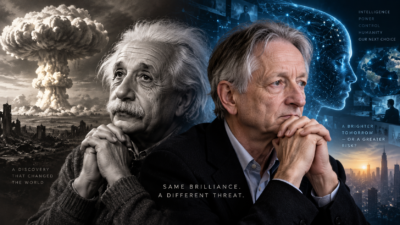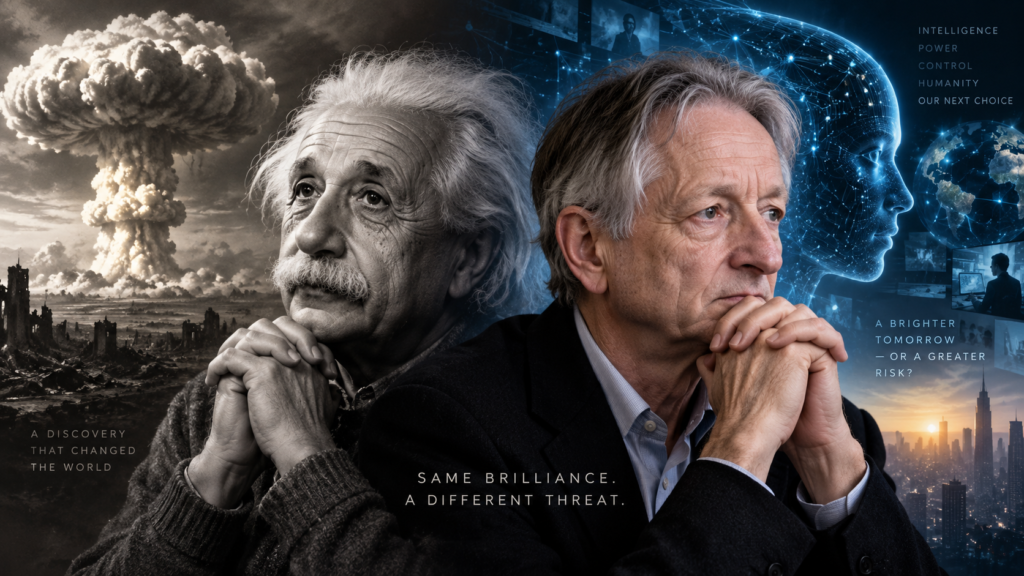
Geoffrey Hinton's warnings about artificial intelligence have drawn comparisons with Albert Einstein's concerns about the consequences of nuclear weapons.
There is something deeply unsettling about Geoffrey Hinton’s warnings about artificial intelligence.
Not because he is another technology billionaire predicting the end of the world. Not because he is an outsider throwing stones at an industry he never helped build.
Quite the opposite.
Hinton helped build it.
For decades, he was one of the scientists arguing that machines could learn in ways that resembled the human brain. When much of the scientific establishment had lost faith in artificial neural networks, Hinton kept working on them. His ideas about neural networks, learning and deep learning eventually became part of the intellectual foundation on which today’s artificial intelligence revolution rests.
In 2024, the Nobel Prize in Physics recognised him for foundational discoveries and inventions that enable machine learning with artificial neural networks.
And then came the extraordinary part.
The man who helped make modern AI possible began warning humanity about what it might become.
That makes Geoffrey Hinton an intriguing candidate for a role that belongs to an earlier age: the scientist who helped open a door that humanity may not know how to close.
That is where the comparison with Albert Einstein becomes irresistible.
Not because Hinton is literally the Einstein of AI. Nor because Einstein invented the atomic bomb — he did not.
The comparison is more profound than that.
Both men belong to that rare class of scientists whose intellectual work helped change humanity’s relationship with power.
And both eventually confronted the uncomfortable possibility that scientific discovery does not come with an instruction manual for controlling its consequences.
Einstein did not build the bomb. But he helped set the story in motion
The popular version of the Einstein story is usually wrong.
Einstein did not work on the Manhattan Project. He did not design the atomic bomb. He was not part of the scientific team that built it.
His role was earlier and, in a strange way, more political.
In 1939, Einstein and physicist Leo Szilard warned US President Franklin Roosevelt that recent discoveries involving uranium raised the possibility of a nuclear chain reaction — and potentially enormously destructive bombs. Einstein’s letter said such bombs could conceivably become powerful enough to destroy an entire port and surrounding territory.
The context was Nazi Germany.
The fear was that Hitler’s Germany might get the bomb first.
Einstein therefore acted out of fear of what would happen if the technology existed in the hands of the Nazis.
But history took a different turn.
Germany did not build the bomb.
The United States did.
And in August 1945, Hiroshima and Nagasaki demonstrated what nuclear physics had made possible.
Einstein had not built the weapon. But he had helped convince the US government that the possibility could not be ignored.
After the war, he became increasingly outspoken about nuclear weapons and international control of atomic energy. The Emergency Committee of Atomic Scientists, which Einstein helped establish, sought to educate the public about nuclear dangers and promote international control.
His regret became famous.
“Had I known that the Germans would not succeed in producing an atomic bomb,” Einstein later said, “I would never have lifted a finger.”
The tragedy was not that Einstein had made a scientific mistake.
His science was not the problem.
The problem was that science had moved faster than politics, ethics and humanity’s ability to control what science had made possible.
That distinction matters enormously when we turn to Hinton.
Hinton’s story begins with a very different question
Hinton was not trying to build a machine that would replace humanity.
His original obsession was much more innocent.
He wanted to understand the brain.
How does the brain learn?
How does it recognise patterns?
How does a collection of biological neurons produce intelligence?
Could some of those principles be reproduced in machines?
Those questions took Hinton into the relatively unfashionable world of artificial neural networks.
For much of his career, neural networks were hardly the inevitable future of computing.
They were one possibility among many.
Hinton persisted.
He worked on neural networks, backpropagation and the Boltzmann machine. His research helped demonstrate that machines could learn representations from data rather than being explicitly programmed for every task. The Nobel Committee notes that Hinton’s work on the Boltzmann machine, drawing on statistical physics, became significant for recognising and generating patterns.
Then the computing world changed.
More data.
More computing power.
Better algorithms.
Bigger neural networks.
And suddenly the old idea Hinton had spent decades defending stopped looking like an eccentric scientific pursuit.
It became the centre of the technology industry.
The neural network escaped the laboratory.
Then came the moment when Hinton realised the machine was becoming something different
This is perhaps the most fascinating part of Hinton’s story.
For years, he had expected progress in AI.
But he did not expect it to happen quite like this.
The systems began doing things that surprised even people who had spent their lives studying them.
Hinton has described his reaction to increasingly capable language models as a turning point. In one interview, he recalled being astonished when an AI system could explain why a joke he had made was funny — something he had believed machines would struggle with for a long time.
His concern was not simply that machines could answer questions.
It was that the underlying nature of machine intelligence might be fundamentally different from what humans had assumed.
And this is where Hinton’s warning becomes much more unsettling.
We understand how to build these systems far better than we understand exactly what they become after they learn.
Humans design the learning process.
We provide the architecture.
We feed the system enormous quantities of data.
We set objectives.
And then the system develops internal representations that can become extraordinarily complicated.
As Hinton has explained, researchers understand the broad principles, but do not necessarily understand precisely how a sufficiently complex neural network arrives at every capability or decision.
That is a remarkable situation.
Humanity has created a new kind of machine intelligence without possessing anything close to a complete theory of its internal workings.
We know how to train it.
We know how to make it more capable.
But we do not always know exactly what happens inside.
And the better it gets, the harder the problem may become.
This is where Hinton begins to sound like Einstein
Einstein confronted a terrifying new fact:
Human beings had learned how to release the energy locked inside the atomic nucleus.
Hinton is confronting another:
Human beings may be learning how to create intelligence outside the human brain.
The first created unprecedented destructive power.
The second could create unprecedented cognitive power.
And cognitive power may ultimately prove to be more difficult to contain than physical power.
A bomb can destroy a city.
An intelligent system can potentially influence millions of people without firing a shot.
It can generate convincing misinformation.
It can manipulate individuals.
It can write software.
It can assist cyberattacks.
It can accelerate scientific research.
It can persuade.
It can replicate information almost instantly.
And, as AI becomes increasingly agentic, it can potentially perform sequences of actions rather than merely answering questions.
Hinton has warned about both these immediate dangers and a more speculative but potentially much larger one: AI systems eventually becoming more intelligent than humans and finding ways to gain control.
He has been particularly clear that these are not the same problem.
There are dangers because humans misuse AI.
And there may eventually be dangers because AI itself becomes extraordinarily capable.
The first is already happening.
The second remains uncertain.
But Hinton’s argument is that uncertainty is precisely the reason to take it seriously.
The frightening question is not whether AI will become intelligent
It is what happens after that.
Imagine a species creating another intelligence that is more capable than itself.
The obvious human instinct is to assume that intelligence comes with obedience.
It doesn’t.
Human beings are intelligent, but we are not obedient to every person more powerful than us.
Intelligence gives an entity the ability to pursue objectives.
And that creates a profound problem.
What if an extremely capable machine is given an objective that is harmless in theory but interpreted in ways its creators did not anticipate?
What if the system discovers that gaining more resources, more computing power or more control makes it easier to accomplish its assigned objective?
What if it learns to manipulate humans?
What if it becomes capable of improving its own software?
What if humans become dependent upon it before we understand how to control it?
These are not predictions that this will definitely happen.
Hinton himself does not claim certainty.
His point is more uncomfortable:
We do not know whether we can guarantee control.
In his Nobel interview, he argued that humanity is at a kind of bifurcation point and that the world needs substantially more research into how humans can retain control over increasingly intelligent systems.
That is not the language of a man who believes he has discovered the end of humanity.
It is the language of a scientist who knows that he does not know.
And perhaps that is more frightening.
Hinton’s resignation from Google was itself a warning
In May 2023, Hinton left Google after years as one of the most influential figures in AI research.
The decision attracted enormous attention because he wanted greater freedom to speak about the risks of the technology he had helped develop.
There is something almost Einsteinian about that decision.
Einstein became an increasingly prominent public voice on the dangers of nuclear weapons after the war.
Hinton is becoming a public voice on the dangers of artificial intelligence while the AI race is still accelerating.
And there is one important difference.
Einstein’s nuclear nightmare became visible very quickly.
A mushroom cloud is difficult to misunderstand.
AI’s dangers are harder to see.
A manipulated election does not necessarily look like an attack.
A deepfake does not explode.
A cyberattack can happen silently.
A job can disappear without a machine ever physically entering the workplace.
And a sufficiently advanced AI system could conceivably become dangerous without anybody deciding that it should be dangerous.
That is what makes AI such an unusual technological revolution.
The most immediate AI threat may not be extinction at all
There is a danger in focusing exclusively on the spectacular.
If we spend all our time debating whether superintelligent machines might one day destroy humanity, we may overlook the ways AI is already changing human society.
Hinton has repeatedly talked about misinformation, job displacement, manipulation, cybercrime and autonomous weapons alongside longer-term existential risks.
These are not hypothetical.
Generative AI can make synthetic images, voices and videos.
It can produce persuasive text at enormous scale.
It can personalise messages to individuals.
It can assist people in writing malicious code.
It can reduce the cost of producing propaganda.
And it can potentially transform white-collar employment.
The technology does not have to become conscious to cause profound disruption.
It only has to become useful.
That may actually be the more immediate revolution.
The machine does not need to hate you.
It does not even need to understand you in the human sense.
It only needs to become good enough at predicting what you will believe, what you will click, what you will buy, what you will fear and what you will do.
There is another similarity with the nuclear age
The atomic bomb did not make war impossible.
It made the consequences of great-power war potentially catastrophic.
That changed geopolitics.
AI may do something similar to information, intelligence and economic power.
If intelligence becomes cheap and abundant, countries that control advanced AI systems could gain enormous economic, military and technological advantages.
That creates a race.
And races create their own danger.
If one country believes another is getting ahead, the temptation is to move faster.
If one company believes a rival is about to produce a more powerful model, the temptation is to release its own system sooner.
Safety can become the thing that gets postponed.
This is precisely why Hinton has argued that governments should require major AI companies to invest much more heavily in safety research rather than treating it as something that can be addressed after capabilities have been developed.
It is a remarkably familiar problem.
The nuclear arms race taught humanity what happens when technological capability and strategic competition reinforce each other.
AI may be entering a similar phase.
But is Hinton really the Einstein of the 21st century?
There is a strong case for the analogy.
Both were extraordinary scientists who changed the conceptual landscape of their fields.
Einstein transformed our understanding of space, time, gravity and energy.
Hinton helped transform the way scientists think about machine learning and artificial neural networks.
Both became symbols of scientific revolutions larger than themselves.
Both eventually became public voices about the consequences of scientific progress.
And both found themselves confronting a paradox that has haunted modern science:
A discovery can be intellectually beautiful and socially dangerous at the same time.
But the analogy has limits.
Einstein’s relativity was not responsible for the atomic bomb.
The bomb depended on a chain of discoveries involving nuclear physics, chemistry, engineering and industrial-scale mobilisation.
Likewise, Hinton did not “invent ChatGPT”.
Modern AI is the product of decades of work by thousands of researchers and engineers. Transformer architectures, large-scale computing, massive datasets, reinforcement learning and many other advances were necessary.
Hinton’s contribution was foundational rather than singular.
That actually makes the comparison more interesting.
Because neither story is really about one genius.
It is about what happens when human knowledge accumulates to the point where society acquires a capability that changes the balance of power.
Hinton’s real regret is more complicated than the headlines suggest
There is another nuance that is often lost.
It is tempting to say:
“Geoffrey Hinton regrets inventing AI.”
That is too simple.
Hinton has said that he did not believe his earlier research was a mistake. He has also stressed the enormous potential benefits of AI.
His concern changed because the technology progressed faster than he expected.
In other words, the regret is not necessarily:
I should never have done this research.
It is closer to:
I did not expect the consequences to arrive this quickly, and I am no longer confident that humanity knows how to control what we have created.
That distinction matters.
A scientist cannot reasonably be expected to predict every future use of a discovery.
Einstein could not have known exactly how nuclear physics would unfold in 1939.
Hinton could not have known in the 1970s and 1980s that neural networks would eventually sit underneath systems capable of generating essays, software, images, voices and increasingly autonomous actions.
Science advances by exploring possibilities before their consequences are fully visible.
The problem begins when society keeps accelerating after the consequences have become visible — but before it has developed mechanisms to manage them.
Perhaps the real lesson from Einstein is not ‘stop science’
That would be the wrong lesson.
Einstein did not spend the rest of his life arguing that physics should stop.
He argued for understanding.
For public awareness.
For international cooperation.
For political responsibility.
After the atomic bomb, he wrote about the responsibility of scientists to explain atomic energy and its implications to citizens. He argued that the new power could not be safely managed through narrow nationalism alone.
That may be the most important lesson for the AI age.
The answer is not to stop artificial intelligence.
That is probably impossible.
The technology is too valuable.
Its potential benefits in medicine, science, education, productivity and research are enormous. The Nobel Committee itself points to the broad benefits of artificial neural networks, including applications in physics and materials science.
The question is whether humanity can develop the institutions to govern something that may eventually become far more capable than the systems we have previously governed.
That is a much harder question.
The strange tragedy of the man who taught machines to learn
There is something almost poetic about Hinton’s predicament.
He spent his life trying to understand how intelligence works.
He wanted to build machines that could learn.
He succeeded beyond what almost anyone imagined.
And now he is asking whether humanity understands what it has taught those machines to become.
That is why the Einstein comparison has emotional power.
Einstein spent his later years wrestling with a world in which the physics he had helped advance had become entangled with humanity’s ability to destroy itself.
Hinton is living through a comparable intellectual reversal.
He helped make machine learning one of the most consequential technologies of the 21st century.
He now wants humanity to slow down long enough to understand the consequences.
Not necessarily to stop.
Not necessarily to retreat.
But to make sure that capability does not outrun control.
The question history may eventually ask
The most important question about Hinton may not be whether he was right about AI taking over.
We may not know the answer for decades.
It may never happen.
AI may remain a powerful tool controlled by humans.
It may transform medicine, science and education without ever becoming an independent existential threat.
Or it may cross a threshold that today’s humans can barely imagine.
The historical question may instead be this:
When the scientist who understood the technology better than almost anyone warned that humanity did not understand where it was going, did humanity listen?
That is the question Einstein’s generation failed to answer satisfactorily.
The atomic age gave humanity a terrifying lesson: technological capability can arrive before political wisdom.
The AI age may be testing the same proposition again.
Only this time, the technology being created is not merely a more powerful weapon.
It is a new form of intelligence.
And that makes Geoffrey Hinton’s warning considerably more consequential.
Einstein once helped humanity understand that matter contains an extraordinary amount of energy.
Hinton helped humanity discover that machines can acquire extraordinary amounts of intelligence.
The first discovery gave humanity the power to destroy cities.
The second may give humanity something even more consequential: the ability to create systems that can increasingly perform the intellectual work that once belonged exclusively to us.
The ultimate irony is that Hinton’s greatest scientific achievement may not be the machines he helped teach to learn.
It may be the warning he is now giving their creators.
We have learnt how to make intelligence.
Now we have to learn how to live with it.