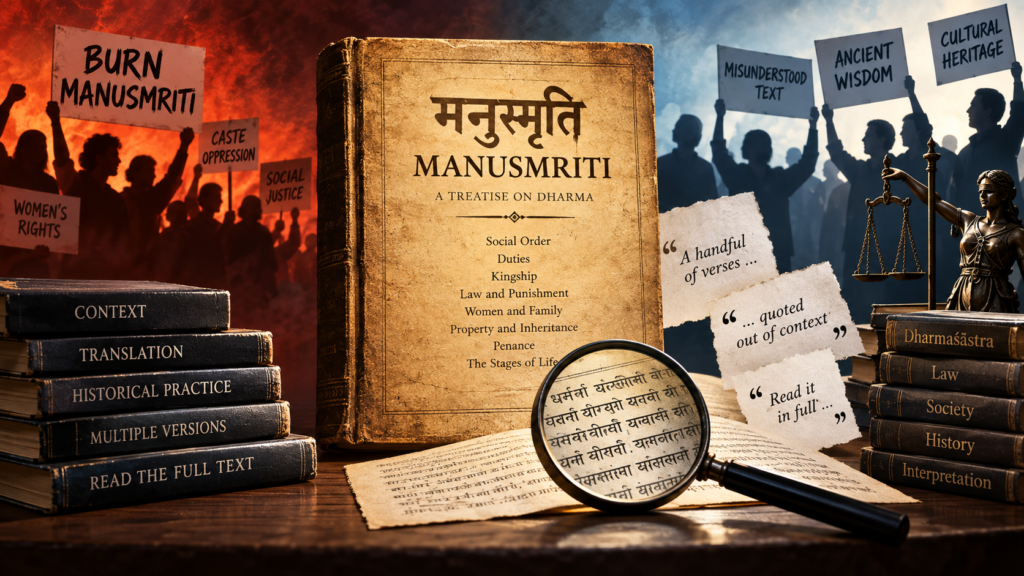
Manusmriti has a reading problem (Image by AI)
The Manusmriti is usually argued about without being read.
That may sound unfair, especially when the text contains passages that are plainly disturbing to modern readers. It does. There are verses dealing with caste hierarchy, women’s conduct, sexual offences and punishment that can be — and have been — subjected to severe moral criticism.
But there is another problem with the way the Manusmriti enters public debate. A complex Sanskrit text is frequently reduced to a handful of verses, quoted in isolation and then made to stand for the entire work. The opposite mistake is just as easy: selecting a few passages that appear benign or even admirable and presenting them as proof that the text has been misunderstood.
Neither approach is really reading.
The more difficult task is to ask what the Manusmriti actually is, what it says across its twelve chapters, how its prescriptions fit together, how its verses have been transmitted and translated, and — crucially — what relationship its prescriptions had to law and social practice.
That does not require defending the text. Nor does it require rehabilitating it.
It requires reading it before passing judgement.
The first problem is treating the Manusmriti as a single argument
The Manusmriti, or Mānava-Dharmaśāstra, is a large Sanskrit treatise dealing with dharma. It is not a modern statute book organised around a single question.
Its subject matter ranges widely: social duties, stages of life, ritual obligations, kingship, judicial procedure, property, inheritance, sexual conduct, punishment, penance and the duties assigned to different social groups.
That matters because a text this broad cannot be fairly represented by one quotation — however outrageous that quotation may be.
The reverse is also true. A favourable verse cannot erase an objectionable one.
The proper unit of judgement is therefore the text as a whole, while individual verses must still be judged for what they actually say.
That sounds obvious. In the Manusmriti debate, it is not.
The second problem is that “law” can be a misleading label
One of the easiest ways to misunderstand the Manusmriti is to imagine it as something equivalent to a modern criminal or civil code.
Scholars of Hindu law have long pointed out that dharma is broader than what modern English calls law. Dharmashastra texts contain legal rules, but also religious duties, moral norms, ritual prescriptions and social obligations. The relationship between those textual prescriptions and actual legal practice in premodern India was neither simple nor uniform.
American Sanskrit scholar Donald R. Davis, for example (because Western scholars are prejudiced to be neutral in India), describes classical Hindu law as a varied collection of local legal systems connected by a common jurisprudential tradition represented by Dharmashastra, rather than a single uniform legal system imposed everywhere by one book.
That distinction does not make the Manusmriti’s prescriptions harmless.
It makes the historical question more precise.
There is a difference between saying:
“The Manusmriti prescribes X.”
and saying:
“This was the law that all Hindus followed.”
The first can often be established by reading the text. The second requires evidence about historical practice — and that evidence is much more complicated.
Then there is the problem of selective reading
Take punishment.
The Manusmriti contains strikingly severe punishments. In Chapter 8, for instance, it prescribes mutilation and fines for some sexual offences. One verse specifies that a man who forcibly violates a maiden is to have two fingers cut off and pay a fine. Another prescribes punishment for a woman who sexually violates a maiden.
These passages do not demonstrate that the text is egalitarian. They do not cancel its caste hierarchy or its restrictions on women.
But they do demonstrate something important about the reading problem: the text cannot be understood by collecting only the verses that produce the desired political conclusion.
The same principle should apply when the conclusion is favourable to Manu.
If someone cites passages praising women and stops there, the reading is incomplete.
If someone cites only its most offensive prescriptions and treats those verses as the entire work, that reading is incomplete too.
A serious examination has to hold contradictory material together.
The third problem is translation
The Manusmriti is a Sanskrit text transmitted through manuscripts and translated repeatedly into modern languages.
That makes the exact wording of a verse important.
Sri Lankan-born Indologist and a Sanskrit a professor of Indian religions in the University of Texas Patrick Olivelle’s critical edition and translation is significant here because it does not simply reproduce one received version. It reconstructs a critical Sanskrit text, records significant manuscript variants and provides explanatory notes and a comprehensive introduction.
That is not an academic technicality.
If a debate depends upon one particular English rendering of a Sanskrit verse, the reader should be able to ask: Which edition? Which manuscript tradition? Which translation? What does the surrounding passage say?
A viral quotation rarely provides any of that.
This does not mean every controversial verse is a mistranslation. It means that translation should not be treated as an invisible step between the ancient text and the modern political argument.
But reading the whole text does not mean excusing it
This is where the debate often becomes confused.
To insist on reading the Manusmriti fully is not to argue that everything in it should be defended.
A reader can conclude that a text contains discriminatory or morally unacceptable prescriptions after reading the entire work.
In fact, that judgement can become stronger after fuller reading.
The point is not that context makes an offensive passage acceptable.
Context tells us what the passage means within the work.
That distinction matters.
A text can contain sophisticated discussions of governance, duties, penance or social responsibility and simultaneously prescribe a deeply hierarchical social order. Finding one does not require denying the other.
Nor does criticism require pretending the text is simple
The Manusmriti is particularly susceptible to simplification because modern arguments often want it to serve as evidence for a larger proposition.
For critics, it can become proof of the historical oppression of lower castes or women.
For defenders, it can become a misunderstood ancient text whose troubling verses are dismissed as interpolations, mistranslations or products of a different age.
Both positions can contain legitimate questions.
But neither should be allowed to replace textual examination.
The harder question is always:
What does the text actually say, across the text?
And after that:
What authority did those prescriptions actually possess in different historical settings?
Those are separate questions.
The Ambedkar question is also a reading question
The burning of the Manusmriti at Mahad in December 1927 cannot be reduced to a literary exercise. It was a political and social act associated with BR Ambedkar’s struggle against caste oppression. The Supreme Court’s historical account describes the burning as a symbolic rejection of the foundations of the caste system.
Ambedkar himself explained the act in terms of the Manusmriti’s role, in his view, in sanctifying the oppression of the so-called Untouchables.
That history matters because it explains why the Manusmriti is not merely another ancient book in contemporary India.
But even here, two questions should not be collapsed into one.
One is:
Why did Ambedkar and his followers choose to burn it?
The other is:
What does the Manusmriti actually contain?
The first is a question of history and politics.
The second is a question of reading.
They inform each other, but they are not interchangeable.
Read it whole — and then argue
There is a temptation to turn the Manusmriti debate into a choice between two camps: those who want to burn it and those who want to defend it.
That is too easy.
A more intellectually demanding position is possible.
Read the text.
Read a serious translation.
Look at the Sanskrit where necessary.
Check the surrounding verses rather than circulating isolated quotations.
Distinguish the text’s prescriptions from evidence of actual historical practice.
Look at how the text fits within the wider Dharmashastra tradition rather than treating it as the only ancient Hindu normative text.
And then make the judgement.
That judgement may be harsh.
It may conclude that particular prescriptions are indefensible, that its social hierarchy is objectionable, or that its historical authority deserves rejection.
None of those conclusions requires selective reading.
Indeed, they are more defensible when they survive complete reading.
The real problem with the Manusmriti debate, then, is not simply that Indians disagree about an ancient text.
It is that too much of the disagreement takes place before the reading has begun.
The Manusmriti does not need to be defended from every criticism.
Nor does it need to be condemned by reducing it to a handful of verses.
It needs to be read closely enough that whatever judgement follows is actually a judgement on the text — not on a quotation, a translation, a political memory or an argument someone else has already made.