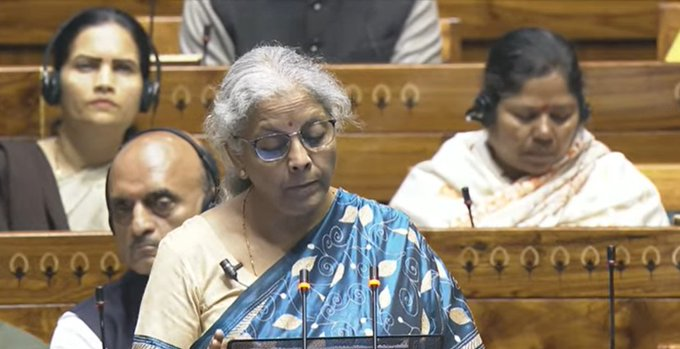
Union Finance Minister Nirmala Sitharaman presenting a vote on account on February 1, 2024, in the Lok Sabha.
A vote on account is Parliament’s permission to the government to use money from the exchequer to pay for essential expenditures for a few months, usually three to four, during a period when regular permission to use the money, through budget, is not available, as happens in an election year. It also allows the government to collect taxes from the people and businesses beyond March 31 in the absence of any law governing taxation during that period.
Every budget is a law, whose validity exists from April to March for a year. Budget becomes a legal instrument only after Parliament gives its approval of the proposals, of taxes to be levied on the people and businesses and expenditure made for welfare and security of the nation, contained in it.
Why no regular budget
In the election year, the government or Parliament is not authorised to propose or vote for a revenue collection or expenditure plan beyond March 31 due to absence of sovereign mandate, i.e. authorisation from “We, the people of India”. People vote for a Lok Sabha for a period of five years. The Members of Parliament (MPs) cannot vote for a period beyond their tenure or loosely said validity. So, a regular budget is proposed and approved by those comprising freshly elected MPs of the Lok Sabha.
The origin
Vote on account is a provision devised for interim period like this. However, the first vote on account was not presented in an election year. It was presented in 1948 by then Finance Minister RK Shanmukham Chetty, who followed it up with a regular budget. The practice has continued since then.
Not sacrosanct
Going by the logic of democracy, a vote on account should not alter tax regime or make fresh policy decisions for the next fiscal. But in recent times, the outgoing finance ministers have not strictly adhered to this principle.
In 1991 before Manmohan Singh announced his economic reforms as finance minister of the PV Narasimha Rao government, the outgoing Finance Minister Yashwant Sinha of Chandrashekhar government made the policy announcement of 20 per cent disinvestment in certain public sector units (PSUs).
At that time, India was facing its worst balance of payment crisis. This was the first policy on disinvestment. Manmohan Singh followed it up with more nuanced liberalized economic policy of India.
BJP did it
In 2004, Jaswant Singh allowed Indians travelling abroad or returning home from abroad to carry up to Rs 25,000 as baggage allowance. It was a major policy decision of the time. He also reduced certain customs duties – peak duty on non-farm goods slashed to 20 per cent from 25 per cent, special duty on customs duty of 4 per cent was abolished. He also merged the dearness allowance of the central government employees with their basic salaries. The government was going into the election equipped with a feel-good factor for its employees.
Congress too
In 2009, Pranab Mukherjee, as finance minister, revised the fiscal deficit target from 2.5 per cent to 6 per cent. He presented a vote on account in February but before that in January he had announced tax cuts worth Rs 40,000 crore.
In 2014, P Chidambaram, then finance minister, altered indirect tax rates related to capital goods and consumer non-durables. Excise duty on small cars, special utility vehicles (SUVs) and two-wheelers, and mobile phones was slashed.
Even the Modi government
In 2019, the stand-in finance minister Piyush Goyal did not have much elbow room to maneuvre as indirect tax rates, the large part of taxation, can now be altered only by the Goods and Services Tax Council (GST Council).
But he announced the launch of PM-Kisan scheme, an important policy announcement against the backdrop of Rahul Gandhi’s Nyay formula of ensuring a minimum income of Rs 72,000 a year for everybody. Goyal said, “Our government is launching a historic programme PM-KISAN with an outlay of Rs 75,000 crore for the FY 2019-20 and Rs 20,000 crore in the Revised Estimates of FY 2018-19.”
In 2024, Nirmala Sitharaman largely stayed stuck to the original mandate of a vote on account presentation, not making too many new announcements. She, however, said the government will launch a housing scheme for deserving middle-class people to buy or build their own houses, expressing confidence that the government would be voted back to power and under the circumstances, the parliamentary election cannot be considered as a disruption or obstruction in the path of government’s welfare or corrective or reform policies.