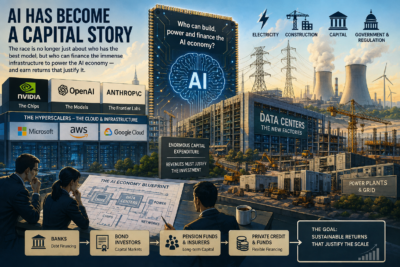
The next AI race isn’t just about who builds the smartest model. It’s about who can afford to build the enormous machine needed to run it.
For the past few years, the artificial intelligence story has been told almost like a technology fairy tale.
There was ChatGPT.
Then came Claude, Gemini, Grok and a growing cast of increasingly capable machines that could write essays, generate software, analyse documents, create images, reason through problems and, occasionally, make us wonder whether we were watching the beginning of something genuinely transformative.
The great question seemed obvious:
Who has the best AI?
OpenAI? Anthropic? Google? Meta? xAI? Perhaps somebody we haven’t heard of yet?
But something rather important has happened while we were busy arguing about models.
The AI race has quietly become a capital race.
And that changes the story.
Because the next question isn’t simply who can build the smartest model.
It is:
Who can afford to build the enormous physical infrastructure required to make AI work at scale — and, eventually, make enough money from it to justify the bill?
That is a much bigger question.
And perhaps a more uncomfortable one.
The astonishing thing about AI is that it isn’t really weightless
We tend to think of software as something almost magical.
You type a question into ChatGPT. A few seconds later, an answer appears.
There is no factory. No lorry arrives at your door. No warehouse is visible.
It feels as though the product exists somewhere in the cloud.
But the cloud is not a cloud.
It is buildings.
Very large buildings.
Inside them are enormous numbers of specialised computer chips. They consume extraordinary amounts of electricity. They need cooling systems, networks, backup power and increasingly sophisticated infrastructure to keep thousands of machines working together.
And those machines are expensive.
Very expensive.
The modern AI economy therefore requires something rather old-fashioned:
capital.
Lots of it.
Meet the new industrialists
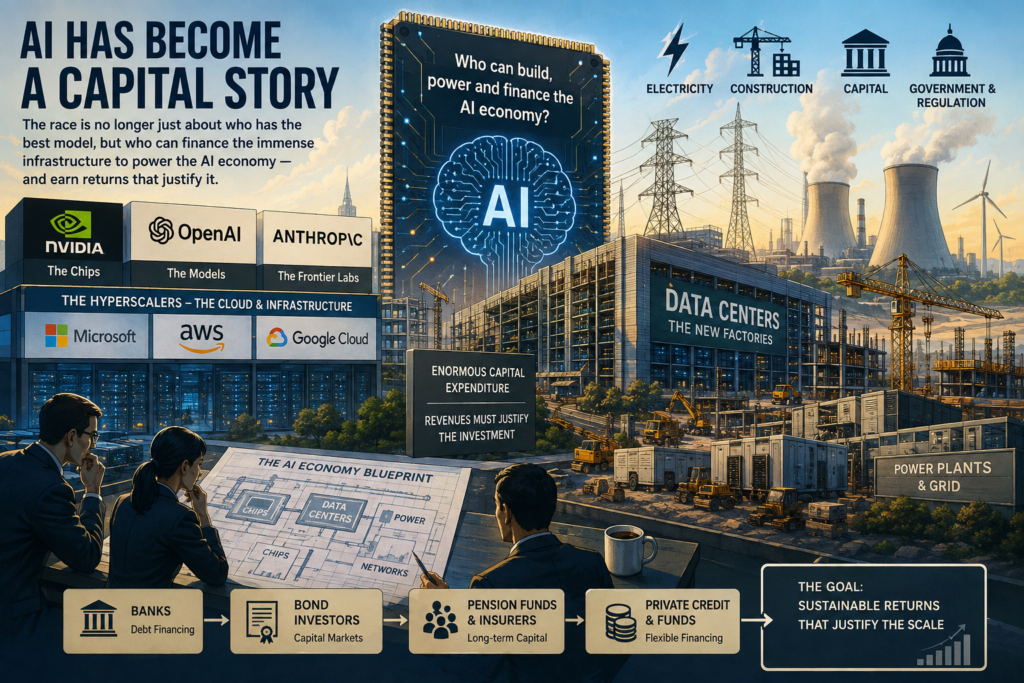
This is where companies such as Nvidia, OpenAI, Anthropic and the giant cloud providers suddenly become part of the same story.
They may appear to occupy different worlds.
Nvidia makes chips.
OpenAI makes AI models.
Anthropic makes Claude.
Microsoft, Amazon and Google operate enormous cloud businesses.
But economically, they are becoming increasingly interconnected.
Think of it as a new industrial chain.
Nvidia makes some of the most important machinery.
The cloud companies provide the factories.
OpenAI and Anthropic build the intellectual products that run inside those factories.
And investors are being asked to finance the entire ecosystem.
That is why an apparently unrelated collection of announcements starts to make sense when you put them beside one another.
Nvidia has become something more than a chip company
Consider Nvidia.
A few years ago, many ordinary people would have struggled to explain exactly what the company did.
Today, its name has become almost synonymous with the AI boom.
Why?
Because modern AI requires enormous computing power, and Nvidia has become the dominant supplier of the specialised processors used for much of that work.
Every time an AI company wants to train a larger model, serve more users or build increasingly sophisticated AI agents, somebody needs to provide the computing infrastructure.
That somebody often leads back to Nvidia.
But here’s the fascinating part.
Nvidia doesn’t necessarily need to know which AI company ultimately wins.
If everybody is racing to build bigger AI systems, everybody needs computing.
The race itself creates demand for Nvidia’s machinery.
That makes Nvidia one of the great infrastructure beneficiaries of the AI boom.
But then comes the uncomfortable question
Suppose you spend billions — or tens of billions — building AI infrastructure.
How do you get your money back?
This is where the story becomes much more interesting.
Imagine that an AI company spends enormous amounts of money on chips, data centres, electricity and engineers.
It then offers you an AI assistant for a relatively modest monthly subscription.
Perhaps you pay ₹2,000 or ₹3,000 a month. Perhaps a large company pays considerably more.
But behind your monthly subscription may be a vast machine costing billions of dollars.
The economics have to work eventually.
And that is the question investors are beginning to ask.
Will they?
The AI industry’s extraordinary spending spree
For years, investors were remarkably willing to accept enormous expenditure.
The argument was simple.
AI is potentially revolutionary.
If you are building the infrastructure of the next technological revolution, spending aggressively today may be perfectly rational.
After all, Amazon spent enormous sums building its logistics network before everyone understood what e-commerce would become.
Telecom companies built huge networks before mobile internet became ubiquitous.
Railway companies built railways before entire economies reorganised around them.
Infrastructure often comes before demand.
But there is a difference.
AI infrastructure is arriving at an astonishing speed.
And the numbers are becoming so large that they are beginning to attract a different kind of attention.
Not just from technology investors.
From banks, bond investors, pension funds, insurers and private-credit firms.
And that brings us to Anthropic
Anthropic is a particularly interesting example.
The company behind Claude has emerged as one of OpenAI’s most serious competitors.
Its models are increasingly used by businesses and developers, and its revenue expectations have risen dramatically.
Investors are consequently assigning enormous valuations to the company.
But look beneath the headline valuation.
A company like Anthropic needs vast computing resources.
Those resources have to be paid for.
And the more successful Claude becomes, the more computing Anthropic needs.
That produces an unusual relationship:
Success itself can make the business more expensive to operate.
If ten million people use your AI system, wonderful.
If 100 million use it, even better.
But somebody has to pay for all those additional calculations.
This is not like selling another digital copy of a book.
Every interaction requires computing.
And sophisticated AI models can require a lot of it.
OpenAI faces the same problem
OpenAI illustrates the same paradox even more dramatically.
ChatGPT became a global phenomenon almost overnight.
But its success created a problem of its own.
Millions — then hundreds of millions — of people wanted to use the system.
That meant more servers. More chips. More data-centre capacity. More electricity. More engineers. More money.
The better the product became, the greater the demand.
And the greater the demand, the more infrastructure OpenAI needed.
This is why the company’s financial requirements are becoming almost as fascinating as its models.
OpenAI isn’t simply trying to build an AI company.
It is effectively helping build an AI utility.
And utilities require infrastructure.
The hyperscalers enter the picture
Now add Microsoft, Amazon and Google.
These companies are sometimes called hyperscalers because their cloud businesses operate at extraordinary scale.
They are building or financing enormous data-centre networks capable of supplying AI companies and their own AI products with computing power.
This is where the AI story starts to resemble an industrial boom.
Imagine someone in the early days of electricity saying:
“I think electricity is going to change everything.”
They would have been right.
But the interesting investment opportunity wasn’t just in inventing appliances.
Someone had to build power stations.
Someone had to lay cables.
Someone had to build substations.
Someone had to finance all of it.
AI is increasingly beginning to look like that.
The electricity problem
And then there is something that doesn’t get enough attention in the glamorous AI conversation.
Electricity.
AI data centres consume enormous amounts of power.
The machines need electricity to operate.
They also produce heat.
So they need cooling.
Which requires more energy.
That means the AI boom is increasingly connected to power generation, transmission networks, transformers, cooling systems and even the availability of suitable land.
Suddenly, the AI story includes:
chips + data centres + electricity + construction + financing.
That is not merely a software story anymore.
It is an industrial story.
The new question for investors
This is why I think the most interesting question about AI has changed.
A few years ago, investors asked:
Who has the best model?
Then:
Who has the most users?
Now increasingly:
Who can finance the infrastructure?
And eventually the question becomes:
Who can earn enough from that infrastructure to justify what has been spent on it?
Those are not the same thing.
A company can have the world’s best AI model and still struggle economically if every user interaction costs too much.
Conversely, a company with a slightly less impressive model might build a better business if it can deliver the service more efficiently.
That means efficiency may become as important as intelligence.
This is where Nvidia’s position becomes fascinating
For Nvidia, the spending race is enormously attractive.
The more companies build AI infrastructure, the more chips they need.
But Nvidia is also becoming part of a larger ecosystem in which its customers need to earn returns on those investments.
If the AI industry eventually discovers that it has built too much computing capacity too quickly, the consequences could travel backwards through the supply chain.
That doesn’t mean an AI crash is inevitable.
It means something more interesting:
The infrastructure boom has to be matched by an economic boom.
And what if the revenues arrive?
This is the optimistic case.
AI genuinely transforms productivity.
Companies use AI agents to automate routine work.
Software developers become dramatically more productive.
Customer-service operations shrink.
Scientific research accelerates.
Businesses discover entirely new products.
People start paying substantial amounts for AI.
Corporate AI spending explodes.
Governments adopt AI.
Entire industries reorganise around it.
If that happens, today’s extraordinary infrastructure spending could eventually look cheap.
The people building data centres today could turn out to have built the factories of the next economic era.
But there is another possibility
What if AI becomes extremely useful but not sufficiently profitable?
What if companies discover that they can use AI to save money but aren’t willing to pay AI providers enough to cover the enormous cost of running the systems?
What if computing becomes cheaper so rapidly that today’s expensive infrastructure loses value?
What if competitors keep cutting prices?
What if open-source models reduce the pricing power of the big AI companies?
And what if investors have simply assumed that future AI revenues will be much larger than they eventually turn out to be?
These aren’t arguments against AI.
They are arguments for taking AI economics seriously.
The dot-com comparison is tempting — but incomplete
There is an obvious historical comparison.
The late 1990s produced enormous enthusiasm for the internet.
Companies raised extraordinary amounts of money.
Infrastructure was built.
Valuations soared.
Then the bubble burst.
But something important happened afterwards.
The internet itself didn’t disappear.
Quite the opposite.
The infrastructure built during the boom helped create the next generation of successful companies.
Amazon survived.
Google emerged.
Online commerce exploded.
The technology ultimately transformed the economy.
That is why saying “AI is a bubble” doesn’t actually answer the important question.
There could be an AI investment bubble and an AI revolution at the same time.
Those two things are not mutually exclusive.
The real AI race may therefore be a race to scale
And this is where the story comes full circle.
OpenAI wants more computing.
Anthropic wants more computing.
Google wants more computing.
Microsoft wants more computing.
Amazon wants more computing.
Meta wants more computing.
And all of them are competing for the same scarce ingredients:
chips, electricity, data-centre capacity, engineers and money.
Nvidia supplies some of the machinery.
The hyperscalers provide much of the infrastructure.
AI companies provide the applications and models.
Banks and investors provide the capital.
Energy companies provide the electricity.
Construction companies build the data centres.
And governments increasingly have to figure out how to provide the power grids and regulatory environment required to support all of it.
This is beginning to look less like a software race.
It looks like an industrial mobilisation.
So who will win?
We don’t know.
And perhaps that is the most interesting part.
OpenAI may dominate.
Anthropic may become the preferred enterprise AI company.
Google may leverage its extraordinary computing infrastructure to regain the lead.
Microsoft and Amazon may capture enormous value through their cloud platforms.
Nvidia may remain the indispensable supplier — or eventually face serious competition.
New companies may emerge that we haven’t even heard of yet.
But one thing increasingly looks clear.
The AI revolution will not be decided solely inside a laboratory.
It will be decided in data centres, power plants, boardrooms and financial markets.
The smartest model may not necessarily win.
The company that raises the most money may not necessarily win either.
The eventual winner may be the one that finds the most sustainable answer to a deceptively simple question:
How do you turn an extraordinarily expensive machine into an extraordinarily profitable business?
That may be the defining economic question of the next phase of the AI revolution.
Because the first phase of AI was about teaching machines to think.
The next phase may be about figuring out how to pay for all that thinking.