History often begins not with kings or wars, but with words.
Imagine travelling back nearly three thousand years and asking a Vedic sage: “Are you a Hindu?” The question would likely have puzzled him—not because the civilisation existed in a different form, but because the word itself had not yet entered the vocabulary of the Vedic hymns.
The history of Hindu begins with a river, moves through Iranian and Greek languages, enters Arabic and Persian usage, and only much later acquires the religious meaning familiar today.
I am writing this as a response to a Facebook post by a sectarian influencer, who has a huge following on social media. He claims that Hindu as a concept or word didn’t exist before the advent of Muslims or Islam in India or Muslim victors of India. (These are his wordings.) My purpose is not to distinguish between Hindustan and Muslims but offering an informed debate so that the Hindu-Muslim identity crises could be understood under the lamp-post of history. Geography or geographical belief or ideology can’t be treated as universal identity and should never be invoked to fan passion in the present to influence the future.
Before there was Hindu
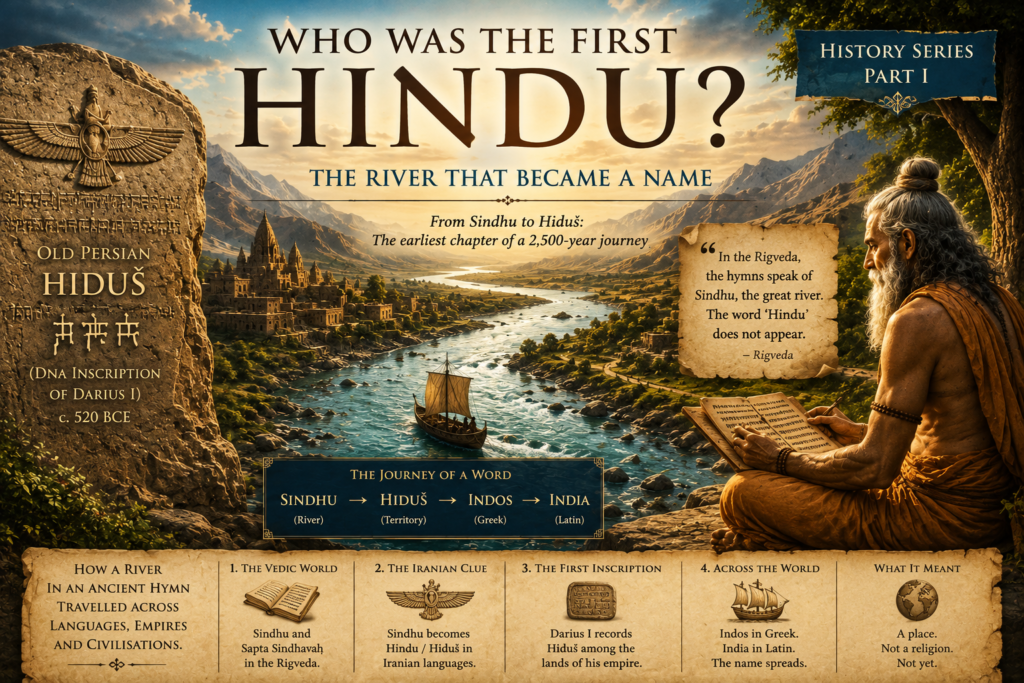
In the received text of the Rigveda Samhita, the word “Hindu” does not appear. The hymns instead use sindhu, associated with rivers and, in important passages, the Indus.
The Rigveda contains Sindhu and Sapta Sindhavaḥ (“seven rivers”), but not Hindu.
This does not mean the traditions later grouped under Hinduism did not exist. It means the history of those traditions and the history of the label are different questions.
A river that became a name
Sindhu was a geographical word. Its descendants would travel far beyond the river itself.
Sanskrit and Iranian languages share an Indo-Iranian inheritance, but developed differently. One Iranian sound change allowed inherited initial Sanskrit s to correspond to Iranian h.
The linguistic clue
Sapta → Hapta
Sindhu → Hindu/Hiduš
The Avestan expression hapta həṇdu (“seven rivers”) closely parallels Vedic Sapta Sindhavaḥ. This is evidence for the linguistic relationship; it was not simply a matter of Persians being unable to pronounce “s”.
The first appearance we can date
During the reign of Achaemenid king Darius I (522–486 BCE), Old Persian royal inscriptions use Hiduš for an eastern territory associated with the Indus region.
Hiduš appears in Darius’ royal inscriptional corpus, including the DNa inscription at Naqsh-e Rustam. The word denotes a territory, not a religion.
Popular accounts sometimes attribute the earliest occurrence solely to Behistun. More precisely, the relevant evidence comes from Darius’ wider royal inscriptional corpus, especially Persepolis and Naqsh-e Rustam.
What did ‘Hidus’ mean?
The answer is simple: a place. It did not mean Hinduism or describe a single religious community. It functioned as a geographical and administrative name within the Achaemenid imperial world.
PART II
A word can cross borders without carrying its old meaning intact. Once Hiduš entered Persian imperial vocabulary, it became available to cultures that encountered the lands beyond the Indus.
The Greeks and their ‘India’
Greek forms such as Indos and Indoi belong to the same historical chain linking Sanskrit Sindhu and Iranian Hindu/Hiduš. Greek and later Latin usage gave the wider world the geographical name India.
Sindhu → Hindu/Hiduš → Indos → India is a useful shorthand for a complex history of transmission across languages.
From “Hindu” to “Hind”
Arabic and Persian writers came to use al-Hind for the Indian subcontinent. The expression was geographical and cultural before it became a fixed religious label.
Al-Biruni
Abu Rayhan al-Biruni (973–c.1050) learned Sanskrit and wrote the celebrated Kitab al-Hind, a detailed account of Indian beliefs, sciences, customs and philosophy.
Al-Biruni’s work shows the diversity of Indian philosophical and religious traditions rather than a centrally organised single faith.
When does ‘Hindu’ become a label for people?
There is no single date. The evidence points to a long transition in which “Hindu” could be geographical, cultural, ethnic or communal, often in contrast with Muslim identities in Persianate political contexts.
Shaivas, Vaishnavas, Shaktas and numerous local traditions retained their own affiliations. A broad label could coexist with narrower identities.
The medieval transformation
By the late medieval period, “Hindu” had accumulated overlapping meanings. This is why translating every premodern occurrence simply as “Hindu” in the modern religious sense can be misleading.
The medieval history of “Hindu” is not a straight line from geography to religion. It is a history of overlapping meanings.
PART III
By the early modern period, “Hindu” had accumulated centuries of history. It could still be geographical or cultural, but it could also serve as a broad category for communities that did not identify with Islam.
The word enters more Indian languages
The history of “Hindu” did not begin with the British. Premodern South Asian sources in Persian, Sanskrit, Prakrit and vernacular languages contain evidence for the word and related forms before colonial rule.
That does not mean “Hinduism” already existed in exactly its modern form. It means the word and related identities have a much longer South Asian history than the claim that the British simply invented them would suggest.
What the British changed
Colonial rule introduced new administrative technologies for classifying populations: censuses, legal categories, education, print networks and comparative religious scholarship. These encouraged grouping diverse practices under large religious headings.
“The British invented Hinduism” is too crude. A more defensible formulation is that colonial-era classification and print culture helped standardise and consolidate a modern conception of Hinduism as a bounded world religion, alongside Indian reform and political movements.
Reform movements and modern identity
Nineteenth-century Indian reformers were active participants in defining Hindu identity. Reform movements debated scripture, ritual, caste, idolatry, monotheism and what should count as authentic Hindu belief.
Print made these debates portable. The word “Hindu” increasingly became a self-conscious umbrella identity while still drawing on much older traditions.
Was ‘Hinduism’ invented by the British?
The most accurate answer is not in the simple sense. The word’s ancestry reaches back more than two millennia in its earliest attested forms; geographical and cultural uses long predate British rule.
At the same time, the modern concept of Hinduism as a single named world religion is comparatively recent. Colonial knowledge systems contributed significantly to its standardisation, but they did so alongside Indian intellectual and political movements.
Coming back to: Who was the first Hindu?
If we mean the first person whom we can prove was called a form of Hindu, the evidence does not give us a named individual. The earliest surviving inscriptional evidence is the Old Persian Hiduš, a geographical designation connected with the Indus region in the Achaemenid Empire.
If we mean the first person who used “Hindu” as a religious self-description in the modern sense, there is no identifiable first person. That meaning emerged gradually through centuries of linguistic, political and religious change.
The word is ancient. The modern religious category is not. Both statements can be true at the same time.
The timeline
- Vedic period: Sindhu and Sapta Sindhavaḥ; “Hindu” absent from the received Rigveda.
- Late sixth century BCE: Achaemenid inscriptions attest Hiduš.
- Classical period: Greek Indos/Indoi and Latin India.
- Islamic period onward: al-Hind becomes a standard geographical term.
- Medieval period: overlapping geographical, cultural and communal meanings of “Hindu”.
- Nineteenth century: census, print culture and comparative religion help consolidate “Hinduism” as a modern umbrella category.
The evidence: What we can say, for sure in verdict
We can say: the word’s linguistic ancestry reaches back to Sindhu; Hiduš is securely attested in Achaemenid royal inscriptions; its early meaning was geographical; later meanings accumulated gradually.
We should not say: that the Persians invented a religion called Hinduism, that the British invented the word Hindu, or that all ancient Indians belonged to one religion bearing the modern name Hinduism.
Note: if you want to read further history-proofing, you may consult the following books:
- Audrey Truschke, “Hindu: A History,” Comparative Studies in Society and History
- Al-Biruni, Kitab al-Hind, trans. Edward C. Sachau.
- L. W. King and R. C. Thompson, The Sculptures and Inscription of Darius the Great on the Rock of Behistûn in Persia
- Darius I, Old Persian royal inscriptions, including DNa and Persepolis inscriptions.
- Rigved