How BJP has redrawn West Bengal's political map
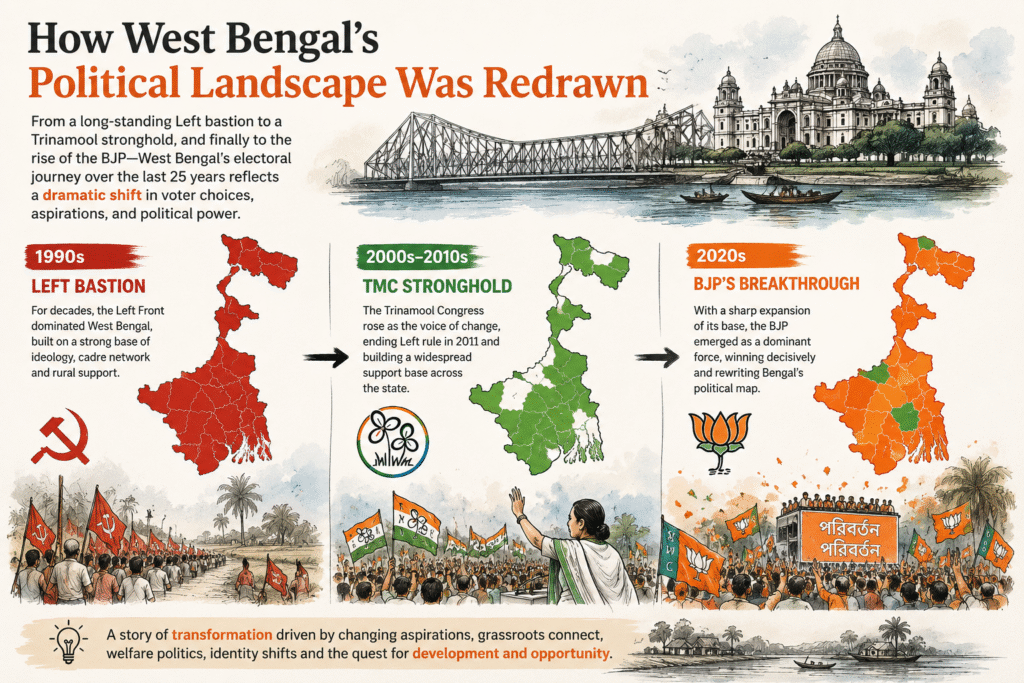
From a long-standing Left bastion to Trinamool Congress dominance and finally the rise of the BJP, West Bengal’s electoral transformation between 2001 and 2026 represents one of the most dramatic political realignments in modern Indian politics.
The political landscape of West Bengal has undergone a dramatic transformation over the last quarter-century, shifting from a long-standing Left bastion to a Trinamool Congress (TMC) stronghold, and finally culminating in a decisive victory for the Bharatiya Janata Party (BJP).
This evolution, reflected in the changing colours of the state’s electoral map over successive elections, captures a profound restructuring of voter priorities, political identity, and party dominance across Bengal.
The Twilight of the Red Era (2001)
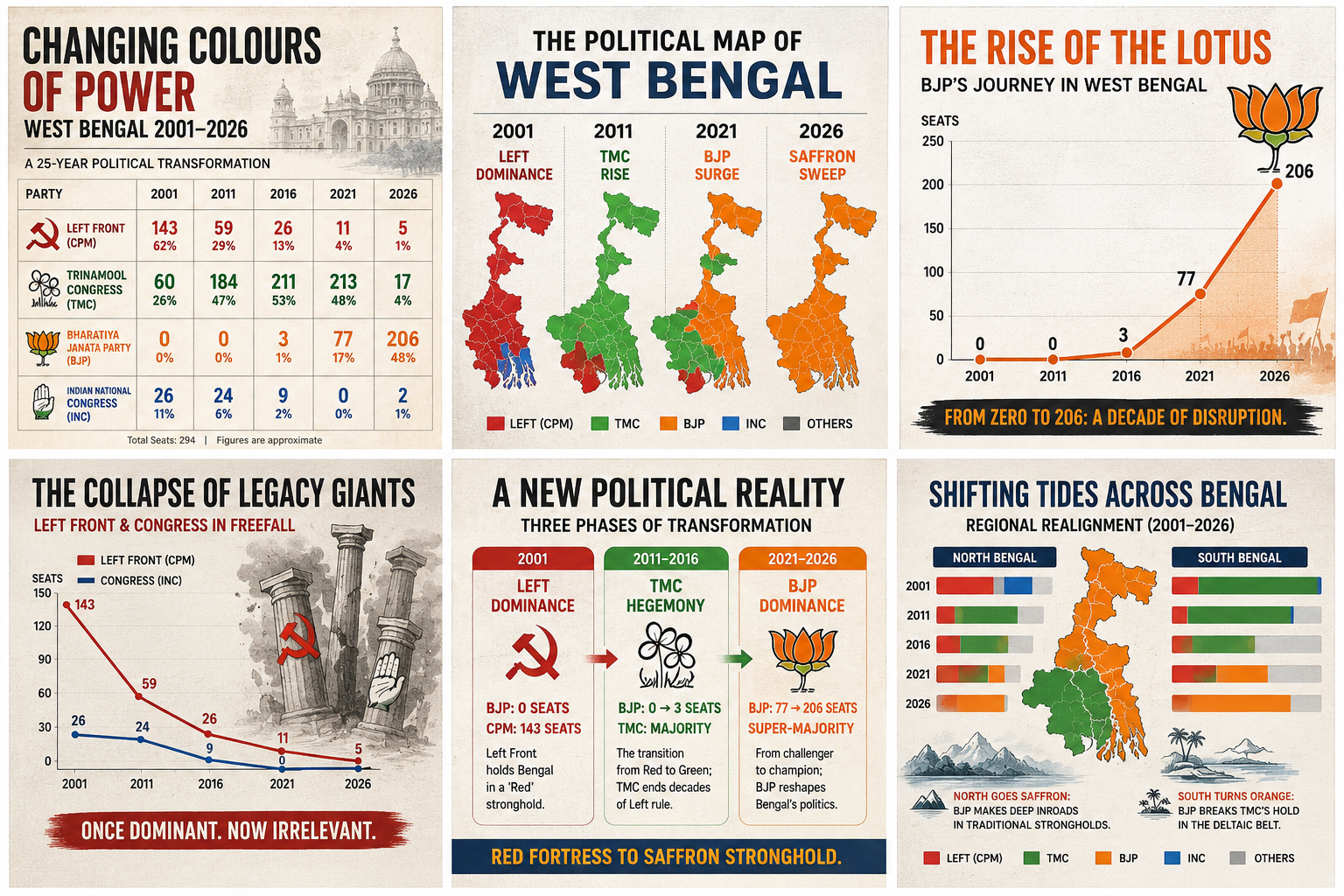
At the turn of the millennium, West Bengal remained firmly under the influence of the Left Front. In the 2001 Assembly Elections, the Communist Party of India (Marxist) [CPM] led the charge with 143 seats, maintaining its position as the dominant political force in the state.
At the time, the BJP had zero representation in the Assembly, while the TMC, with 60 seats, and the Indian National Congress (INC), with 26 seats, functioned as the principal opposition forces. Bengal’s political discourse was largely shaped by the ideological contest between the entrenched Left establishment and the growing populist challenge posed by Mamata Banerjee’s Trinamool Congress.
The Rise and Consolidation of the Trinamool (2011–2016)
The decade following 2001 witnessed a gradual erosion of the Left’s “Red” dominance. By 2011, Bengal’s political map had begun turning “Green,” symbolising the rise of the TMC as the state’s dominant political force.
Although the BJP still held zero seats in 2011, the TMC succeeded in ending decades of uninterrupted Left rule, fundamentally altering the political equilibrium of the state.
By 2016, the TMC had consolidated its hold across much of Bengal. The BJP registered only a modest presence with three seats, appearing as a small saffron footprint within an electoral landscape overwhelmingly dominated by TMC green, alongside shrinking pockets of CPM red and Congress blue.
At this stage, the BJP was still widely perceived as a marginal player in Bengal’s deeply regional political structure.
The 2021 Inflection Point
The 2021 Assembly Elections marked a major political turning point and the beginning of what many analysts described as Bengal’s “Saffron Surge.”
The BJP’s seat tally jumped dramatically from 3 to 77, transforming it into the principal challenger to the TMC. Electoral maps from this phase revealed expanding saffron clusters across Northern and Southwestern Bengal, signalling a widening acceptance of the BJP beyond its traditional urban pockets.
Despite this surge, the TMC retained power by holding onto large sections of Southern Bengal and the deltaic belt, preserving its statewide majority.
The Saffron Takeover of 2026
The 2026 Assembly Elections represented a complete upheaval of Bengal’s traditional political order.
The BJP achieved a sweeping victory, securing 206 seats and effectively taking control of the state’s political machinery. The electoral map from this phase displayed saffron dominance across nearly every district, leaving only isolated pockets of TMC green.
The result marked the collapse of Bengal’s earlier political binaries and signified the emergence of a new ideological and electoral consensus.
Bengal: A New Political Reality
The electoral trajectory between 2001 and 2026 reveals three distinct phases in West Bengal’s contemporary political history:
- Left Dominance (2001):
A period in which the BJP remained a non-entity with zero seats, while the CPM-led Left Front retained overwhelming control. - TMC Hegemony (2011–2016):
The transition from Red to Green, accompanied by the BJP’s slow but visible rise from zero to three seats. - Bipolarity to BJP Dominance (2021–2026):
A rapid saffron expansion from 77 seats in 2021 to a commanding super-majority of 206 seats in 2026.
This shiws that the BJP’s rise in Bengal was not merely incremental but exponential in its later stages. The simultaneous collapse of the Left and Congress — once the defining pillars of Bengal politics — alongside the eventual displacement of the TMC, reflects a complete restructuring of the state’s political identity.