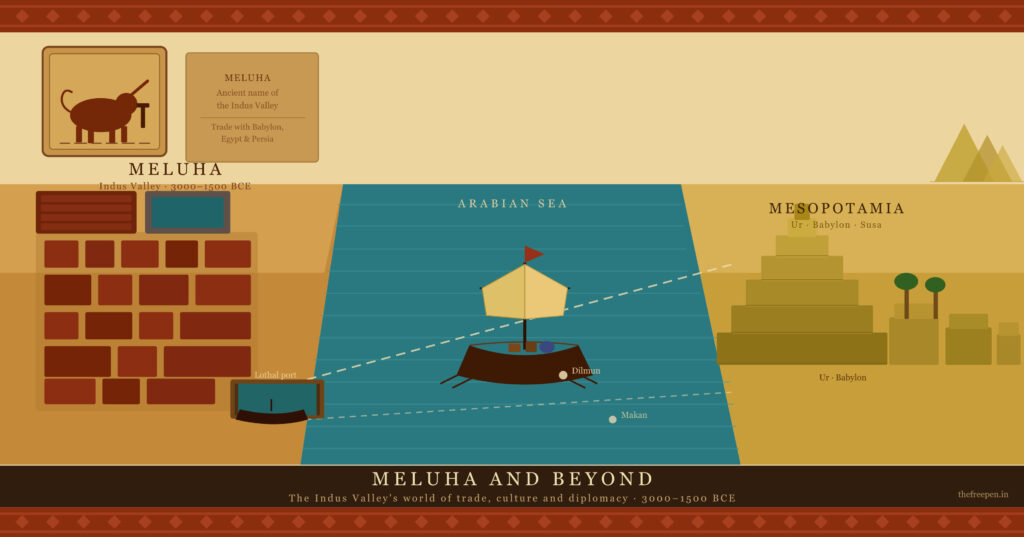
AI illustration depicting external contacts of the Indus Valley Civilisation
Indians living in Harappan cities had external contact through trade and voyages, and possibly some kind of diplomatic ties as well. Historians including Romila Thapar have favoured identifying the land mentioned by the name of Meluha in ancient Sumerian texts as the geographical region across which Harappan cities and villages were spread.
If established with the possible deciphering of the boustrophedon script of the Indus Valley Civilisation, India’s ancient name would come out to be Meluha — long before it became Jambudweepa during the time of Magadh emperor Ashoka. Mesopotamian texts refer to Makan or Magan, Dilmun, and Meluha. The other two have been identified as Oman and the Makran coast (modern-day Balochistan), and Bahrain respectively.
There is historical evidence to show that boats carried goods from Indus ports to Agate in Babylon after crossing Makan and Dilmun.
Clearly, the Indus people had ties with the outside world. The sources that establish this include Mesopotamian cities, the Egyptian civilisation, Persian sites, Afghanistan, Tibet, and South Indian sites in Karnataka and elsewhere.
The evidence
The evidence for this contact is both material and textual. Articles made of metals not locally available in the natural environment indicate they were brought from outside. Similarly, articles made of stones not locally available show that they were imported — either as raw stones or as finished products.
The famous edict of Ur, which mentions Meluha, Makan, and Dilmun, gives a list of articles sent from Meluha to Agate, identified as southern Babylon. These items are: gold, silver, copper, blackwood, ivory items, beads, and seals. This clearly establishes that Indians of Harappan times were in advanced trade relations with the Babylonians.
Harappan seals and potteries have been found in Sumerian cities such as Ur, Kish, Lagash, and Susa. Noted archaeologist and Sumerologist C J Gadd studied these articles to establish that they were not locally made but came from the Indus region. This is further evidence that the Indus people were in regular contact with other city civilisations of the time.
Syria was the centre of Mesopotamian civilisation during the Indus period, and excavations there have thrown up weights and measures that were in vogue at Harappan sites. Mesopotamians did not use those units of measurement, indicating that an Indus colony might have been established in Mesopotamia to facilitate trade.
It is also no coincidence that Egypt showed usage of the decimal system at the same time as the Indus people. If later centuries were any indication of continuity in civilisational knowledge, the decimal system might have travelled from the Indus region to Egyptian cities.
Another evidence of external contact comes from Lothal, an Indus city in Gujarat. Located on the Bhogavo river, Lothal had a huge port connected to the Gulf of Cambay or Khambhat. The size of the port — capable of handling multiple ships simultaneously — shows that it was a trading port, establishing India’s external contact millennia ago.
Granaries offer another interesting point of historical study. The wedge-shaped cuneiform script of Mesopotamia, once deciphered, has texts talking about granaries — but no building or physical evidence has been found to prove that they existed there. The Indus region, by contrast, is littered with granaries, even as its boustrophedon script remains a mystery. The Mesopotamian people very likely got the idea of the granary from their contemporary Indians.
The Mother Goddess and the Bearded Bull
The worship of the Mother Goddess was an identifying feature of the Harappans. Similar attributes have been found in contemporary Mesopotamian and Egyptian civilisations. It is not clear where the practice originated or how it spread, though the mode of spread looks certain: through the visits of traders. Indian traders possibly took the Mother Goddess worship to other parts of the world, as it remained in the Indian subcontinent despite centuries of invasions and the destruction of its material culture, while it was wiped out from foreign lands.
The Bearded Bull or ram is a common feature of Mesopotamian civilisation — bulls and rams were carved out and depicted with beards. The Indus civilisation might have emulated these bearded bull images from their Mesopotamian counterparts.
Death in dignity
This is a unique feature of the Indian land. Evidence from Harappa and Lothal points to an emphatic regard for those who died on Indian soil but belonged to foreign lands. Indians of the time practised both burial and crematorial rituals. They did not, however, put their dead in coffins. Yet at one place in Harappa, a coffin burial was found — consistent with Mesopotamian practice.
In another example from Lothal, a memorial was built on a grave. Egyptians were known to build such memorials; the pyramids are the most enduring examples of this practice. Giving a funeral to a foreigner according to his or her local customs on Indian land shows the value of tolerance, the ability to co-exist, and respect for all customs and creeds — as well as deep cultural, economic, and possibly diplomatic ties with foreign civilisations. Such funerals might have been arranged in consultation with some kind of diplomatic attaché posted in Indian cities, much like present-day consulates.
The Epic of Gilgamesh
The story of Gilgamesh is more widely known in Egyptian and Mesopotamian cultures, but Harappan sites have yielded seals depicting the story. How this story travelled from one place to another is not a mystery — deep contacts were clearly there, even if the exact origins of the story remain open to speculation.
The Epic of Gilgamesh tells the story of the king of Uruk, believed to have been part god and part human. Initially a tyrannical ruler, he is challenged by the gods, who create Enkidu, a wild man. After a fierce wrestling match, Gilgamesh wins — and the two become close friends. Together, they embark on adventures, including a journey to the Cedar Forest where they kill the monstrous guardian Humbaba and cut down sacred trees.
Later, Gilgamesh rejects the advances of the goddess Ishtar, who sends the Bull of Heaven to punish him. Gilgamesh and Enkidu kill the bull, angering the gods, who sentence Enkidu to death. Devastated, Gilgamesh becomes obsessed with finding immortality. He journeys to find Utnapishtim, the only human granted eternal life after surviving a great flood. Utnapishtim tells Gilgamesh that immortality is reserved for the gods and that humans must accept death. Gilgamesh returns to Uruk, wiser and reconciled to his mortality.
The epic explores themes of friendship, the quest for fame and immortality, the inevitability of death, and the wisdom gained through experience. It is one of the oldest known literary works and has influenced heroic sagas and epics that came after it.
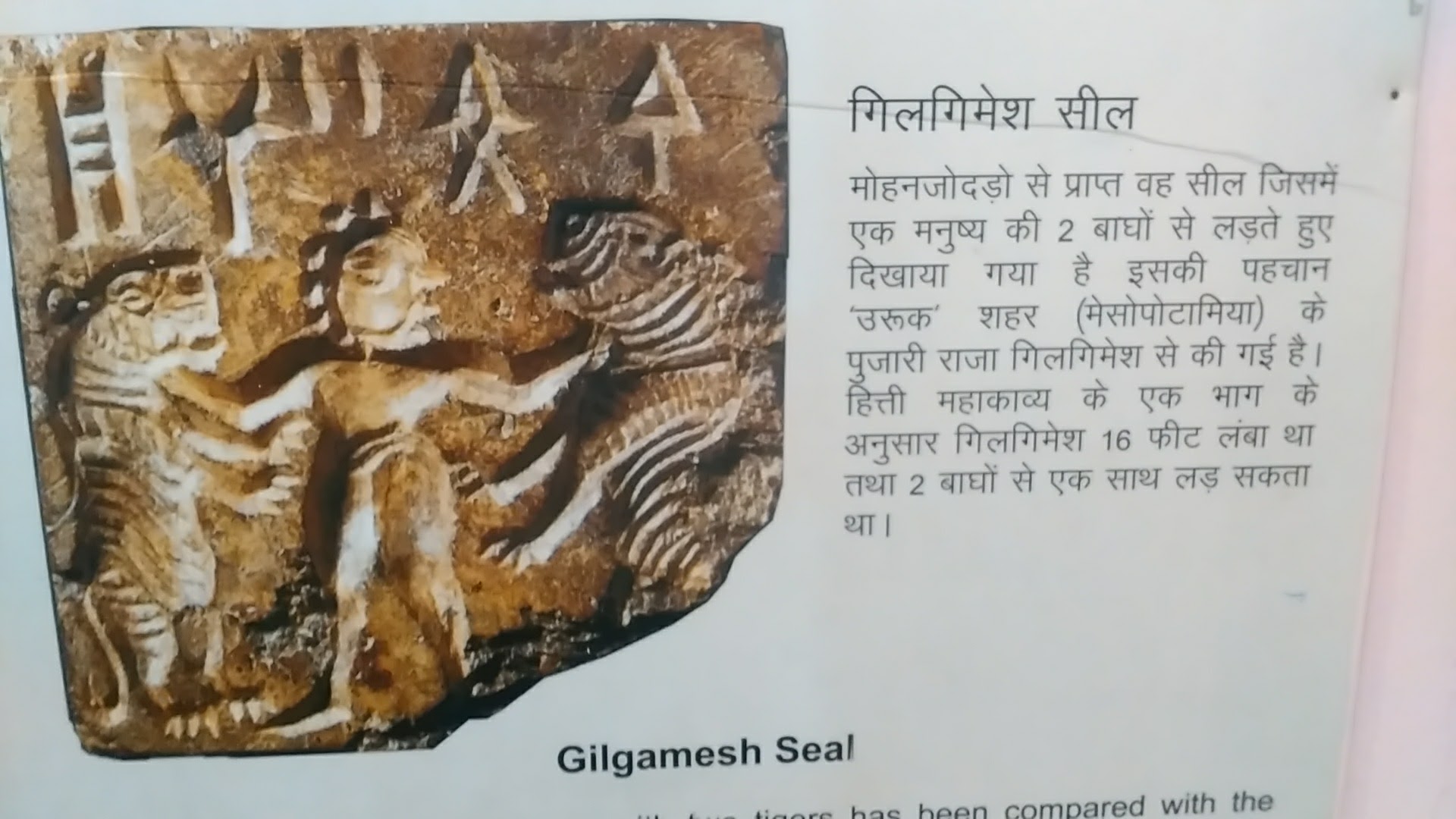
The Persian Seal and the Mesopotamian seal at Alamgirpur
Further evidence of external contact comes from Lothal, where a unique rounded seal has been found. This is consistent with seals made in the Gulf region in that era and points to contact between Indians and Persians. It is perhaps no coincidence that when the Persian people later faced onslaught from outside cultures, a large number of them took shelter in India — and specifically in Gujarat, where Lothal is also situated.
Alamgirpur in Uttar Pradesh’s Meerut district — also the site of the ancient city of Hastinapur — has thrown up a seal showing two bent black kites and a sign of cross. Alamgirpur, known locally as Parshuram Ka Kheda, the village of the legendary fighter-teacher Parshuram, was quite possibly a major centre of ancient trade. A Mesopotamian seal would not otherwise be found at a place hundreds of kilometres from the coast.
Socotra of Yemen and Socotri Devi of Gujarat
Few connections in ancient history are as quietly mesmerising as the one between coastal Gujarat and the island of Socotra, now part of Yemen. Lothal and the rest of coastal Gujarat worship a goddess known variously as Socotri Devi or Sukatara Mata, believed to have the power to safeguard seafarers — particularly those who travelled to Socotra island, which served as a halting port for onward journeys to North and East Africa.
The origin of Goddess Socotri is believed to lie in the faith systems of the Indus Valley Civilisation. The seafarers of present-day Gujarat still worship her before undertaking a sea journey. One theory links the name Socotra itself to a Sanskrit origin: Dvipa Sukhdhara, or the “Island of Bliss”. Possibly, Socotri Devi was originally Sukhdatri Devi — the Mother Goddess of Bliss. Gujaratis still head to Yemen (when its civil war allows) and to Africa. The historical impulse keeps driving them to the same destinations their forefathers once reached.
That red colour
Before the invention of chemical dyes, natural dyes were articles of great value and international trade. Consider the scale and sophistication of the Indus pottery business: they painted their wares with an imported colour. The characteristic red colouring of Indus pottery and wares was imported from Hormuz, a strait located between the Gulf of Persia and the Gulf of Oman. The Indians of that time would not compromise on quality.
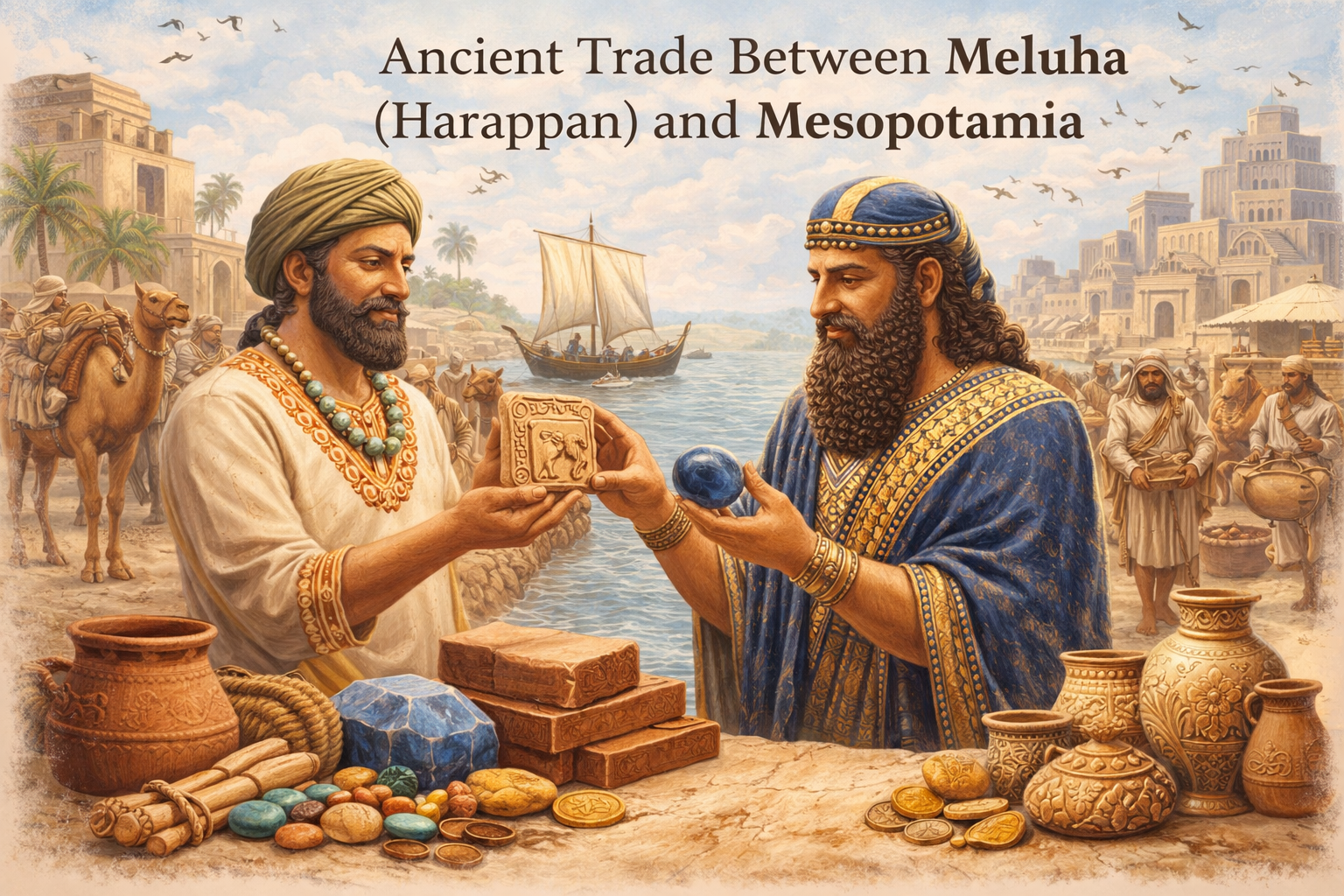
The trade table: What the Indus Valley bought and sold
All these references, taken together, show that the people of the Indus Valley Civilisation had deep ties with nations far and away. The table below summarises what was available locally, what could be sourced from within the subcontinent, and what had to be brought in from abroad.
| Article | Locally available | Nationally available | Needed to be imported |
|---|---|---|---|
| Gold | Yes and no | Kolar (Karnataka); Bhukia-Jagpura area, Banswara (Rajasthan) | |
| Silver | No | No | Iran and Afghanistan |
| Tin | Yes and no | Hazaribagh, Jharkhand | Iran and Afghanistan |
| Copper | Yes | Khetri, Rajasthan | Also from Oman |
| Lead (limited use) | Yes | Rajasthan | Also from Afghanistan |
| Chert stone | Yes | Sukkur, Sindh | |
| Steatite (soapstone) | Yes | Gujarat | |
| Agate (Gomed) | Yes | Saurashtra | |
| Amethyst (Jambumani) | Yes | Maharashtra | |
| Turquoise | Yes | Kashmir | Also from Mesopotamia and Persia |
| Jasper | Yes | Rangpur, Gujarat | |
| Jade / Jadeite (Haritashm) | No | No | Tibet, Pamir, Central Asia |
| Lapis lazuli (Lajvart) | No | No | Badakhshan, Afghanistan |
| Marine products (conch, clam, oyster) | Yes | Lothal; Kot Bala, Balochistan | |
| Asphaltum (Shilajit), medicinal herbs | Yes | Kashmir | |
| Ivory | Yes | Gujarat, mostly Kachchh | |
| Bitumen | Yes | Musakhel, Balochistan | |
| Red dye | No | No | Hormuz (Oman and Persia) |
The Indus people imported gold, silver, tin, lead, red dye, lapis lazuli, jade, and turquoise, among others. They also traded in finished goods: articles made of gold, silver, copper, and ivory; black and red ware pottery; blackwood; carnelian beads; and steatite seals, among other things. Clearly, the Indus society was as vibrant and flourishing as one could imagine for that time — and, quite possibly, more advanced, orderly, and peaceful than many others that have featured on the timescale of history.