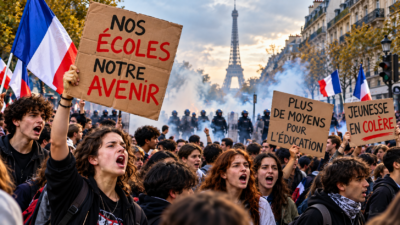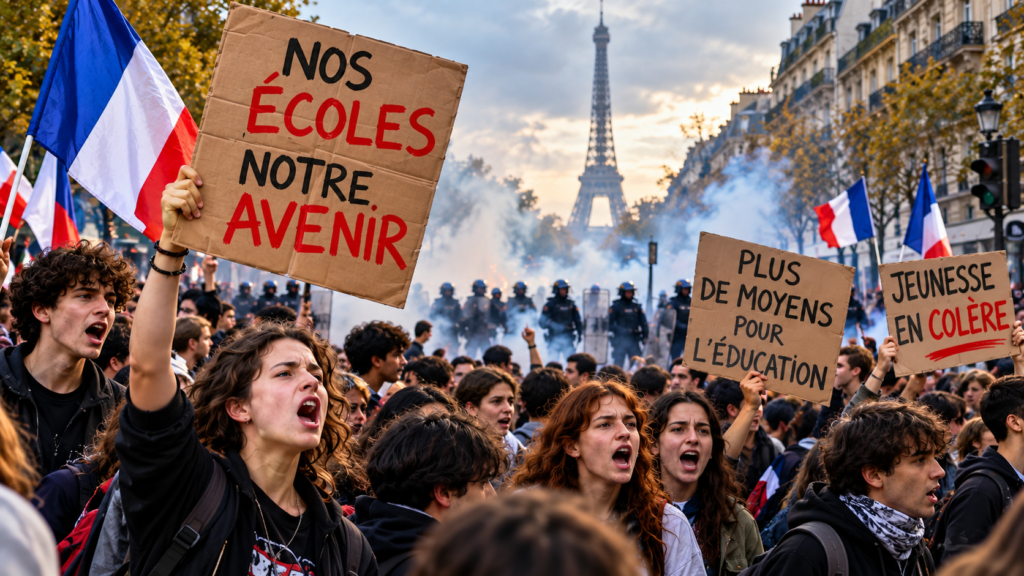
France is facing a new wave of street protests, but this time the anger began inside schools.
For more than two weeks, high-school students have been blocking schools and taking to the streets across the country, complaining about teacher shortages, overcrowded classrooms, poor infrastructure and difficult learning conditions. What began in schools around the Paris region has spread to cities including Marseille, Lyon, Nantes, Bordeaux, Toulouse and Rennes.
The protests have since become a much bigger political problem for Prime Minister Sébastien Lecornu’s government. They have collided with France’s budget crisis, wider public-sector discontent and growing anger over the police response to demonstrations.
On Wednesday, the government suspended the use of stun grenades in policing high-school protests after a 15-year-old boy lost his hand during a clash with police in Lens. More than 500 schools remained disrupted or closed as the protests continued.
How did the protests begin?
The movement began on September 21 at Lycée Saint-Exupéry in Créteil, southeast of Paris, where students, teachers and parents protested over unfilled teaching positions and inadequate resources.
The complaints were not new. Schools, particularly in poorer areas, have struggled with teacher absences, staff shortages, ageing buildings and overcrowded classrooms.
The protests quickly spread. Student organisations called for nationwide school blockades, turning what had initially been a local education dispute into a national movement. By early October, hundreds of schools had been affected.
What do the students want?
There is no single list of demands shared by every protester, but several themes recur.
Students want vacant teaching posts filled and absent teachers replaced more quickly. They are demanding smaller classes, better-maintained school buildings, more support staff and changes to school schedules.
Some student groups are also questioning Parcoursup, France’s university admissions system, arguing that it lacks transparency and increases pressure on students.
The movement has also widened to include concerns about student poverty, inequality and the broader condition of France’s public education system.
Why has the protest become violent?
Most demonstrations have been peaceful, but some school blockades have involved fires, vandalism, clashes with police and attempts to force entry into schools.
The police response has itself become one of the central issues.
Rights groups, student organisations and some political opponents have accused police of using excessive force against minors. The government says violence and damage to schools cannot be tolerated.
The controversy intensified after a 15-year-old in Lens suffered a devastating hand injury during a clash involving a stun grenade. Interior Minister Laurent Nunez subsequently ordered the suspension of stun-grenade use in the policing of the student movement pending an investigation. Eighteen incidents have been referred to the police inspectorate for investigation.
What does France’s budget have to do with the protests?
This is where the student movement becomes a much larger political story.
France is under pressure to reduce its large budget deficit and public debt. Lecornu’s government is simultaneously trying to find billions of euros in savings while students and public-sector workers are demanding more spending on essential services.
The protests have therefore exposed a difficult contradiction: the government is being asked to spend more on schools at precisely the moment when it is trying to spend less.
A proposed 2027 cost-cutting budget has targeted tens of billions of euros in savings, while public-sector unions have objected to measures including a proposed salary freeze.
For the government, increasing education spending without explaining where the money will come from could worsen its fiscal problem. For students and teachers, however, years of underinvestment are already visible in classrooms and school buildings.
Why is Macron under pressure?
The protests come at an especially difficult moment for France’s political system.
President Emmanuel Macron cannot seek another term in the 2027 presidential election. His government is already dealing with political fragmentation and limited room to manoeuvre in parliament.
That makes the student protests more than an education dispute. They are another test of whether the government can respond to public anger without either abandoning its fiscal plans or allowing street protests to escalate.
The political stakes are also rising ahead of next year’s presidential election, in which the far right and the left are expected to play major roles.
Is this another French protest movement?
France has a long history of mass protests against government reforms, from the Yellow Vest movement to demonstrations over pensions.
But the current movement has a different starting point. It is being driven by students who say the state is failing them in one of the most basic public services: education.
That distinction matters.
The protests are not simply about one budget measure or one government decision. They reflect a wider anxiety among young people about the quality of public services and their own future.
What happens next?
The government has acknowledged that some of the students’ concerns are legitimate and has begun work on measures addressing teacher replacements, school buildings, timetables and the university admissions system. It has indicated that initial decisions will be presented before the end of October.
But the immediate challenge is to prevent the protest from becoming a cycle of demonstrations, police action and escalating violence.
For Lecornu, the dilemma is stark: France needs to control spending, but the protests are showing what years of financial pressure can look like inside a classroom.
That is why the student movement could become much more than a protest about schools. It could turn into a referendum on what kind of public services France can afford — and what its citizens are willing to accept when the government says there is no more money to spend.