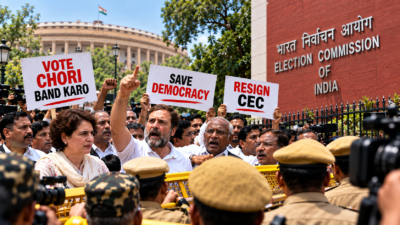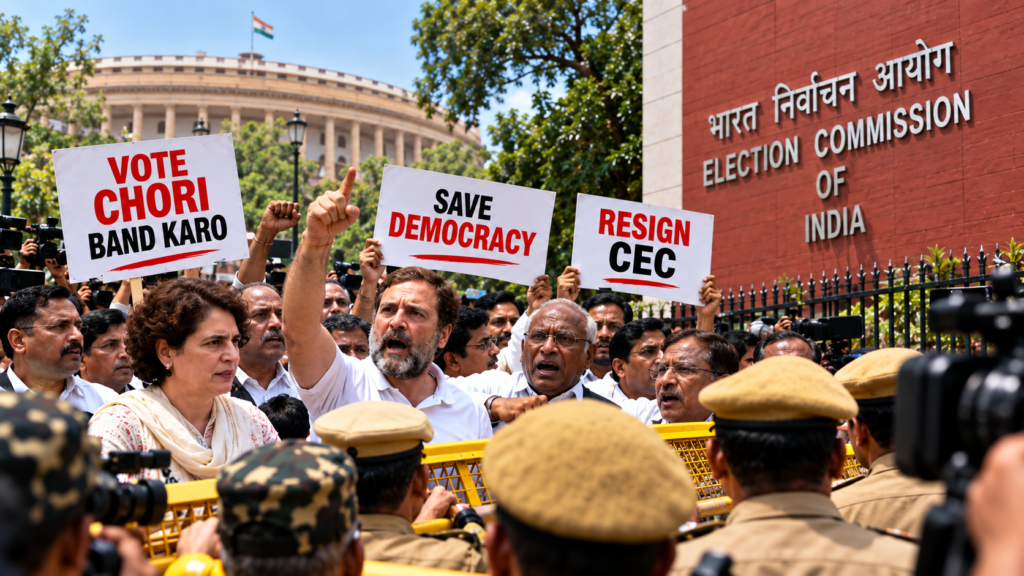
The streets around Parliament and the Election Commission headquarters in New Delhi have become the latest theatre of confrontation between the Narendra Modi government and the Opposition. For two consecutive days, INDIA bloc leaders led by Leader of Opposition Rahul Gandhi have taken to the streets, demanding the resignation of Chief Election Commissioner Gyanesh Kumar and challenging the Election Commission’s handling of electoral rolls.
The immediate trigger is the Special Intensive Revision (SIR) of electoral rolls, a nationwide exercise aimed at verifying voters and removing names considered ineligible. The Opposition, however, alleges that the process could disenfranchise legitimate voters and has accused the Election Commission of enabling what Rahul Gandhi calls “vote chori”.
The protest has now moved beyond a disagreement over electoral rolls. It has become a larger political battle over the credibility and independence of the Election Commission, the right to vote and the Opposition’s ability to challenge the government ahead of crucial elections.
What is the SIR?
The Special Intensive Revision is an exercise by the Election Commission to verify and update electoral rolls. It involves checking voter details and identifying people who may no longer be eligible to remain on the rolls, including those who have died, moved away or are otherwise ineligible.
The exercise has already resulted in a huge number of names being removed or flagged during different stages of the revision. Critics say the scale of the deletions and the documentation requirements could disproportionately affect genuine voters, particularly those who have difficulty producing the required records. The Election Commission maintains that the exercise is intended to clean up electoral rolls and ensure that only eligible citizens remain registered.
Why is the Opposition angry?
The Opposition’s central argument is that the Election Commission cannot conduct such a large-scale revision without ensuring that no genuine voter is excluded.
Rahul Gandhi and other INDIA bloc leaders have alleged that the process could be used to remove legitimate voters from electoral rolls. Their broader accusation is that the exercise could benefit the ruling BJP by affecting voters in areas where the Opposition has electoral support.
The Election Commission and the government reject these allegations. The poll panel says the revision is part of its constitutional responsibility to maintain accurate electoral rolls.
The political dispute has therefore become a question of trust: how can voters be removed from electoral rolls without undermining confidence in the electoral process?
Why does Rahul Gandhi want the CEC to resign?
The Opposition has escalated its attack from the SIR exercise to the person overseeing the Election Commission.
Gandhi and INDIA bloc parties are demanding the resignation of Chief Election Commissioner Gyanesh Kumar, accusing the poll panel of failing to act independently and fairly.
The Opposition has also pointed to reported disagreements within the Election Commission over aspects of the electoral-roll revision as evidence of a deeper crisis. The Election Commission has rejected the allegations and maintained that its actions are within its constitutional mandate.
What happened during the protests?
On October 6, INDIA bloc MPs marched from Parliament towards the Election Commission headquarters. Police barricaded the route and stopped the protesters before they could reach the poll panel’s office.
The confrontation then turned into a prolonged sit-in. Rahul Gandhi, Priyanka Gandhi Vadra and other Opposition leaders were detained after attempting to continue the protest despite police restrictions. On October 7, another attempt by Opposition MPs to move towards Jantar Mantar was again stopped by security personnel, with several MPs detained.
The scenes — Gandhi climbing barricades, MPs being detained and Opposition leaders continuing their sit-in — have given the electoral-roll dispute a much larger political and visual dimension.
Why is this bigger than the SIR?
India’s electoral system depends not only on conducting elections but also on public confidence that the voter list is accurate and that the institution conducting the election is independent.
That is why the SIR controversy matters.
For the government and the Election Commission, the argument is about maintaining clean and accurate electoral rolls.
For the Opposition, the issue is about preventing legitimate voters from being excluded and ensuring that the institution supervising elections cannot be seen as favouring the ruling establishment.
The two positions are difficult to reconcile because the dispute is ultimately about who gets to vote and who decides whether a person remains on the voters’ list.
What happens next?
The political confrontation is unlikely to end with the latest detentions. The Opposition has indicated that it will continue its campaign, while legal and institutional scrutiny of the electoral-roll revision is also continuing.
The larger test will be whether the Election Commission can demonstrate, through transparent verification and correction mechanisms, that genuine voters will not be disenfranchised.
For the Opposition, the challenge is different: it has to turn allegations of “vote chori” into a sustained campaign based on evidence rather than allow the protest to become only another confrontation with the government.
The real issue, therefore, is not simply whether the Opposition can take its protest to the Election Commission. It is whether India’s political system can maintain public trust in the institution that decides who gets to vote.