This the story of a newborn nobody could identify for 38 years.
He was found dead in a laundry bin in 1988. There was no name, no identified mother and no suspect. Thirty-eight years later, forensic genealogy reconstructed his family tree — and investigators found the woman who had hidden her pregnancy.
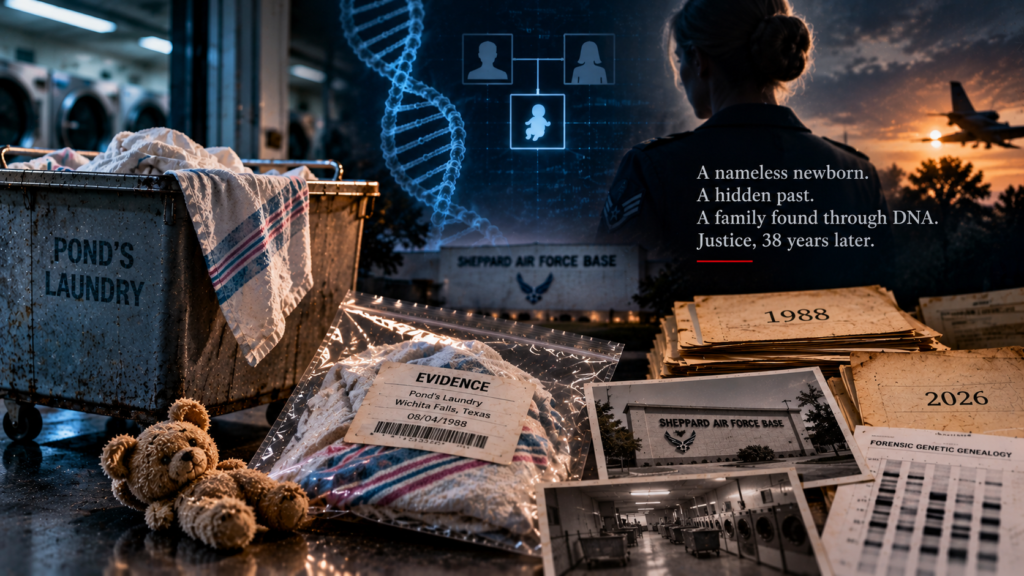
On August 4, 1988, an employee at a laundromat in Wichita Falls, Texas, made a discovery that would remain a mystery for almost four decades.
Inside a laundry bin at Pond’s Laundry was a dead newborn baby.
He was wrapped in linens from the Air Force Regional Hospital at nearby Sheppard Air Force Base.
The infant was full-term.
He had been born alive.
And he had no name.
Investigators searched for answers.
But every obvious lead appeared to go nowhere.
The newborn could not tell them who his mother was.
The hospital records offered no obvious answer.
And no suspect emerged.
Eventually, the investigation went cold.
The baby became known simply as Infant Male Doe.
Then science caught up with the case.
The hospital had a problem
There was one immediate question.
If the baby had been wrapped in hospital linens, could he have been born at the Air Force hospital?
Investigators checked.
At the time the infant was discovered, all known pregnant patients and newborns at the hospital and on the base had been accounted for, according to the Justice Department.
That appeared to eliminate the most obvious possibility.
But it did not answer the bigger question:
Who was the baby’s mother?
The autopsy performed the next day determined that the infant had been born alive.
The investigation could establish that he had survived birth.
It could not establish who had given birth to him.
With no suspect identified, the case eventually closed.
And the newborn remained unidentified.
The file stayed alive
Nearly three decades later, someone decided to reopen it.
In 2015, the Air Force Office of Special Investigations established its Cold Case Team and revived the investigation into the infant’s death.
Investigators conducted new interviews.
They went back over the old evidence.
And they searched for something that could not have been fully exploited in 1988:
the baby’s DNA.
In 2017, the Air Force pathology unit located genetic material from the infant.
The material was sent to the Armed Forces DNA Identification Laboratory, where investigators developed a familial DNA profile.
For the first time, the dead infant could potentially be connected to living relatives.
But finding relatives was only the beginning.
The DNA produced a family
In May 2022, investigators sent tissue samples from the 1988 case to forensic laboratory Othram for advanced DNA sequencing and forensic genetic genealogy.
Instead of simply asking whether the DNA matched someone already in a criminal database, investigators attempted to reconstruct the infant’s biological family.
The process produced a breakthrough.
In 2023, investigators identified a man known as M.R. as a potential biological father.
They did not immediately have a complete answer.
But they now had one half of the child’s family.
M.R. was interviewed in December 2024.
A subsequent DNA comparison confirmed that he was indeed the baby’s biological father.
The investigation had travelled nearly 40 years backwards.
The baby now had a father.
But investigators still had to find his mother.
The military records held another clue
This is where the investigation became less like conventional detective work and more like reconstructing a life from fragments.
Investigators knew M.R.’s movements.
They knew where he had been stationed.
They knew approximately when the child must have been conceived.
And they knew where the baby was born.
AFOSI investigators examined personnel rosters from Andrews Air Force Base and Sheppard Air Force Base covering 1987 and 1988.
They were looking for women who fitted a very specific set of circumstances.
Someone who had been stationed at Andrews during the likely conception period.
Someone who had subsequently been transferred to Sheppard.
Someone who was at the base around the time the baby was born.
According to the Justice Department, the search produced one woman who matched all of those circumstances.
Her name was Tammy Sue Kerns.
The woman investigators had been looking for
By 2025, Kerns was 57.
She was no longer at the Air Force base.
Almost four decades had passed.
But the personnel records had preserved a crucial part of her history.
On May 20, 2025, AFOSI investigators interviewed Kerns.
She admitted that she was the infant’s mother.
Investigators then obtained her DNA.
The result confirmed the maternal relationship.
The unidentified newborn now had both biological parents.
But there was still a question that DNA could not answer:
What had happened to him?
What Kerns told investigators
According to the plea documents released by the Justice Department, Kerns had concealed her pregnancy.
She had not sought medical care during the pregnancy.
Then, while working a night shift at the Air Force hospital, she went into labour.
She concealed herself in an X-ray room.
She locked the doors.
And she gave birth there.
The plea agreement states that after the birth, Kerns placed her hand over the baby’s mouth until he stopped crying and/or breathing.
She then severed the umbilical cord, wrapped the baby in hospital linens and placed him in a laundry bin.
She cleaned the room and returned to work.
These details come from Kerns’ own admissions in the federal plea proceedings, rather than from an allegation that remains untested.
The laundry bin that held a secret
The investigation had now come full circle.
In 1988, investigators had found an infant wrapped in hospital linens inside a laundry bin.
They had known almost nothing about him.
They did not know his parents.
They did not know where exactly he had been born.
They did not know who had left him there.
Thirty-eight years later, the evidence had produced an extraordinarily different picture.
Genetic sequencing identified relatives.
Genealogy connected the family.
Personnel records narrowed the possibilities.
DNA confirmed the father.
DNA confirmed the mother.
And the mother eventually told investigators what had happened.
The technology had not solved the case by itself.
It had given investigators the first pieces of a family tree.
The rest required old-fashioned detective work.
The breakthrough was not just DNA
This is the part of the story worth emphasising.
It would be easy to write:
“DNA solved a 38-year-old murder.”
But that isn’t quite what happened.
DNA created the possibility.
Genetic genealogy connected the infant to relatives.
Investigators then combined that information with historical military personnel records.
The records identified the only woman who fitted the timeline.
Investigators interviewed her.
She admitted being the mother.
Her DNA confirmed it.
And then her own account supplied the final missing part of the story.
It was a chain.
DNA → family → records → person → interview → confession → guilty plea.
That is what makes this such a strong Crime Solved story.
The case finally reached court
On September 1, 2026, federal prosecutors charged Kerns with second-degree murder.
Eight days later, on September 9, she pleaded guilty.
She admitted killing her newborn son in 1988.
There was no need for a jury trial.
The guilty plea established her criminal responsibility in court.
Kerns is scheduled to be sentenced on January 8, 2027.
Under the plea agreement, she faces between five and 20 years in federal prison, a fine of up to $250,000 and up to five years of supervised release.
The second-degree murder charge could otherwise carry a sentence of up to life imprisonment.
For the investigators who had lived with the case since 1988, the guilty plea marked the end of an investigation that had outlived several generations of forensic technology.
The clue trail
Victim: Infant Male Doe
Location: Wichita Falls, Texas, US
Date: August 4, 1988
Discovery: Dead newborn found in a laundry bin
Original evidence: Hospital linens and preserved biological material
Case reopened: 2015
DNA material located: 2017
Advanced genetic testing: 2022
Biological father identified: 2023
Father confirmed by DNA: 2024
Mother identified: 2025
Mother’s DNA confirmed: 2025
Charge: Second-degree murder
Guilty plea: September 9, 2026
Sentencing: January 8, 2027
Investigative breakthrough: Forensic genealogy + military personnel records + DNA
CRIME SOLVED STATUS; SOLVED — GUILTY PLEA
Unlike some cold cases in which investigators identify a suspect who later dies or awaits trial, this case has reached a legal resolution: Kerns pleaded guilty to second-degree murder.
Thirty-eight years to give a child a name
The baby found in that laundry bin in 1988 had no name.
For decades, he existed in the records simply as Infant Male Doe.
The investigators who first examined his death could not identify his mother.
They could not identify his father.
They could not explain what had happened.
But they preserved the evidence.
Thirty years later, technology gave investigators another chance.
The baby’s DNA led them to his father.
His father’s history helped them identify his mother.
Military records narrowed the search.
Another DNA test confirmed the relationship.
And then the mother herself supplied the final missing piece.
The case had begun with a nameless child in a laundry bin.
It ended with a guilty plea in federal court.
The most remarkable part may be the simplest:
The evidence waited 38 years.
The investigators came back.
And the child finally got his story back.