Texas cold case: How DNA genealogy helped crack Irasema Chavez's 2012 murder
For more than a decade, police had a tiny piece of evidence from a brutal Texas murder. It belonged to an unknown woman. Then genetic genealogy produced a name — and DNA from discarded rubbish provided the match.
On the morning of January 20, 2012, police officers arrived at an apartment complex in Arlington, Texas, after a family member reported finding Irasema Chavez unresponsive inside her home.
Chavez, 32, was dead.
The medical examiner determined that she had suffered more than 100 stab wounds.
There was evidence at the apartment. There was also surveillance footage.
But there was no obvious suspect.
For investigators, one piece of evidence stood out.
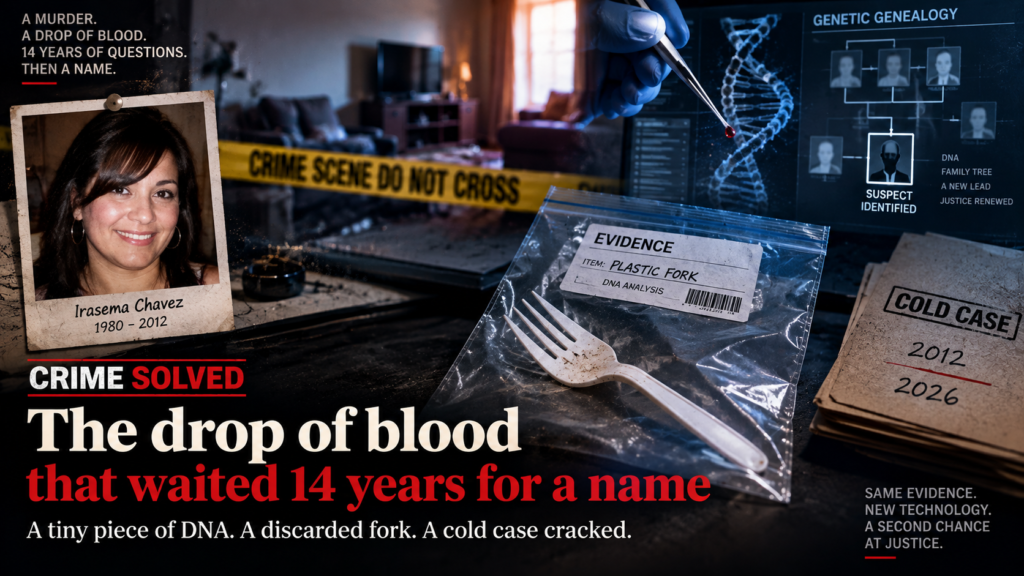
A tiny drop of blood had been found on a television stand in the bedroom. It did not belong to Chavez.
It belonged to someone else — a woman whose identity investigators could not establish.
For the next 14 years, that drop of blood waited for a name.
The killer forgot something
The investigation had begun with several unanswered questions.
Why had Chavez been killed?
Who had entered her apartment?
And whose blood was on the television stand?
Investigators also found that a television was missing from the apartment.
Surveillance footage from the night before the killing showed a person entering the apartment, but investigators could not establish the person’s identity. The footage became another piece of a puzzle that refused to come together.
The blood was more promising.
Police tested it and entered the resulting DNA profile into the national Combined DNA Index System, or CODIS.
Nothing came back.
There was no matching profile.
The evidence had effectively reached a dead end.
And then it stayed there.
For years.
But the case was not forgotten
Cold cases have a peculiar quality.
They can appear dormant while investigators continue to carry them.
In November 2024, Arlington Police’s homicide unit approached the FBI’s Dallas Field Office about using Investigative Genetic Genealogy, or IGG, in the Chavez case.
The technology had changed the possibilities of what investigators could do with an unidentified DNA sample.
Traditional DNA matching asks a relatively simple question:
Does this DNA match someone already in a database?
Genetic genealogy asks a different question:
Can this DNA be connected to a family?
Investigators can compare a DNA profile with genetic genealogy databases, identify possible relatives and then construct family trees using genealogical records and other publicly available information.
It does not necessarily produce the name of a killer.
Instead, it can produce a lead.
And in the Chavez case, that lead eventually pointed towards Mayra Velasquez.
A name emerged: Suspect?
Velasquez was 42 when police arrested her in July 2026.
She was not a stranger to Chavez.
Arlington police said Velasquez had once been a close friend of Chavez and lived only a few miles from the apartment where Chavez was killed.
The FBI’s genetic-genealogy work had not, by itself, established that Velasquez was the killer.
It had given investigators something they had not possessed for 14 years:
a person to investigate.
The next step was more conventional.
Police needed a direct DNA comparison.
And they needed it without simply asking Velasquez to provide a sample.
Rubbish held the clue
In May 2026, detectives obtained DNA from discarded rubbish associated with Velasquez and sent the material to a crime laboratory.
The laboratory produced the result investigators had been looking for.
The DNA matched the blood recovered from Chavez’s apartment.
Later reporting described the discarded item as a plastic fork left behind after Velasquez had eaten at a restaurant with friends. Investigators collected several items and sent them for testing; the DNA from the fork reportedly matched the crime-scene blood.
A tiny drop of blood from a television stand, preserved since 2012, had finally been connected to a living person.
The investigation had crossed a crucial threshold.
Velasquez was no longer merely a name produced by genetic genealogy.
Police now had a direct DNA comparison that, they said, matched the crime-scene evidence.
But there was still a problem
DNA can tell investigators that biological material is associated with a person.
It does not automatically tell them when or why that material got there.
That distinction could become important at trial.
Police believe the blood came from the attacker accidentally cutting herself during the stabbing. Arlington police said this was consistent with what can happen during a stabbing attack.
But Velasquez’s lawyers have challenged the prosecution’s interpretation of the evidence.
Her defence has pointed out that Velasquez knew Chavez and had regularly visited her apartment. Her lawyers have also questioned aspects of the crime-scene evidence and argued that the DNA match does not prove that Velasquez committed the killing.
Velasquez herself has denied involvement.
In a public statement after her arrest, she said: “I did not do this.”
That is why this is a case that has been cracked, not solved.
The police have identified and charged a suspect.
A court has yet to determine whether she is guilty.
A critical question
There is another major question.
Why?
Police have not publicly established a motive for Chavez’s killing.
That makes the case particularly intriguing.
The two women knew each other. Police say Velasquez had been a close friend of Chavez.
According to an arrest-warrant affidavit reported by KERA, investigators alleged that Velasquez’s husband had been jealous of the relationship between the two women around the time of the killing. Velasquez’s lawyers have disputed aspects of the prosecution’s account.
The motive therefore remains an allegation to be tested in court, not an established fact.
And the absence of a clear motive leaves the 2012 crime with another unresolved question.
A wait that lasted 14 years
Think about what investigators had in 2012.
A murder.
A surveillance recording.
A missing television.
A drop of blood.
An unknown woman.
No database match.
No identified suspect.
No arrest.
Fourteen years later, the same blood sample could be approached in a completely different way.
First came genetic genealogy.
It narrowed an unknown person into a family network.
Then came conventional detective work.
Investigators developed Velasquez as a potential suspect.
Then came forensic DNA testing.
A sample obtained from discarded material was compared with the old blood.
The profiles matched, according to police.
The investigation had effectively travelled backwards through time.
A piece of evidence collected in 2012 had been waiting for technology that did not yet exist — or was not yet routinely available to investigators.
When science came to the rescue, or did it?
This is what makes the Chavez case larger than one murder investigation.
Genetic genealogy has changed the cold-case landscape because investigators no longer need the person they are looking for to have their DNA sitting in a police database.
A relative may be enough to start the search.
That can lead to a family tree.
The family tree can lead to a person.
And that person can then be investigated through conventional police work.
The technology has already helped investigators revisit unidentified remains and long-unsolved killings across the United States.
But it also raises difficult questions about privacy and the use of genetic information.
A person who has never committed a crime may voluntarily upload DNA to a genealogy service to discover their ancestry — and unknowingly provide information that could help investigators identify a distant relative.
That tension between privacy, science and justice is likely to become one of the defining crime stories of the coming years.
But a clue refused to die
Victim: Irasema Chavez, 32
Location: Arlington, Texas, US
Year of killing: 2012
Original breakthrough: An unidentified drop of blood recovered from the apartment
First problem: DNA produced no match in CODIS
New technology: Investigative Genetic Genealogy
New lead: Mayra Velasquez
Confirmation: DNA from discarded material matched the crime-scene blood, according to police
Arrest: July 2026
Charge: Capital murder
Motive: Not established publicly
Current status: Velasquez has denied involvement and was released on a $450,000 bond; the case remains before the courts.
Crime Solved? Verdict: Cracked — not solved yet
Police have identified and charged a suspect after 14 years, but there has been no conviction. The evidence will ultimately have to withstand scrutiny in court.
The drop of blood didn’t hold enough water
For 14 years, investigators knew they had something important.
A tiny drop of blood.
They knew it belonged to a woman.
They knew it had nothing to do with Chavez herself.
But they didn’t know whose it was.
In 2012, a database search could not answer that question.
In 2024, investigators tried a different route.
In 2026, genetic genealogy produced a name.
Then a piece of discarded rubbish provided the direct DNA comparison police were seeking.
It is tempting to say that a fork solved a murder.
It didn’t.
The fork, the blood, the genealogy, the old surveillance footage and years of police work were pieces of a much bigger investigation.
The real breakthrough was simpler:
Investigators finally learned how to ask the old evidence a new question.
And after 14 years, the drop of blood finally had a name.