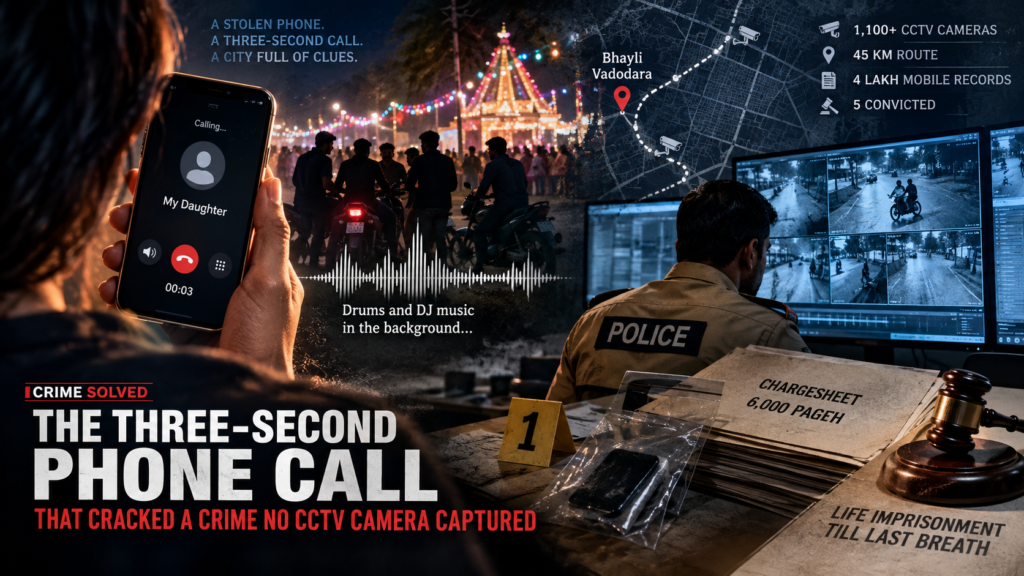
In October 2024, investigators faced a crime committed in an isolated part of Vadodara with no camera at the spot and unidentified assailants. Then one of them made a tiny mistake: he answered the victim’s stolen phone.
At around midnight on October 4, 2024, investigators in Vadodara had a crime to solve but almost none of the conventional clues they would normally hope for.
The assault had taken place in an isolated part of Bhayli, a rapidly developing area on the outskirts of the city. There was no CCTV camera covering the exact spot.
The perpetrators were unknown.
What investigators did have was a survivor’s account, her friend, the abandoned crime scene and a missing mobile phone.
Then the phone rang.
The call came from the survivor’s mother, who was trying to reach her daughter’s stolen handset.
Someone on the other end answered.
The conversation lasted roughly three seconds.
It was enough to change the investigation.
The person who answered did not identify himself. But in those few seconds, the survivor’s mother heard something in the background: drums and DJ music.
For investigators, that fragment of sound became a clue.
They now had something more than a stolen phone. They had a possible location.
And they began working backwards.
There was no camera where the crime happened
The survivor, then 16, had been out with a male friend during Navratri.
According to the prosecution case, the two were intercepted by five men travelling on two motorcycles in a secluded part of Bhayli. The men took the keys to the two-wheeler and threatened the pair.
When the girl raised an alarm, two of the men fled, according to the prosecution. The remaining three assaulted her while her friend was restrained.
The survivor and her friend subsequently reached a police station and reported the crime.
The police had to identify five people who had apparently vanished into a city preparing for one of its busiest nights of the year.
The immediate problem was geography.
The crime scene itself offered no CCTV coverage.
So instead of asking, What did the camera see at the crime scene?, investigators asked a different question:
Where did the attackers come from, and where did they go afterwards?
That meant reconstructing their route.
Police eventually examined footage from more than 1,100 CCTV cameras along a route of roughly 45 km, while teams searched the surrounding area. Investigators were looking for patterns — particularly motorcycles carrying multiple riders and movements that could be connected to the time of the crime.
But CCTV was only one part of the investigation.
The stolen phone offered another.
Then came the three-second clue
The survivor’s mother called the stolen handset at about 12.30 am.
One of the eventual convicts answered.
He disconnected after approximately three seconds.
That would ordinarily be almost meaningless.
There was no useful conversation to record. No name. No confession. No obvious identification.
But the call generated something else: a location and a soundscape.
The mother heard the unmistakable sounds of drums and DJ music in the background.
Investigators could compare that information with the location of the phone and with what they knew about the movements of the suspects.
The phone had effectively become a moving beacon.
The background noise helped narrow the possibilities further.
Police then began matching the phone’s location and the possible routes with CCTV footage.
The investigation was no longer simply about finding a missing handset.
It was about reconstructing the movements of a group of people through a city using thousands of fragments of evidence.
The city became the crime scene
The eventual investigation involved an extraordinary amount of data.
More than 1,100 cameras were examined over the roughly 45-km route.
Police teams also searched more than 1,000 houses within a three-kilometre radius of the crime scene, according to the later account of the investigation.
And investigators analysed an enormous volume of mobile-location information — reported at roughly four lakh records — as they tried to reconstruct movements.
That is the part of modern policing that rarely makes it into the dramatic version of a crime story.
There was no single magical piece of technology.
Instead, investigators had to make thousands of small pieces fit together:
A phone.
A call.
Three seconds of ambient sound.
A tower location.
A motorcycle.
A CCTV frame.
Another CCTV frame.
And another.
The objective was to establish whether these fragments belonged to the same chain of events.
The motorcycles became another clue
The CCTV search was not simply about finding faces.
The investigators were trying to identify the movements of two motorcycles carrying five people.
That mattered because the group described by the survivor was distinctive enough to narrow the search.
Once investigators began following the motorcycles through different camera locations, they could reconstruct parts of the group’s journey before and after the crime.
The phone data provided another layer.
And the police eventually identified and arrested all five suspects within about two days of the crime. Contemporary reporting said investigators had used CCTV footage, mobile-phone information and other evidence to trace them.
The investigation had moved remarkably quickly.
But identifying suspects was only the beginning.
The harder question was:
Could the evidence survive in court?
From a three-second clue to a 6,000-page case
Police filed a chargesheet of about 6,000 pages within weeks of the crime.
It contained statements from witnesses, CCTV material, forensic-science reports, medical evidence and DNA-related material.
The prosecution eventually examined 45 witnesses during the trial.
The forensic evidence became particularly important.
According to the prosecution, biological evidence recovered from the survivor’s clothing and other forensic material helped establish the case against the accused.
That distinction matters.
The three-second phone call did not by itself prove the crime.
It was the breakthrough that helped investigators find their way to the suspects.
The eventual prosecution case was built from multiple independent strands of evidence.
That is how a circumstantial case becomes a chain: each link has to connect with the next.
Nearly two years later, the case reached its final chapter
On August 20, 2026, a special POCSO court in Vadodara convicted all five men.
The court heard evidence from 45 witnesses and considered the forensic, medical, CCTV and other material presented by the prosecution.
On August 31, the court sentenced all five to imprisonment for the remainder of their natural lives.
Each was also fined ₹50,000, according to reports of the sentencing. The court ordered ₹10 lakh in compensation for the survivor under the Gujarat Victim Compensation Scheme.
The five convicts were identified in court records and reporting as Munna Abbas Banjara, Mumtaz alias Aftab Subedar Banjara, Shahrukh Kismatali Banjara, Saifali Mahendihasan Banjara and Ajmal Sattar Banjara.
The convictions and sentences are the outcome of the trial; the significance of the investigation lies in how the police got from an isolated crime scene with no camera to the people ultimately convicted.
The clue was not really the phone call
It is tempting to call this a story about technology.
It isn’t.
Or at least, not entirely.
The phone call was useful because investigators knew how to ask the right question of it.
Three seconds of audio would ordinarily be discarded as useless.
But investigators heard something else:
Where was this phone when it rang?
Then:
Who was carrying it?
Then:
Where had that person been?
Then:
Can cameras confirm those movements?
And finally:
Can forensic evidence connect the people identified through that reconstruction to the crime?
The answer came from the accumulation of evidence rather than one spectacular breakthrough.
That is increasingly what modern crime investigation looks like.
A crime scene may contain no obvious clue. But a city full of phones, cameras and digital records can leave behind a trail of movement.
The investigators’ job is to reconstruct it.
The clue that changed the case
Crime: Gang rape of a 16-year-old during Navratri, Vadodara
Date: October 4, 2024
Breakthrough: A suspect answered the survivor’s stolen phone for about three seconds
What investigators heard: Drums and DJ music in the background
CCTV examined: More than 1,100 cameras
Route examined: About 45 km
Mobile-location data: Roughly four lakh records, according to later reporting
Chargesheet: About 6,000 pages
Trial witnesses: 45
Verdict: All five convicted
Sentence: Life imprisonment for the remainder of their natural lives
Survivor compensation: ₹10 lakh
Why this case matters
The most revealing part of the investigation may be the smallest.
The criminals did not make a confession.
They did not leave their names behind.
They did not walk in front of a camera at the crime scene.
One of them simply answered a telephone call.
For three seconds.
And in the background, somebody could hear music.
That was enough to give investigators a starting point.
Everything that followed was painstaking police work.