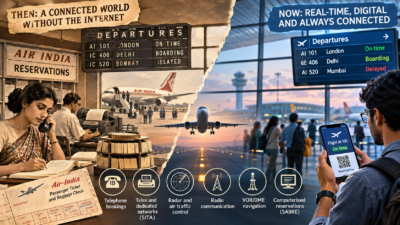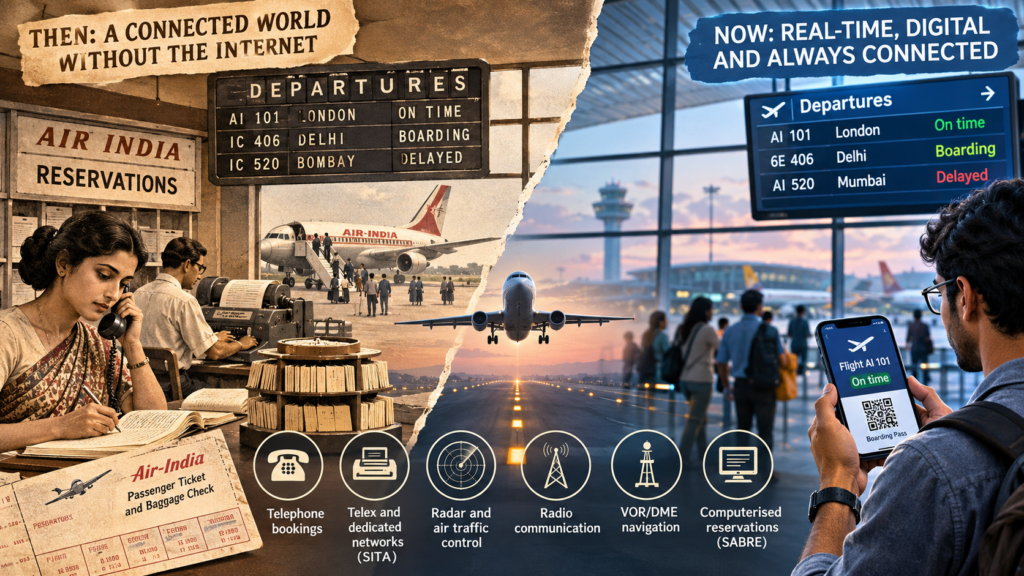
From paper tickets, telephone bookings and telex machines to digital boarding passes and real-time flight tracking: how aviation evolved before and after the internet.
A communications breakdown brought America’s aviation network to an extraordinary standstill on November 13. The Federal Aviation Administration (FAA) ordered a nationwide ground stop for departing flights after communication problems affected all 22 of its regional Air Route Traffic Control Centres. Aircraft already in the air were allowed to land, while some international departures were handled on a case-by-case basis. Thousands of flights were disrupted, leaving passengers stranded at airports and airlines scrambling to manage the fallout.
The incident brought into focus an important question about an industry that moves millions of people across continents every day: How dependent has aviation become on digital connectivity, and what happened when there was no internet to begin with?
Imagine arriving at an airport without having booked your ticket online, checking in without a smartphone, finding your departure gate without an app and boarding an aircraft without a digital boarding pass. Now imagine doing all this without the internet even existing.
For generations of air travellers, this was not an extraordinary proposition. It was simply how flying worked.
Long before airline websites, mobile applications and real-time flight-tracking services became indispensable to air travel, airlines operated an extraordinarily complex global network using telephones, teleprinters, printed timetables, paper tickets, radio communications and, eventually, sophisticated computer systems.
The aviation industry did not wait for the internet to become global. It had already learnt to connect cities, countries and continents through a combination of human coordination, engineering and technology.
So how did the world manage to fly before the internet? And what did passengers, pilots, air traffic controllers and airline employees do when information was not available at the touch of a screen?
Booking a flight meant speaking to a person
Today, booking a flight can take less time than ordering a cup of coffee. A passenger can compare fares, check seat availability, select a meal, pay and receive a ticket without speaking to an airline employee.
It was a very different experience before computerised reservations became widespread.
Passengers generally visited airline offices or travel agents, consulted printed timetables and made telephone calls to check availability. Reservations were often recorded manually, with employees maintaining records of available seats and passenger details.
In the United States, American Airlines used a system in which reservation agents maintained handwritten cards containing customer and flight information. These were arranged in slots around large rotating filing systems, often called Lazy Susans.
The arrangement was vulnerable to clerical errors and could lead to seats being oversold or left vacant. As air travel expanded after the Second World War, keeping track of reservations across multiple offices became an increasingly difficult exercise.
Airlines were already using telephones and teletype machines to communicate reservation requests and availability. But the process remained labour-intensive.
The problem was not that airlines lacked technology. It was that the technology available could no longer keep pace with the growth of commercial aviation.
SABRE: The computer revolution began much earlier
One of the most significant turning points in airline reservations came from a chance encounter in 1953.
American Airlines president C.R. Smith happened to share a flight with IBM salesman R. Blair Smith. Their conversation about the difficulties of managing airline reservations led to a collaboration that would transform the industry.
The result was SABRE, short for Semi-Automated Business Research Environment, a computerised reservation system developed by American Airlines and IBM.
SABRE linked reservation terminals at American Airlines offices to a central computer through dedicated telephone lines. Agents could check seat availability and retrieve passenger information without having to telephone a central reservations office and wait for a response.
The system became operational across American Airlines’ reservation network in the 1960s. By the middle of that decade, IBM says, SABRE was processing 7,500 reservations an hour. A process that had previously taken an average of 90 minutes could be completed in seconds.
American Airlines extended the system to travel agents in 1976, allowing them to access reservations directly.
Other airlines followed with their own computerised reservation systems. Eventually, these developed into global distribution systems, enabling travel agents to access information from multiple airlines.
This is an important distinction in aviation history: computerised airline reservations were already a reality decades before the public internet became widely accessible.
The Indian experience: When booking a flight required patience
The transition to computerised reservations did not happen simultaneously across the world. India’s experience offers an interesting illustration of how different countries entered the computer age at different speeds.
In the 1970s, Indian Airlines largely dominated domestic aviation, while Air India operated international services. The number of airlines and available flights was considerably smaller than today, and fares were largely regulated.
Booking a flight involved visiting an airline office or a travel agent. Reservations and ticketing were largely manual, and confirming a seat could take considerable time, particularly when booking offices were not connected through reliable communication facilities.
A 1970 government record acknowledged that Indian Airlines’ manual reservation system was becoming inadequate as passenger traffic increased. The government was considering computerisation, including the possibility of a joint reservation system for Air India and Indian Airlines.
A parliamentary committee report in 1972 highlighted the difficulties. Several booking offices lacked adequate telephone and teleprinter connections. Confirmation of reservations could be delayed, and the absence of a real-time reservation system was becoming a significant operational handicap.
Air India took a major step towards computerisation on March 16, 1981, when it introduced a reservation system based on a Sperry Univac computer. The system initially covered flights operating from Bombay, with Delhi, Calcutta and Madras scheduled to follow.
Indian Airlines entered the computerised reservation era in 1985, although the transition was not without difficulties. An India Today report from May that year documented problems with overbookings, communication links, waiting lists and computer downtime.
The experience is revealing. Computerisation itself did not guarantee efficiency. The supporting telecommunications infrastructure, trained personnel and backup arrangements were equally important.
For Indian passengers, the transition from manually maintained reservation records to computerised bookings was an important milestone, even though online reservations and digital ticketing would arrive much later.
Paper tickets, coupons and printed boarding passes
Once a passenger secured a reservation, the next step was obtaining a ticket.
For decades, airline tickets were physical documents, often consisting of several coupons. Each coupon represented a particular sector of the journey and was collected or processed at different stages.
For an international journey involving multiple airlines, the ticket could be a substantial document. Airline employees checked its details, validated the coupons and updated records as the passenger moved through the journey.
The ticket was not merely proof of payment. It was also an important travel and accounting document.
Boarding passes, too, were issued at airport counters. Staff verified reservations, checked passenger details, allocated seats and printed the documents required for boarding.
There was no QR code on a smartphone to scan at the gate. The passenger carried the paperwork.
The transition to electronic ticketing gradually reduced this dependence on physical documents. Airlines could maintain ticket records electronically, while passengers increasingly received confirmation through email and other digital channels.
The change made travel more convenient, but it also meant that passengers began depending on airline reservation systems for information that they had previously carried in physical form.
Finding your flight without an app
Imagine arriving at an airport today and discovering that your flight-tracking application is not working. You might check the airline’s website, look at an airport information screen or call the airline.
Before the internet, passengers had fewer options.
Printed airline timetables were an important source of information. Airlines published schedules containing departure and arrival times, routes, flight numbers and connecting services. Travel agents and ticket offices used these publications to advise customers.
At the airport, passengers relied on departure boards, public-address announcements and airline staff.
Mechanical split-flap boards, with their characteristic clicking sound as flight information changed, became familiar sights at airports around the world. They displayed flight numbers, destinations, scheduled departure times and status updates.
A delayed or cancelled flight meant approaching an airline counter or waiting for an announcement.
There were no instant notifications explaining that an aircraft was running 40 minutes late because of weather at its previous destination.
Information travelled through people and communication systems rather than directly to passengers.
SITA: How airlines communicated across continents
While passengers were relying on telephone calls and printed documents, airlines were developing their own international communication infrastructure.
One of the most important developments came in 1949, when 11 airlines joined hands to establish SITA, the Société Internationale de Télécommunications Aéronautiques.
The organisation was created to address a common problem: airlines needed a reliable way to exchange operational and commercial information across national boundaries.
SITA began developing a dedicated communications network for the aviation industry. By 1957, its network extended across 75 communication centres and served 52 airline members.
This was a significant achievement at a time when international telecommunications were expensive and far less accessible than they are today.
Airlines used such networks to exchange messages relating to reservations, passenger information and operations. Telex and other dedicated messaging technologies played an important role.
It is worth distinguishing these networks from the public internet. SITA’s aviation communications infrastructure existed decades before ordinary consumers began using the internet.
The industry had already developed a way to communicate globally without relying on the public internet.
How pilots navigated without Google Maps
Perhaps the most interesting misconception about pre-internet aviation is that pilots somehow had to navigate blindly or rely entirely on visual references.
They did not.
Aircraft navigation had developed sophisticated systems long before the internet. Pilots used radio navigation aids, ground-based beacons, compasses, charts and instruments to establish their positions and follow planned routes.
One important technology was VOR, or Very High Frequency Omnidirectional Range. These ground-based radio navigation stations transmitted signals that allowed pilots to determine their direction relative to a station.
Distance Measuring Equipment (DME) provided information about an aircraft’s distance from a ground station.
For longer journeys, aircraft also used inertial navigation systems, which calculated position by measuring movement and acceleration. These systems became particularly important in long-distance commercial aviation.
Radar helped air traffic controllers monitor aircraft movements and maintain safe separation.
Satellite-based navigation systems, including GPS, later added another dimension to aviation navigation.
An important point is that GPS does not require an internet connection. Aircraft can receive satellite navigation signals independently of the public internet. Similarly, conventional radio navigation aids continue to function without it.
The internet was never the technology that made aircraft navigation possible.
Air traffic control: The communication network behind every flight
Every commercial flight involves coordination between pilots, air traffic controllers, airport authorities and airline operations teams.
Before the internet, much of this coordination took place through radio transmissions, dedicated telephone circuits, radar and teleprinter networks.
The earliest air traffic control systems were considerably more basic than today’s. In the United States, controllers initially tracked aircraft using maps and blackboards, with telephone connections linking them to airline dispatchers and airport personnel.
Radio communication between pilots and controllers subsequently became central to the system.
Radar transformed air traffic control during the late 1950s and early 1960s. It allowed controllers to monitor aircraft positions more effectively, while computers gradually became part of the process of handling increasingly large volumes of traffic.
Teleprinter systems also played an important role. Weather reports, flight plans and other operational messages could be transmitted between aviation facilities.
These were different technologies performing different functions:
- Radio connected pilots and air traffic controllers.
- Radar helped controllers monitor aircraft movements.
- Dedicated telephone circuits enabled coordination between ground facilities.
- Teletype and data networks carried flight plans, weather information and operational messages.
The aviation industry had therefore developed a specialised communications ecosystem long before the public internet.
How airlines managed aircraft, crews and baggage
A commercial airline does not merely need to sell tickets and fly aircraft. It must coordinate pilots, cabin crew, maintenance teams, airport slots, baggage, fuel, weather conditions and aircraft availability.
A delay in one city can affect an aircraft’s subsequent journey, the crew assigned to it and passengers waiting at another airport.
Before modern digital platforms, much of this work involved telephone calls, radio communications, printed schedules, telex messages and central operations offices.
Airline dispatchers prepared flight plans and monitored weather conditions. Operations teams coordinated aircraft movements and crew assignments. Airport employees handled passenger lists and baggage records.
Baggage handling was also evolving. Printed tags identified passengers’ luggage, while conveyor belts and mechanical sorting systems were already being used at major airports.
What was missing was the degree of digital connectivity and end-to-end tracking available today. Identifying a bag and physically moving it were increasingly automated processes, but tracing its journey across multiple airports remained a more limited exercise.
When flights were disrupted, employees had to work through available information and contact other departments or airlines to find solutions.
The system was more labour-intensive and offered passengers considerably less immediate information. But it was supported by increasingly sophisticated reservation, communication and operational technologies.
The internet changed the passenger experience
The arrival of the public internet transformed how passengers interacted with airlines.
Online booking platforms allowed customers to compare fares and purchase tickets without visiting travel agents or airline offices.
Electronic tickets reduced paperwork. Online check-in reduced queues at airport counters. Mobile boarding passes made physical documents increasingly optional.
Flight-tracking services allowed passengers to follow aircraft movements, while airlines began sending automated updates about delays, cancellations and gate changes.
The internet also transformed airline distribution. Travel agencies, comparison websites and online travel aggregators could offer customers access to multiple airlines and fare options.
Airlines gained new ways to manage inventory, pricing and customer relationships.
But the change went beyond convenience.
Modern aviation increasingly depends on interconnected digital systems that exchange information across airlines, airports, service providers and government agencies.
There is, however, an important distinction between aviation’s dependence on digital technology and its dependence on the internet. The two are not interchangeable.
Airlines had computerised reservation networks long before the public internet became accessible to ordinary consumers. Air traffic controllers relied on radar, radio and dedicated data communication networks. Aircraft navigated using ground-based radio beacons and, later, satellite systems.
The internet transformed the passenger experience and connected many aspects of airline commerce. It did not create the technological infrastructure that makes flying possible.
When connectivity fails, what happens?
The American disruption offers a reminder of the importance of reliable communications.
On November 13, the FAA ordered a nationwide ground stop after communications problems affected all 22 of its regional air traffic control centres.
The restriction prevented departing aircraft from taking off while aircraft already airborne were allowed to land. Some international departures continued under specific arrangements.
The scale of the disruption was substantial. The Associated Press reported that at least 600 aircraft had been diverted by early evening, while FlightAware recorded thousands of delays and cancellations.
Officials described the problem as a telecommunications outage. The precise technical cause remained under investigation, and authorities had not established evidence of a deliberate attack.
The incident also renewed questions about the age and resilience of American aviation infrastructure.
It demonstrated why the aviation industry cannot simply fall back on the systems of the pre-internet era.
Air traffic control today handles an enormous volume of aircraft movements. Airlines operate complex schedules involving multiple airports, countries, time zones and connecting services. A disruption in one part of the network can quickly affect operations elsewhere.
There is also a difference between the ability to fly an aircraft and the ability to manage an entire airspace safely.
A pilot may have the equipment and skills to navigate an aircraft, but commercial aviation requires much more than that. Controllers must know where aircraft are, communicate instructions and maintain safe separation.
The technology has changed, but the fundamental requirement has not: reliable communication is indispensable to safe flying.
Could aviation return to its pre-internet ways?
Not really, at least not on the scale at which the industry operates today.
The pre-internet aviation world was built around smaller volumes of traffic, different operating models and a much larger role for manual coordination.
Air travel was already a mass industry in the 1960s. The introduction of computerised reservation systems was itself a response to rapidly growing passenger numbers and the limitations of manual booking.
As traffic increased, airlines progressively automated their operations. The internet subsequently made many of these capabilities directly accessible to passengers.
Today, millions of people book tickets, check in, change itineraries and receive updates through digital platforms. Airlines coordinate aircraft and crew movements across vast networks.
Reverting to paper tickets, telephone bookings and manual passenger records would not solve the problems created by a modern communications outage.
However, the history of aviation offers an important lesson. Technology has always evolved alongside human expertise, established procedures and alternative communication systems.
Radio did not disappear when radar arrived. Conventional navigation aids did not become irrelevant when satellite navigation emerged. Human air traffic controllers remain central to the system despite increasing automation.
The challenge for modern aviation is not to abandon digital technology. It is to ensure that the systems on which it depends are resilient, secure and capable of dealing with failures.
The world learnt to fly without the internet. But it never learnt to fly without communication.