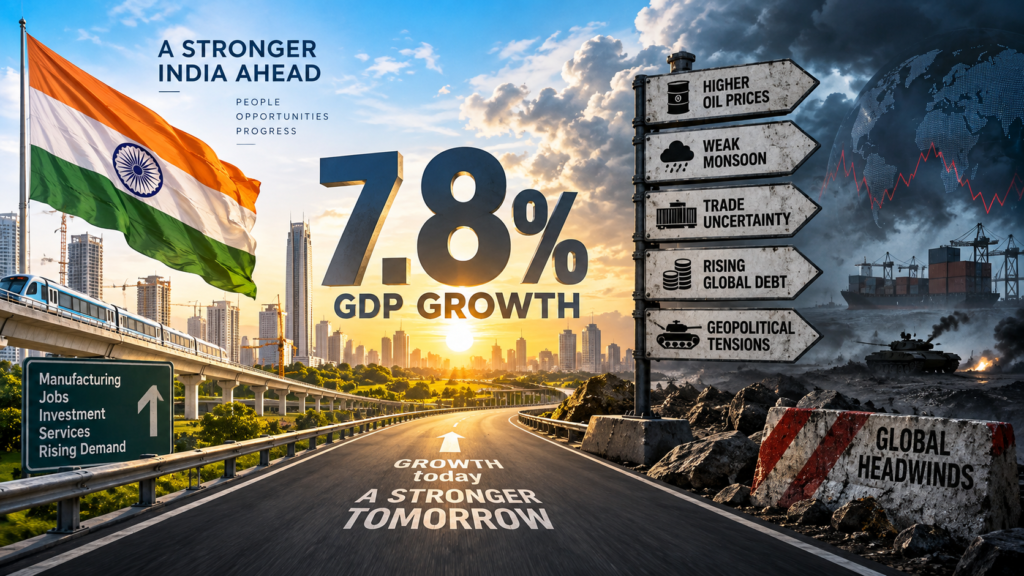
Indian economy is growing but some experts still cast doubts over sustenance. (Image: AI generated)
India has started 2026-27 with a number that looks difficult to argue with: 7.8 per cent real GDP growth in the April-June quarter.
That was considerably better than the Reserve Bank of India’s 7 per cent estimate. Manufacturing, investment and services helped drive the expansion, while private investment grew strongly.
So, is India’s economy in the clear?
Not quite.
The bigger story is that India is growing strongly at a time when the world economy is becoming harder to navigate. And some of the biggest risks to India’s growth may come from outside the country.
The GDP number is good. But GDP is not a shield
A 7.8 per cent growth rate tells us that economic activity expanded rapidly in the first quarter.
It does not mean India is insulated from future shocks.
Think of GDP as the speed at which a car is travelling. A high speed tells you the car is moving quickly. It does not tell you whether the road ahead is smooth.
For India, some of the bumps ahead are already visible: oil prices, weather, global trade, interest rates and geopolitical tensions.
Oil is the first vulnerability
India imports the overwhelming majority of the crude oil it consumes.
That makes oil prices particularly important.
When crude becomes expensive, the impact does not stop at petrol and diesel. Transport becomes costlier, which can raise the cost of moving food and other goods. Aviation, manufacturing and several other industries also feel the pressure.
India can absorb a temporary oil-price spike.
A prolonged one is much harder.
That is why geopolitical conflicts thousands of kilometres away can eventually become an Indian inflation problem.
Then there is the monsoon
India’s growth story is increasingly driven by manufacturing and services, but agriculture still matters enormously to household incomes, food prices and rural demand.
And 2026 has brought another concern: rainfall.
Reuters reported on 4 September that India’s September rainfall was running below normal after a weak monsoon season, raising concerns about crops and food inflation.
This matters because a poor harvest can create a double problem.
Farm incomes suffer while food prices rise.
That can squeeze consumers and make it harder for the Reserve Bank of India to keep monetary policy focused on supporting growth.
Global trade is another question mark
India wants to become a bigger manufacturing and export hub.
But global trade itself is facing uncertainty.
Tariffs, protectionism and supply-chain restructuring can make it more expensive for companies to move production across borders.
India can benefit if multinational companies diversify their supply chains away from China.
But India also needs strong demand in major overseas markets to keep its exports growing.
If the world economy slows, Indian exporters can feel the impact even when domestic demand remains healthy.
And then comes the debt problem
This is a less visible risk.
Governments around the world have accumulated large amounts of debt after years of borrowing to deal with the pandemic and subsequent economic and geopolitical pressures.
High debt becomes more uncomfortable when interest rates remain elevated.
Why?
Because governments have to spend more simply servicing what they already owe.
That can leave less money for infrastructure, welfare and other spending.
It can also keep borrowing costs higher for businesses and households.
India is not in the same position as heavily indebted advanced economies. Its public finances, growth rate and domestic demand provide important buffers.
But India cannot completely escape global financial conditions.
If global investors become more cautious, emerging markets can face pressure through capital flows, currencies and borrowing costs.
The GDP methodology debate is a different issue
There is another reason the latest GDP number has attracted attention.
India introduced a new GDP series with 2022-23 as the base year earlier this year.
The new series uses updated data sources and methodologies, including a new Producer Price Index and double deflation for manufacturing. MoSPI says these changes are intended to improve the measurement of economic activity.
That has triggered debate over how India’s growth is being measured.
But two things should not be confused.
A debate over methodology does not automatically mean the growth number is fabricated.
At the same time, one strong quarterly number should not be treated as proof that every part of the economy is equally healthy.
GDP is an aggregate. It can grow rapidly even when particular households, industries or regions experience very different conditions.
So, should India be worried?
Worried, no. Watchful, certainly.
The latest numbers actually give India a useful cushion.
Strong domestic demand, investment and manufacturing mean the economy is entering a potentially difficult global period from a position of strength. Economists have consequently raised several FY27 growth forecasts following the 7.8 per cent Q1 surprise.
But the risks are interconnected.
An oil shock can push up inflation.
Higher inflation can limit the room for interest-rate cuts.
Higher borrowing costs can slow investment.
A global slowdown can hurt exports.
A weak monsoon can push up food prices and weaken rural demand.
And geopolitical uncertainty can make all of these problems harder to predict.
That is the real challenge for India.
It is not whether the economy can grow at 7.8 per cent.
It has just demonstrated that it can.
The question is whether it can maintain that momentum when the global economy throws something much less favourable at it.
For now, India’s biggest advantage is its domestic engine.
The biggest risk is that the rest of the world keeps getting harder to ignore.