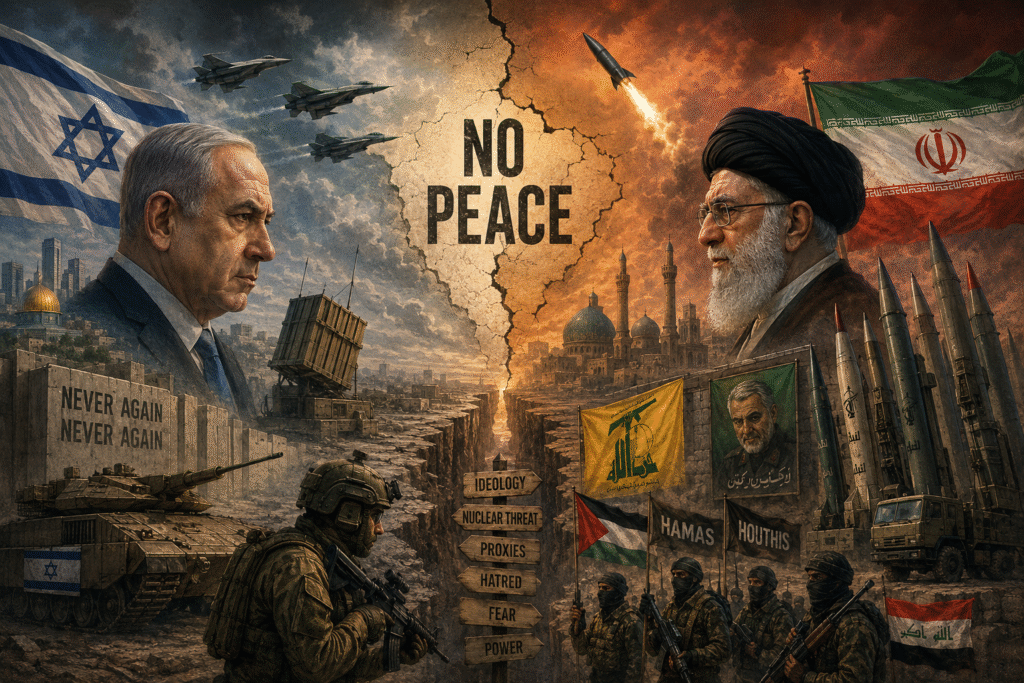
Despite peace efforts, Iran and Israel continue fighting (AI-generated image)
There is a peculiarly cruel irony at the heart of the Middle East’s most dangerous rivalry. Once, not so very long ago, Iran and Israel were allies — quiet, pragmatic, and genuinely interdependent. Iranian oil flowed to Israeli refineries through a discreet pipeline. El Al jets connected Tel Aviv to Tehran. Israeli agricultural engineers planted knowledge in Iranian soil. Prime ministers visited. Generals conferred. Intelligence services traded secrets. The two non-Arab, non-Sunni powers in a hostile Arab neighbourhood had found in each other something rare and valuable: a friend who understood.
That world ended on 11 February 1979, the day Ayatollah Ruhollah Khomeini’s revolution completed its work and Israel evacuated its last representatives from Tehran. What replaced it was something more than ordinary enmity. It was a conflict built on ideology, nuclear fear, proxy warfare, domestic politics, and a structural logic so deep that no individual leader — however rational, however pragmatic — has ever been able to dissolve it.
Now, in June 2026, as Iranian missiles arc again over the desert towards Israeli cities and Israeli and American strikes continue to pound what remains of Iran’s battered military infrastructure, the question is not merely why the two countries are at war. The question is why peace between them was always, structurally, almost impossible.
The answer runs across at least seven distinct and interlocking dimensions — and understanding each one is essential to understanding why every diplomatic off-ramp has, for forty-seven years, led nowhere.
I. The World That Was: A Friendship the Revolution Erased
To understand the present, you must first mourn the past. Under Shah Mohammad Reza Pahlavi, Iran and Israel developed one of the most functional covert alliances in the modern Middle East. The Shah recognised Israel in 1950 — one of the earliest Muslim-majority nations to do so. Through the 1960s and 1970s, the partnership deepened significantly. Iran supplied as much as 60 per cent of Israel’s oil through a discreet pipeline arrangement. Israeli military advisers helped train the Shah’s imperial guard. The two countries’ intelligence services, SAVAK and Mossad, cooperated closely against shared enemies, particularly Iraq’s Ba’athist regime and Soviet influence in the region.
The alliance was never publicly acknowledged — the Shah was careful to maintain Arab street credibility — but it was real, operational, and mutually beneficial. Both states were non-Arab powers in a region dominated by Arab nationalism. Both feared a Soviet-aligned Iraq. Both saw advantage in each other’s military and intelligence capabilities.
The Shah never established full diplomatic relations with Israel and maintained that he would do so only after Israel ended its occupation of Palestinian territories — a position structurally similar to that of many Arab states today. Even before 1979, Iran’s relationship with Israel was characterised by public ambiguity and private cooperation.
Notably, Iranian leftist opponents of the Shah trained alongside Palestinian fedayeen in Jordan and Lebanon throughout the 1970s — meaning that anti-Israel sentiment was already deeply woven into the revolutionary movement that would eventually seize power.
The 1979 revolution did not simply change Iranian foreign policy. It inverted it entirely, overnight. Khomeini’s new regime immediately severed ties with Israel, handed over the Israeli embassy in Tehran to the Palestine Liberation Organisation, and declared opposition to the “Zionist entity” a foundational pillar of the Islamic Republic. This was not merely a policy choice. It was a theological and ideological commitment — enshrined in the revolution’s founding documents and woven into its self-conception.
The tragedy of those early years is that some pragmatists on both sides believed the break might not be permanent. Even after Khomeini took power, covert trade reportedly continued for a period. Israel participated in the Iran-Contra affair partly because some in Jerusalem still believed certain Iranian factions might, one day, return to pragmatism. They were wrong — or at least, wrong about the timeline.
II. The Ideological Cement: When Enmity Becomes an Identity
Most international rivalries are rooted in territory, resources, or security competition. Those rivalries can, in theory, be resolved — through negotiation, partition, guarantees, or the simple exhaustion of both sides. The Israel-Iran conflict is categorically different because one side has built its political identity, its theological legitimacy, and its domestic narrative almost entirely upon the destruction of the other.
Since 1979, the Islamic Republic has positioned opposition to Israel not as a foreign policy choice but as a religious obligation and a revolutionary duty. Ayatollah Khomeini declared Israel an illegitimate usurper of Muslim land. His successors, including Ali Khamenei — killed in the February 2026 strikes — repeated variations of this formulation thousands of times over four decades. The annual “Quds Day,” established by Khomeini in 1979, turned opposition to Israel into a ritual act of state, a public holiday devoted to demanding the Jewish state’s elimination.
“For almost forty-five years the Islamic regime and Israel have been fighting an often cold, sometimes kinetic war. Events of the last week are but the massive eruption of this seething volcano.”
— Abbas Milani, Stanford University, June 2025
This matters enormously because it means that any Iranian leader who sought normalisation with Israel would not merely be making a controversial diplomatic choice — they would be committing something close to ideological apostasy. The regime’s legitimacy rests, in part, on its posture of resistance. To abandon that posture is to surrender a founding myth.
Israel, for its part, has developed its own ideological framework around the Iranian threat — one rooted not in theology but in a very specific and hard-won historical lesson. After the Holocaust, Israeli strategic culture calcified around a single axiom: when a government announces its intention to destroy the Jewish people, you must believe it. Iran’s repeated calls for Israel’s elimination — whatever their tactical or rhetorical context — are processed in Jerusalem not as bluster, but as programme. This is not paranoia. It is a rational response to a particular historical experience.
The result is a conflict where both sides have deeply structural reasons to maintain the enmity — one rooted in theological revolution, the other in civilisational memory.
III. The Bomb That Changed Everything: Iran’s Nuclear Programme
If ideology is the cement of this conflict, the nuclear question is its detonator. Israel’s transformation from wary observer to active belligerent against Iran accelerated sharply in the 1990s as the first credible evidence of an Iranian nuclear weapons programme began to emerge. By the early 2000s, preventing a nuclear-armed Iran had become the single most dominant strategic preoccupation of the Israeli state.
Israel’s logic is straightforward and, within its own premises, unassailable: a country that has declared your destruction as an ideological imperative must never be allowed to acquire the means to achieve it. A nucl……..ear Iran would not merely threaten Israel directly. It would create a regional deterrence umbrella under which Iranian proxies could operate with far greater impunity. It would almost certainly trigger a cascade of regional proliferation, with Saudi Arabia, Turkey, Egypt, and the UAE all likely to pursue their own programmes in response — fundamentally altering the strategic environment that Israel has spent decades managing.
Iran, meanwhile, presents its nuclear programme as a sovereign right under the Non-Proliferation Treaty and as essential deterrence against a hostile, nuclear-armed West and its Israeli ally. Whether or not this is entirely sincere — and there is evidence that the programme has military dimensions — it is a position that enjoys genuine domestic support in Iran, even among citizens deeply critical of the Islamic Republic.
If Iran were to acquire nuclear weapons, the global non-proliferation architecture — already strained — would face a severe test. Egypt, Saudi Arabia, Turkey, and the UAE have all, at various points, indicated that a nuclear Iran would prompt them to reconsider their own postures. The consequences would extend far beyond the Middle East, affecting strategic calculations from Asia to Europe.
The nuclear issue is not simply a technical problem that arms-control diplomacy can resolve. It is the material expression of the ideological conflict. So long as Iran defines itself as a revolutionary state opposed to Israel’s existence, Israel will view an Iranian nuclear capability as an existential threat requiring pre-emption. And so long as Israel treats Iranian nuclear ambitions as a casus belli, Iran will regard the nuclear programme as its most valuable insurance policy against exactly the kind of strikes it has now suffered.
It is a circular trap with no obvious exit.
IV. The Octopus and Its Arms: The Proxy Network
One of the most sophisticated and consequential innovations of the Islamic Republic has been its construction, over four decades, of a pan-regional network of armed groups that can project Iranian power without deploying Iranian soldiers. Hezbollah in Lebanon, Hamas and Palestinian Islamic Jihad in Gaza and the West Bank, the Houthis in Yemen, various Shia militias in Iraq and Syria — together, these form what Tehran calls the “Axis of Resistance” and what its adversaries call a terrorist network.
The logic of this architecture is elegant and, until recently, highly effective. By embedding Iranian power in local conflicts and local grievances across the region, Tehran creates deterrence at multiple remove — adversaries striking Iran must reckon with retaliatory escalation from five different directions simultaneously. The network also allows Iran to bleed Israel and American forces at a manageable cost, sustaining pressure without triggering the kind of direct confrontation that might unite the region against it.
Iran’s Quds Force — the IRGC unit responsible for managing these relationships — provided an estimated $100 million or more annually to Hamas before October 2023, hundreds of millions more to Hezbollah, and significant sums to the Houthis and Iraqi militias. Weapons flowed via Syria, through tunnels, by sea and by air. The infrastructure was patient, deliberate, and decades in the building.
“Iran’s proxy network is not merely a military tool. It is the physical expression of the Islamic Republic’s claim to lead a region-wide resistance — the means by which a country of 90 million people punches far above its conventional weight.”
— Analysis, INSS
From Israel’s perspective, this network is not a peripheral irritant — it is the operational heart of the Iranian threat. Every Hezbollah missile in a Lebanese warehouse is an Iranian missile pointed at Israel. Every Hamas tunnel in Gaza is an Iranian investment in Israeli insecurity. The proxy war is permanent, low-grade, and deliberately calibrated to remain just below the threshold that might justify a decisive Israeli response — until, as in October 2023, it abruptly crosses it.
This is why Israeli strategists began speaking, years ago, about attacking “the head of the octopus” rather than continuing to cut its arms. The proxy architecture made peace impossible by ensuring that even periods of apparent calm were simply the interval between rounds of a conflict that never truly stopped.
V. The Domestic Trap: Why Leaders on Both Sides Fear Peace
Even if a hypothetical Iranian leader — rational, pragmatic, secretly exhausted by four decades of confrontation — were to conclude that normalisation with Israel served Iran’s national interest, the domestic political cost would be annihilating. The Islamic Republic has spent nearly half a century building its legitimacy, in part, on resistance to Israel and America. The Friday prayers, the revolutionary calendar, the IRGC’s institutional culture, the vast propaganda apparatus — all of it points the same direction. To reverse course would not merely require courage. It would require dismantling the ideological foundations of the state itself.
Israeli domestic politics creates its own complications, though of a different character. The Israeli right — which has dominated Israeli politics for most of the past two decades — has defined itself around the Iran threat in a way that has become deeply politically useful. A permanent enemy justifies permanent emergency powers, permanent military budgets, permanent coalition-building across otherwise irreconcilable factions. Benjamin Netanyahu, in particular, has spent decades making Iran the organising principle of Israeli foreign policy. Peace, in this calculus, would be disorienting.
More broadly, the Israeli public has absorbed, over decades of rocket fire, proxy attacks, and nuclear brinkmanship, a genuine and well-founded belief that Iran poses an existential threat. Any Israeli leader who extended a hand to Tehran would need to overcome not just political opposition but a deep and rational popular scepticism — a scepticism earned through lived experience.
VI. The Regional Architecture: A Rivalry That Organises the Middle East
The Israel-Iran conflict does not exist in isolation. It has become the organising axis of the entire Middle East’s strategic landscape — and a remarkable number of regional actors have a vested interest in its continuation.