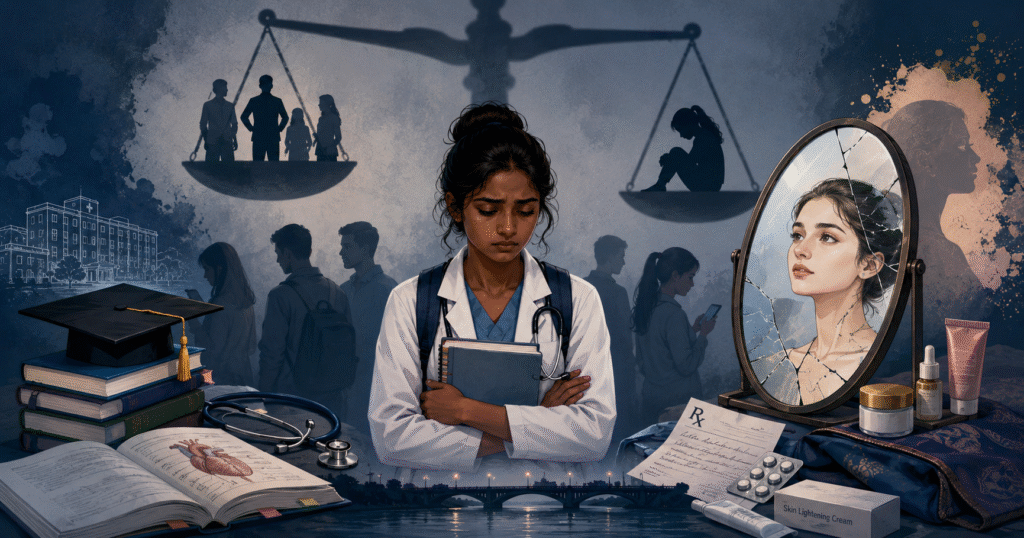
You are not your complexion (AI-generated image)
A young medical student is dead.
And the allegations emerging from Odisha raise uncomfortable questions that go far beyond one relationship.
According to police and family members, Chandrika Bhanjbala Hembram, a medical student whose body was recovered from the Kathajodi River in Cuttack, had been in a relationship with the same man since Class VI. For nearly 15 years, they reportedly built a future together and even planned to marry.
Now, after her death, her family alleges that the relationship collapsed after her partner became involved with another woman and began distancing himself from Chandrika.
What makes the case particularly disturbing are allegations linked to skin colour.
Family members claim Chandrika was repeatedly made to feel inadequate because of her dark complexion. Investigators have reportedly recovered prescriptions, medicines and cosmetic creams that suggest she had been undergoing skin-related treatment in an effort to improve her complexion.
Think about that for a moment.
A future doctor.
A young woman who had successfully entered one of the most competitive educational systems in the country.
Someone whose academic achievements should have been a source of pride.
Yet, according to the allegations, she may have felt compelled to change the colour of her skin to save a relationship.
If true, this is not merely a story about heartbreak.
It is a story about colourism.
The belief—still deeply embedded in parts of Indian society—that fair skin is somehow more desirable, more beautiful, more worthy of love, acceptance or marriage.
It is a prejudice that survives across communities, classes and generations.
It appears in matrimonial advertisements.
It appears in beauty products.
It appears in films and television.
It appears in casual comments made at family gatherings.
And sometimes, it appears in relationships.
The tragedy also highlights another reality: emotional pain is often invisible.
People assume that educational success protects individuals from psychological distress.
It does not.
Medical students, engineers, civil-service aspirants and professionals can all struggle with rejection, loneliness, anxiety and depression.
Achievements cannot always shield someone from emotional wounds.
The Odisha Police have registered a case under provisions relating to abetment of suicide and the investigation is continuing. The allegations made by the family remain subject to investigation and legal scrutiny.
But irrespective of what investigators ultimately conclude, one fact is impossible to ignore:
No young person should ever feel that their skin colour determines their worth.
No relationship should make someone believe they must alter their appearance to deserve love.
And no society should continue rewarding beauty standards that leave people feeling inadequate in their own skin.
Behind the headlines is a young life that ended far too soon.
And behind that tragedy lies a question India still has not fully confronted:
How many lives continue to be shaped, damaged or diminished by colour prejudice that many pretend no longer exists?