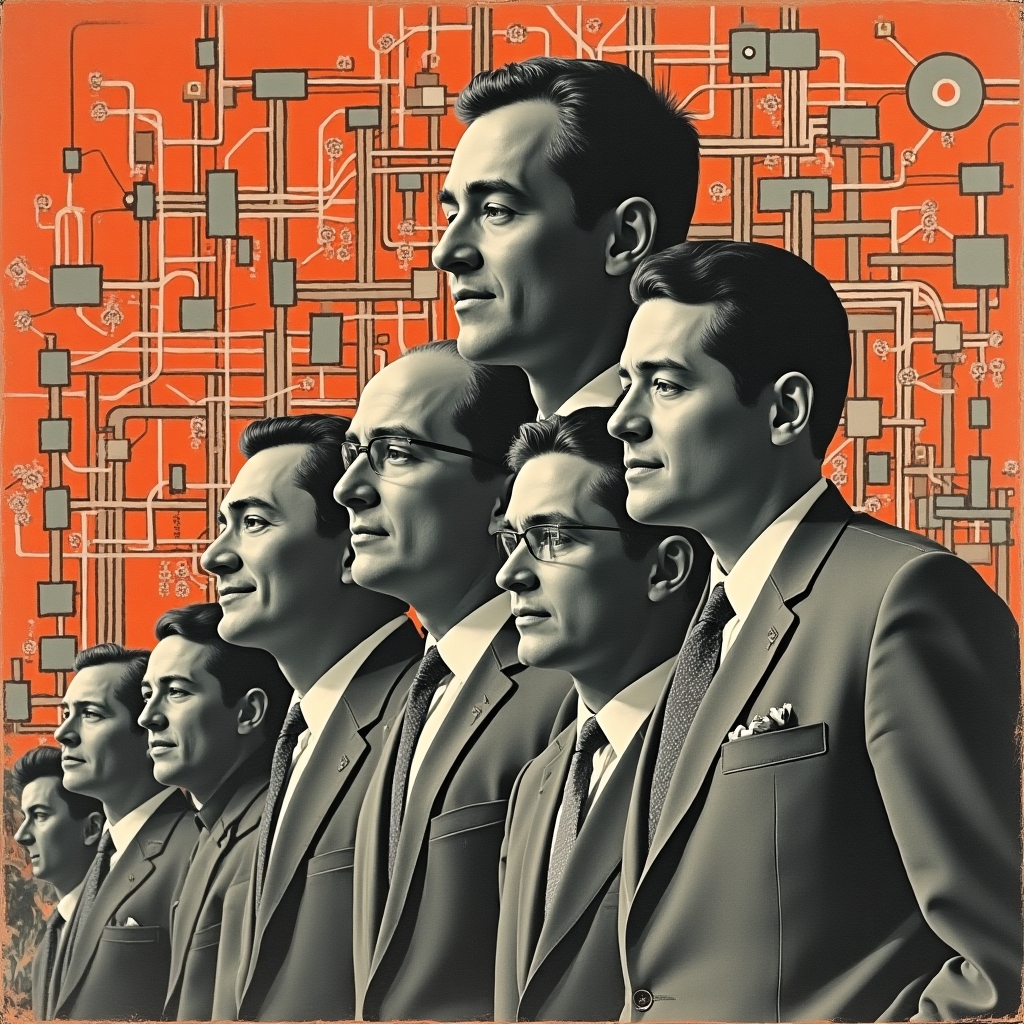
There is every chance that you might not have heard or read about the group of eight people, engineers, to whom you owe possibly more than you can imagine. The present-day technology, chip-based, used in almost everything, from a frying cooker to flying drones, from your smartphones to your workstation, has an imprint of those eight men. They have, but, a rather dubious identity: The Traitorous Eight.
Let’s begin from the very beginning.
The tale of the “Traitorous Eight” is one of rebellion, brilliance, and the birth of a technological revolution that reshaped the world. It began in 1957, in the heart of California’s burgeoning tech scene, when eight young scientists and engineers, frustrated by the difficult management style of their Nobel laureate boss William Shockley at Shockley Semiconductor Laboratory, decided to part ways and forge their own path.
These eight—Julius Blank, Victor Grinich, Jean Hoerni, Eugene Kleiner, Jay Last, Gordon Moore, Robert Noyce, and Sheldon Roberts—were no ordinary employees. Most were PhD holders, aged between 26 and 33, with backgrounds spanning physics, chemistry, engineering, and metallurgy. Their collective expertise was formidable, yet they were stifled under Shockley’s mistrustful and erratic leadership, which included lie detector tests to root out supposed moles.
Their defection was dramatic and symbolic. Meeting in a hotel room, they signed dollar bills as contracts with each other, a pact of mutual trust and shared ambition. With difficulty, they secured backing from Sherman Fairchild of Fairchild Camera and Instrument Corporation, who provided the capital to launch Fairchild Semiconductor. This bold act of defiance earned them the moniker “Traitorous Eight,” a term coined by Shockley himself, who never reconciled with them.
Fairchild Semiconductor became the crucible of innovation. Jean Hoerni developed the planar process in 1958, a technique that allowed for the reliable manufacture of silicon transistors by layering silicon dioxide to protect and control the wafer surface.
Robert Noyce, often dubbed the “Mayor of Silicon Valley,” invented the first commercially viable integrated circuit in 1959, placing all components on a single silicon chip—an invention that revolutionised electronics by making devices smaller, faster, and more reliable.
The impact of the Traitorous Eight extended far beyond Fairchild. Their success attracted talent and investment to the San Francisco Bay Area, laying the foundations for Silicon Valley as the world’s premier technology hub.
The culture of innovation and entrepreneurship they fostered inspired a wave of spin-offs, known as “Fairchildren,” which included giants like Intel, founded by Noyce and Moore, AMD, and National Semiconductor.
Gordon Moore went on to formulate Moore’s Law, predicting the exponential growth of transistor density on chips, a principle that has guided the semiconductor industry for decades. Eugene Kleiner became a key venture capitalist, funding many Silicon Valley startups, while others like Grinich and Hoerni continued to innovate and lead new companies.
In essence, the Traitorous Eight did not merely change companies—they changed the world.
Their breakaway from Shockley Semiconductor set in motion a technological renaissance that transformed computing, telecommunications, and countless facets of modern life.
Their story is a testament to the power of collaboration, risk-taking, and vision, and their legacy remains the beating heart of Silicon Valley’s enduring spirit.
The Traitorous Eight and Fairchild Semiconductor can be seen as the original Silicon Valley tech mafia, a network of pioneers whose innovations and entrepreneurial spirit created the blueprint for the modern technology industry.
Thus, from a hotel room pact to a global revolution, the Traitorous Eight’s journey is one of defiance, genius, and lasting impact—a story that continues to inspire innovators worldwide.