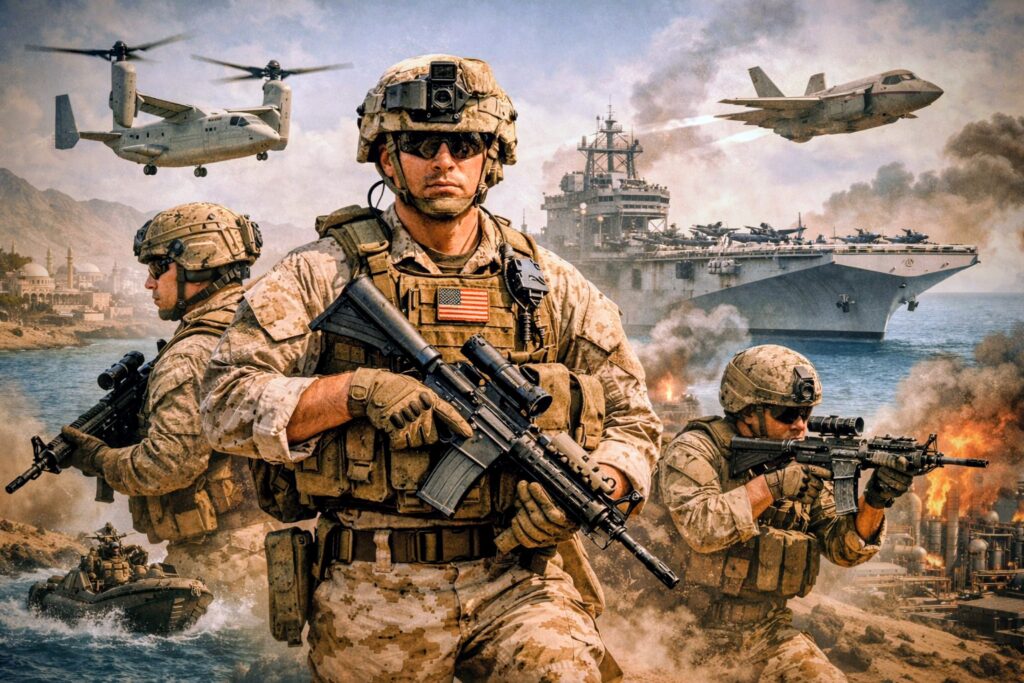
Born in a tavern, shaped by war
The United States Marine Corps was born on 10 November 1775, in a Philadelphia tavern called Tun Tavern, when the Second Continental Congress authorised the formation of two battalions of Continental Marines. The founding mission was simple and unglamorous: guard the ship’s officers from mutiny, fight at sea during boarding actions, and conduct raids on enemy shores. They were, in essence, the navy’s hired muscle.
Their first combat action came on 3 March 1776, when Marines landed in the Bahamas and seized a British ammunition depot — America’s first amphibious assault. It was modest by later standards, but it established a pattern that would define the Corps for the next 250 years: go in first, go in fast, and go in where nobody else wants to.
The Marines have never lost that original instinct. What has changed, dramatically, is the scale, lethality, and complexity of what they are asked to do.
Why are they called marines?
The word comes from the Latin mare, meaning “sea.”
When European navies in the 16th and 17th centuries began stationing soldiers permanently aboard warships — rather than simply embarking armies for specific voyages — those soldiers needed a name that distinguished them from regular army infantry. The French called them infanterie de marine. The Dutch called them mariniers. The English settled on marines — soldiers of the sea.
The logic was straightforward: these were fighting men whose battlefield was the ocean and the coastline, not the inland. They lived at sea, fought at sea, and landed from the sea. The name reflected their element.
When the British Royal Marines were formally established in 1664 — a direct predecessor and model for the American Corps — the name stuck. A century later, when the Continental Congress authorised the formation of American Marines in 1775, they simply borrowed both the concept and the title from the British, with whom they had been fighting, and occasionally serving, for generations.
So in essence: marines are called marines because the sea — mare — is where they come from, and where they are always pointed back toward. Every amphibious assault, every ship boarding, every beach landing since 1775 has been a variation on the same original idea: soldiers who belong to the water.
‘First to fight’ — and what that actually means
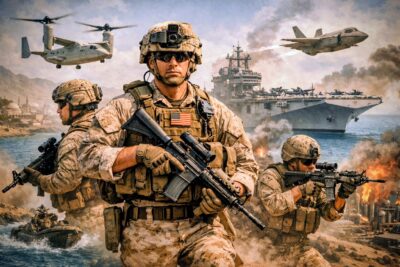
The Marines’ unofficial motto is “First to Fight.” It is not just marketing. Structurally, the Marine Corps exists to do something no other branch of the US military can quite replicate: deploy a fully self-contained fighting force — infantry, aviation, artillery, logistics — from the sea, within days, without needing a friendly port or airfield to receive them.
This is called the Marine Air-Ground Task Force, or MAGTF. It is essentially a mini-military within a military, capable of operating independently in hostile environments. A Marine Expeditionary Unit, or MEU — the type currently headed to West Asia — typically consists of around 2,200 personnel and can be combat-ready within six hours of an order to launch. It carries everything it needs: aircraft, assault vehicles, medical units, and enough firepower to seize a beachhead or evacuate a city.
No other branch of the US military offers that combination of speed, self-sufficiency, and amphibious reach in a single deployable package. That is why, when a crisis erupts and the President wants options before the situation solidifies, the Marines are invariably the first call.
The island-hoppers: World War II and the making of a legend
If one conflict made the Marine Corps what it is today, it was the Second World War in the Pacific. After Pearl Harbor, the US had to take the war to an empire spread across thousands of islands, many of them fortified, all of them defended with extraordinary ferocity by Japanese forces who regarded surrender as dishonour.
The Marines became the instrument of the island-hopping campaign — a brutal, methodical strategy of capturing strategic Pacific islands one by one, cutting Japanese supply lines, and inching toward the home islands. The names of those battles — Guadalcanal, Tarawa, Saipan, Iwo Jima, Okinawa — became synonymous with some of the most savage fighting of the 20th century.
Iwo Jima, in February and March 1945, is perhaps the most iconic. In 36 days of combat on a volcanic island roughly the size of Manhattan, the Marines suffered nearly 26,000 casualties. The Japanese garrison of 21,000 fought almost entirely from underground tunnels and bunkers. When photographer Joe Rosenthal captured six Marines raising an American flag atop Mount Suribachi on day five, the image became one of the most reproduced photographs in history — and the model for the Marine Corps War Memorial in Washington. Fleet Admiral Chester Nimitz said of the battle: “Among the Americans who served on Iwo Island, uncommon valour was a common virtue.”
By the time Japan surrendered in August 1945, the Marines had established themselves as America’s most celebrated fighting force — and the architects of modern amphibious warfare doctrine.
Korea: The Inchon landing
The Korean War gave the Marines one of their most audacious operations. By September 1950, the North Korean People’s Army had pushed UN forces into a tiny perimeter around Pusan in the south. The situation looked grim. General Douglas MacArthur’s solution was to bypass the front entirely.
On 15 September 1950, the 1st Marine Division executed an amphibious landing at Inchon — a port city on Korea’s west coast, deep behind enemy lines, with 30-foot tidal variations that left only a few hours each day when landing craft could operate. Military planners called it near-suicidal. MacArthur called it the only option.
The Marines went in anyway. Within days they had captured Seoul. The North Korean army, cut off from its supply lines, collapsed. It was one of the most dramatic reversals of fortune in military history — and it was built on a Marine amphibious assault that conventional military wisdom said could not be done.
Korea also gave the Marines one of their most celebrated tactical retreats. When Chinese forces entered the war in late 1950, the 1st Marine Division found itself surrounded by eight Chinese divisions at the Chosin Reservoir in temperatures of minus 35 degrees Celsius. Rather than surrender, the Marines fought their way out — 78 miles in 17 days through mountains and enemy forces — bringing their dead and wounded with them. The Chosin Reservoir became a byword for Marine endurance. General Oliver Smith’s response to a reporter who asked about the retreat is legendary: “Retreat hell! We’re just attacking in a different direction.”
Vietnam, Beirut, and the cost of political wars
Vietnam tested the Marines in a different way. Unlike the Pacific or Korea, there were no beaches to storm, no clear objectives to seize. The Marines were assigned to I Corps, the northernmost part of South Vietnam, where they fought a grinding counterinsurgency against an enemy that blended with the civilian population.
The battles of Hue City and Khe Sanh in 1968 became the defining engagements. Hue was house-to-house urban combat to retake a city that had fallen to the North Vietnamese during the Tet Offensive; Khe Sanh was a 77-day siege of a Marine base near the Laotian border, under constant rocket and artillery bombardment. Both were brutal. Both were ultimately won. But the war itself was not — a lesson in the limits of military excellence when political strategy is absent.
Beirut in 1983 was a different kind of wound. On 23 October, a suicide bomber drove a truck laden with explosives into the US Marine barracks at Beirut Airport, killing 241 Marines — the deadliest single-day loss for the Corps since Iwo Jima. The attack exposed the vulnerability of forces deployed in a politically ambiguous peacekeeping role, without clear rules of engagement or defined military objectives. Reagan withdrew the Marines four months later. The lesson — that the Marines are designed for decisive military action, not indefinite political missions — was not always heeded in the decades that followed.
The Gulf War and the art of deception
The 1991 Gulf War gave the Marines a role that was almost entirely theatrical — and was no less important for that. As the US-led coalition prepared to eject Saddam Hussein’s army from Kuwait, the Marines conducted a massive amphibious feint in the Persian Gulf, simulating a beach landing that would threaten Kuwait City from the sea.
Saddam believed it. He kept roughly five divisions — between 80,000 and 100,000 troops — pinned on Kuwait’s coast in anticipation of a Marine landing that never came. Meanwhile, the actual coalition offensive swept around from the west, routing the Iraqi army in 100 hours. The Marines eventually crossed the border from Saudi Arabia and liberated Kuwait City — but their most decisive contribution had been to draw the Iraqi army’s attention in entirely the wrong direction.
Fallujah: The hardest battle since Hue City
Two battles for Fallujah in 2004 — one in April, one in November — bookend one of the most difficult chapters in Marine Corps history. Fallujah was a Sunni city in Iraq that had become a stronghold for insurgents following the US invasion of 2003. The November battle, called Operation Phantom Fury, was the largest urban combat operation since Hue City in 1968.
Roughly 10,000 US and Iraqi forces — the majority Marines — fought house by house, room by room, through a city that had been systematically fortified with booby traps, snipers, and a network of tunnels. After six weeks, Fallujah was cleared. It cost the Marines 82 killed and hundreds wounded. The battle demonstrated that the Corps could still fight and win in the most unforgiving urban terrain — but it also illustrated, again, the gap between tactical brilliance and strategic coherence in a war whose objectives kept shifting.
From Venezuela to West Asia: The Marines today
In the months before the Iran war, the Marines had already been busy. In the Caribbean, the 22nd Marine Expeditionary Unit had been conducting maritime interdiction operations as part of Operation Southern Spear — seizing oil tankers linked to Venezuelan sanctions violations and training for ship boarding and search-and-seizure operations in contested sea lanes.
In the Pacific, the Corps had been quietly revolutionising itself. Force Design 2030 — a sweeping modernisation programme — has been transforming the Marines from a heavy, armour-based force into a leaner, faster, missile-armed force built for island fighting and sea denial in a potential conflict with China. New units called Marine Littoral Regiments are now deployed in the Pacific, armed with NMESIS anti-ship missiles and designed to operate from small islands, denying sea lanes to an adversary’s navy.
Now, with the USS Tripoli tracked off Singapore and heading toward West Asia, the 31st MEU is being repositioned to a very different theatre — one where the threat is not Chinese warships but Iranian drones, sea mines, and a blocked strait that is costing the global economy hundreds of millions of dollars a day.
What does their arrival in West Asia signal?
Amphibious assault ships carrying Marine Expeditionary Units are not typically deployed for air campaigns. The USS Tripoli carries F-35B fighters capable of conducting strikes — but it also carries landing craft capable of putting troops ashore. An MEU exists to seize objectives: ports, airfields, coastal facilities.
The most plausible military logic for deploying an MEU to West Asia right now involves one or more of the following: securing key facilities along the Strait of Hormuz to help reopen the waterway; providing a rapid-response force for the evacuation of US personnel if the situation in the Gulf deteriorates; or preparing for a ground-element operation in Iran itself, should the air campaign require a physical follow-through.
The Pentagon has not officially confirmed the deployment. That silence is itself a signal. When the Marines move, the world pays attention — and Washington knows it.
Semper Fidelis. Always faithful. Two and a half centuries of it.