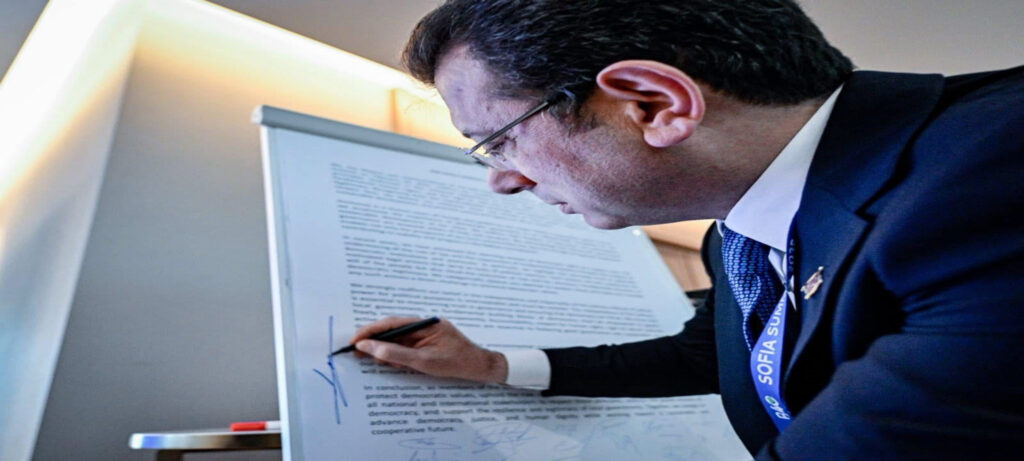
Istanbul Mayor Ekrem Imamoglu signing a petition (Image: https://x.com/imamoglu_int)
The arrest of Istanbul Mayor Ekrem İmamoğlu on 19 March 2025 has ignited nationwide protests in Turkey, marking the most significant wave of civil unrest since the 2013 Gezi Park demonstrations. These protests reflect deep-seated frustrations with President Recep Tayyip Erdoğan’s administration, perceived authoritarian governance, economic instability, and the criminalisation of political opposition.
As clashes between protesters and security forces escalate, the crisis underscores Turkey’s precarious democratic trajectory and the growing polarisation between Erdoğan’s Justice and Development Party (AKP) and opposition factions.
On March 28, X handle of Ekrem Imamoglu shared a New York Times opinion article he penned and wrote on the microblogging site,
In the early hours of March 19, I was detained by dozens of armed police officers. It was a political operation — not a legal one — timed just days before CHP’s presidential primary. But what followed was far more powerful than the repression itself: people from all across Türkiye stood up. From Istanbul to Rize, citizens took to the streets, joined our party, and reminded us all that democracy lives in the will of the people. As I wrote in my op-ed for The New York Times, “I have faith in the people of Türkiye and beyond who fight for justice and democracy.” This struggle is not just about one candidacy or one city — it is about rebuilding a republic that belongs to its citizens, not to fear.
How much influence Ekrem İmamoğlu has in Turkish politics?
Ekrem İmamoğlu, a 54-year-old politician from the Republican People’s Party (CHP), rose to prominence after defeating AKP candidates in Istanbul’s 2019 and 2024 municipal elections. His victories were seen as existential threats to Erdoğan’s political hegemony, given Istanbul’s symbolic and economic importance.
İmamoğlu’s tenure as mayor focused on transparency and anti-corruption measures, which positioned him as a credible challenger to Erdoğan’s centralised authority. His growing influence culminated in plans by the CHP to nominate him as a presidential candidate for the 2028 elections, a move that directly threatened Erdoğan’s legacy.
It’s not about Imamoglu only
In the months preceding his arrest, İmamoğlu faced escalating legal challenges. Turkish prosecutors accused him of leading a criminal organisation, accepting bribes, manipulating municipal tenders, and unlawfully acquiring personal data. While terrorism-related charges involving the Kurdistan Workers’ Party (PKK) were initially filed, courts declined to enforce detention on those grounds.
Notably, Istanbul University revoked İmamoğlu’s academic degree—a procedural manoeuvre that could disqualify him from future elections if upheld. Critics argue these actions exemplify Erdoğan’s strategy of weaponising judicial institutions to neutralise rivals.
The 2025 protests have a nationwide mobilisation
Protests erupted in 55 of Turkey’s 81 provinces within days of İmamoğlu’s detention, drawing participation from opposition parties, labour unions, civil society groups, and citizens.
In Istanbul, crowds exceeding 300,000 gathered at symbolic sites like Taksim Square and Beşiktaş, echoing slogans from the Gezi era: “Hükümet istifa!” (“government, resign!”) and “Hak, hukuk, adalet!” (“right, law, justice!”).
Protesters employed tactics reminiscent of 2013, including banging pots and pans from balconies and erecting barricades against police advances.
Last night, thousands of Istanbulites gathered at Saraçhane Square to demand justice and democracy in Türkiye.
United by a strong common desire for a better future, a nation’s will becomes unstoppable. pic.twitter.com/rbyy7jW1E9
— Ekrem İmamoğlu (International) (@imamoglu_int) March 20, 2025
Security forces responded with tear gas, rubber bullets, and water cannons, citing bans on public gatherings imposed under anti-terrorism laws. Over 343 arrests were reported, including 37 individuals detained for anti-government social media posts.
In Kadıköy, a CHP stronghold, clashes left at least ten protesters hospitalised with head injuries from rubber bullets, while medics struggled to operate amid tear gas. The crackdown highlights Erdoğan’s intolerance for dissent, with the president dismissing protests as “theatrics” and accusing demonstrators of “street terrorism”.
The real reasons behind Turkey protests: Inflation and eroding public trust set the socioeconomic context
Economic crisis has acted as a catalyst. Turkey’s annual inflation rate, hovering above 40% since 2024, has eroded living standards and public trust in Erdoğan’s economic stewardship.
The lira’s collapse to record lows (38 per USD) following İmamoğlu’s arrest triggered a stock market suspension and a $10 billion central bank intervention to stabilise the currency. Many protesters explicitly linked economic mismanagement to political repression, arguing that corruption allegations against İmamoğlu deflect attention from systemic graft within the AKP.
High youth unemployment and generational divides are also impactful contributors to these protests. With youth unemployment exceeding 25%, young protesters have emerged as a vocal contingent demanding opportunities and accountability.
Students participating in the Beşiktaş sit-ins criticised Erdoğan’s policies for stifling innovation and exacerbating brain drain. This demographic shift poses long-term risks for the AKP, as younger voters increasingly reject its conservative-nationalist platform.
There are geopolitical dimensions to anti-Erdogan protests in Turkey
Erdoğan seems to have played calculated gambits. Analysts suggest Erdoğan timed İmamoğlu’s arrest to exploit geopolitical dynamics. With U.S. President Donald Trump’s perceived tolerance for authoritarian allies and Europe’s reliance on Turkey for regional security, Erdoğan anticipates muted Western criticism.
Concurrently, his overtures to Kurdish leaders—including potential concessions to the PKK—aim to fragment opposition unity.
Some analysts point out to Western hypocrisy and silence. Despite calls from European leaders to uphold democratic norms, the EU has prioritised stability over principled condemnation, fearing disruptions to migration deals and Nato cohesion. This pragmatism has emboldened Erdoğan, who frames external criticism as neo-imperialist interference.
What it means for Turkish Democracy?
There is a constitutional crisis and are questions of electoral integrity. The CHP’s plan to nominate İmamoğlu for the 2028 elections now hinges on legal battles over his eligibility.
If courts uphold his disqualification, Turkey’s democratic credentials will face irreversible damage. Meanwhile, Erdoğan’s allies have floated constitutional amendments to extend term limits, signalling a potential power grab.
Civil society has been under siege in Turkey. The protests’ resilience—despite mass arrests and media blackouts—reveals a fractured social contract. While the AKP retains support in rural Anatolia, urban centres like Istanbul and Ankara increasingly view the government as illegitimate. The CHP’s ability to sustain mobilisation will test its capacity to channel discontent into electoral gains.
It could be another inflection point in Turkey’s history
An old civilisation, Turkey may be witnessing another turning point in its history, something it saw with Ottoman Empire and Mustafa Kemal Pasha earlier. The 2025 protests represent a watershed in Turkey’s political history, juxtaposing Erdoğan’s authoritarian consolidation against a reinvigorated opposition.
While immediate outcomes remain uncertain, the crisis underscores systemic rot within institutions and the urgent need for democratic renewal. As clashes persist, the international community must reconcile strategic interests with principled support for civil liberties—or risk enabling Erdoğan’s transformation of Turkey into an elected autocracy.
The path forward hinges on whether the CHP can translate street momentum into electoral strategy, and whether economic pressures force Erdoğan to compromise. For now, Turkey stands at a crossroads, its future balancing on the edge of tear gas canisters and the resolve of citizens demanding accountability.
There are some FAQs that people seem to be googling, we try here to explain them.
1. Who is Ekrem Imamoglu?
Ekrem Imamoglu is the current mayor of Istanbul, Turkey. He is a prominent figure in the opposition to Turkish President Recep Tayyip Erdogan. He’s also considered a potential challenger to Erdogan in future elections.
2. What are the charges against Mayor Imamoglu?
He is facing charges of corruption. Recent reports also indicate that terror charges are being leveled against him.
3. What has been the legal outcome so far?
A Turkish court has ordered the formal arrest and imprisonment of Ekrem Imamoglu pending the outcome of his trial.
4. What has been the public reaction to his arrest?
His detention has sparked large-scale protests across Turkey. There is widespread public outcry against the arrest.
5. What are the allegations of political motivation?
Many observers and opposition supporters believe the charges are politically motivated, aimed at undermining Imamoglu’s political career and his potential to challenge President Erdogan.
6. What is the Turkish government’s stance?
The Turkish government denies that the charges are politically motivated, asserting that they are based on legitimate legal grounds.
7. How has the opposition responded?
The opposition has rallied in support of Imamoglu, condemning the legal actions and expressing solidarity with him.
8. What is the status of Imamoglu’s diploma from Istanbul university?
Istanbul University has annuled Mayor Ekrem Imamoglu’s diploma. This action has been heavily criticised by opposition leaders, who claim it is unlawful.
9. What has been the response to social media?
Turkish authorities have detained multiple people for social media posts related to the situation.
10. What are the implications for Turkish politics?
The situation has heightened political tensions in Turkey and raised concerns about the state of democracy in the country. It has also galvanized opposition support and could have a significant impact on future elections.




2 thoughts on “The 2025 Turkish protests: Why is Turkey up against its president Erdogan over Mayor Ekrem Imamoglu’s arrest?”