India’s push to showcase its tourism potential is running into a basic infrastructure wall, with a nationwide citizen survey revealing deep dissatisfaction over hygiene, public toilets, ticketing systems and crowd management at state government–run tourist sites.
Released on National Tourism Day, the findings show that barely one in seven visitors rate toilets as good, while only about one in five are satisfied with safety and crowd control — signalling that core facilities, rather than attractions themselves, are shaping travellers’ experiences.
The survey by community platform LocalCircles gathered over 45,000 responses from citizens across 317 districts.
Respondents came from across India’s urban–rural spread: 42% from tier 1 cities, 33% from tier 2 and 25% from tier 3, 4 and rural districts, with men forming 67% of respondents and women 33%.
The scale and spread suggest the findings reflect broad domestic traveller sentiment rather than isolated complaints.
At a time when states are investing heavily in festivals, global branding, niche tourism segments and large events, the survey suggests that everyday basics — clean toilets, manageable queues, sanitation and safe crowd flow — continue to define how visitors actually judge destinations.

Public toilets emerge as the weakest link
Among all parameters surveyed, public toilet facilities drew the harshest verdict.
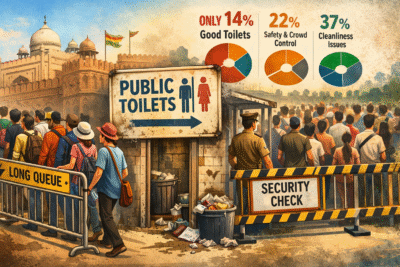
When asked about the condition of public toilets at state government–managed tourist sites visited in the past three years, only 14% of 10,792 respondents rated them as “good”. Just 3% described them as “very good” and 11% as “good”.
In contrast, 38% labelled the toilets “pathetic or very poor”, while another 23% rated them “poor”. A further 25% said conditions were merely “average”. In effect, a clear majority of visitors place toilet facilities in the poor-to-average category.
For families, elderly travellers and those visiting remote religious or heritage sites, access to clean, functional washrooms can influence how long they stay — and whether they return.
Cleanliness: More ‘average’ than impressive
Cleanliness, often highlighted in official tourism messaging, also received middling scores.
Of 12,124 respondents, only 37% said cleanliness at state-run tourist sites was “good” — including 15% who rated it “very good” and 22% “good”.
However, 35% described cleanliness as merely “average”, while 18% rated it “poor” and 10% “pathetic or very poor”. That means nearly three in ten visitors have a clearly negative perception of site hygiene.

The data suggests many sites are stuck in a middle ground — not clean enough to impress, yet not consistently poor enough to trigger urgent action.
Ticketing hassles frustrate many
The ticketing process — crucial for both convenience and crowd control — also drew criticism.
Asked about ticketing at state government–managed tourist sites, just 40% of 10,745 respondents said the process was “good”, including 13% who rated it “very good” and 27% “good”.
Another 27% called the system “average”, while 29% rated it “poor”; 4% gave no clear response. Long queues, unclear procedures and technology glitches can quickly sour the experience before visitors even enter a site.
Safety and crowd management a major concern
Perhaps most concerning is the perception of safety, security and crowd management — critical at temples, pilgrimage centres, festivals and heritage monuments that see seasonal surges.
Of 12,109 respondents, only 22% said safety/security and crowd management were “good”, with 4% rating them “very good” and 18% “good”.
Meanwhile, 41% said arrangements were “average”, 23% “poor” and 14% “pathetic or very poor”. In total, more than a third of visitors hold a negative view of safety and crowd handling.

Given recurring reports of overcrowding and accidents at major pilgrimage and event sites, the findings underline how safety management remains a visible and sensitive issue for travellers.
Big tourism ambitions, basic service gaps
The survey comes as states step up efforts to boost tourism through new policies, global outreach, infrastructure drives and large-scale events. Domestic tourism volumes run into hundreds of crores of visits annually, and the sector is increasingly viewed as a major source of jobs and revenue.
Yet the citizen feedback indicates that basic civic-style services — sanitation, toilets, smooth entry systems and safe crowd flow — may not be keeping pace with promotional ambitions. For domestic tourists, who often travel with families and on tight budgets, these fundamentals can matter more than marketing campaigns.
Repeat visits depend on the basics
Tourism experts often stress that repeat visits and word-of-mouth recommendations hinge on comfort, convenience and safety, not just the monument or landscape.
With only 37% satisfied with cleanliness, 40% with ticketing, 22% with safety and crowd management, and a mere 14% with public toilets, the survey points to significant room for improvement at state-managed tourist destinations.
As India marks National Tourism Day and looks to expand both domestic and international travel, the message from citizens appears clear: grand events and branding may attract visitors, but clean toilets, organised entry and a sense of safety are what make them want to come back.