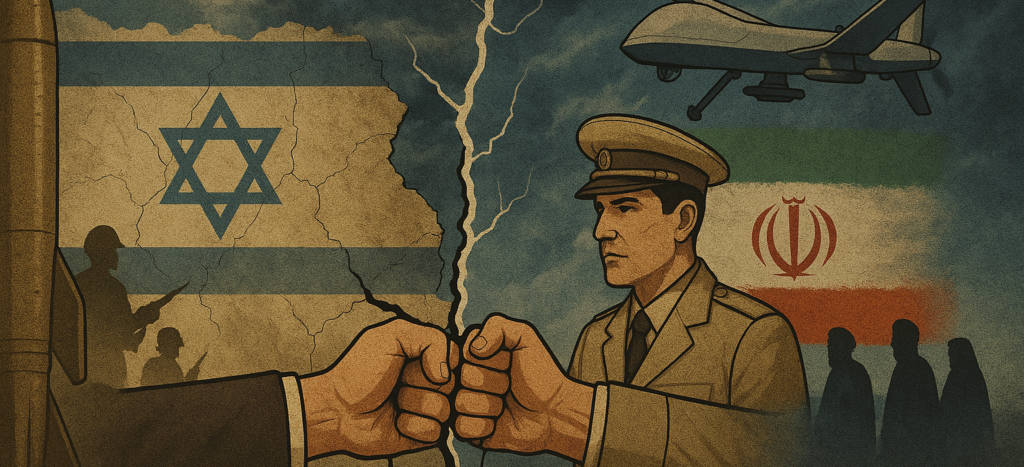
Once covert allies, now sworn adversaries — Israel and Iran’s relationship has fractured under the weight of revolution, ideology, and modern warfare. This image symbolically captures decades of broken trust, regional power struggles, and a future shaped by unresolved hostilities. (Photo: AI generated)
On 21 June 2025, US President Donald Trump ordered coordinated airstrikes on three of Iran’s most critical nuclear facilities — Fordow, Natanz, and Isfahan — using advanced bunker-busting bombs and submarine-launched cruise missiles.
This dramatic escalation followed Israel’s surprise offensive on 13 June, which targeted Iranian military and nuclear installations and resulted in the assassination of top Iranian officials and scientists.
Despite severe damage and over 200 Iranian casualties, Iran’s regime and nuclear programme have survived, and a fragile ceasefire has since been declared.
China’s strategic rethink: Energy, logistics, and Taiwan
For China, the US intervention has triggered a major reassessment of its regional strategy. Beijing’s energy imports and overland logistics — especially the China–Pakistan Economic Corridor, a vital part of the Belt and Road Initiative — are now under threat.
The conflict has destabilised Iran and raised the spectre of Israeli action against Pakistan, which would directly endanger Chinese investments and supply chains across Central Asia and beyond.
Moreover, the US strikes have sent a strong deterrent message. Chinese leaders, who previously viewed Trump as transactional and hesitant, now see a US president willing to use force unpredictably — especially if Beijing were to consider military action against Taiwan. This has “rebuilt some deterrence vis-à-vis China,” pushing Beijing to weigh its options more cautiously.
North Korea: Nuclear weapons as survival insurance
The events in Iran have further convinced North Korea of the value of its nuclear arsenal. The fact that Iran, lacking a credible nuclear deterrent, was bombed, while North Korea has not faced such strikes, is not lost on Pyongyang.
Kim Jong Un’s regime is likely to double down on its nuclear programme, believing that only nuclear weapons can guarantee its survival against US intervention. This hardening stance reduces the likelihood of meaningful denuclearisation talks and may push North Korea closer to China and Russia for support.
Impact on India and the wider region
For India, the US-Iran escalation carries both risks and opportunities. India already possesses nuclear weapons, which acts as a deterrent against external aggression. However, the conflict threatens global oil markets and maritime trade routes — especially the Strait of Hormuz and the Red Sea — on which India depends for energy security and commerce.
The instability also presents India with a chance to strengthen its own strategic corridors, such as the proposed India–Middle East–Europe Corridor (IMEC), which could emerge as a key alternative to China’s Belt and Road. However, any destabilisation in Pakistan or Iran would have direct security implications for India, given the interconnectedness of South Asian and West Asian security.
Global and regional reverberations
The US strikes have not only escalated the Israel–Iran conflict into a regional crisis but also signalled Washington’s intent to contain China’s influence across the Indo-Pacific and Eurasia. Tehran has threatened retaliation, including possible attacks on US bases and disruption of shipping lanes, raising the risk of further escalation and volatility in energy prices.
Meanwhile, Israel’s willingness to target Pakistan if Iran is defeated has alarmed both Islamabad and Beijing, with Pakistan warning of potential retaliation and seeking diplomatic leverage with the US. The situation remains fluid, with the ceasefire between Israel and Iran still fragile and sporadic missile fire continuing.
In nutshell: a new security calculus for Asia
The US airstrikes on Iran’s nuclear sites have fundamentally altered the geopolitical landscape across Asia. China is more likely now to reconsider its regional ambitions and energy security, North Korea could be more convinced than ever of the need for nuclear deterrence, and India faces both heightened risks and new strategic opportunities.
As the dust settles on Israel-Iran-US conflict, all eyes are on how these powers will adapt to a world where military strength and unpredictability are once again at the forefront of international relations.