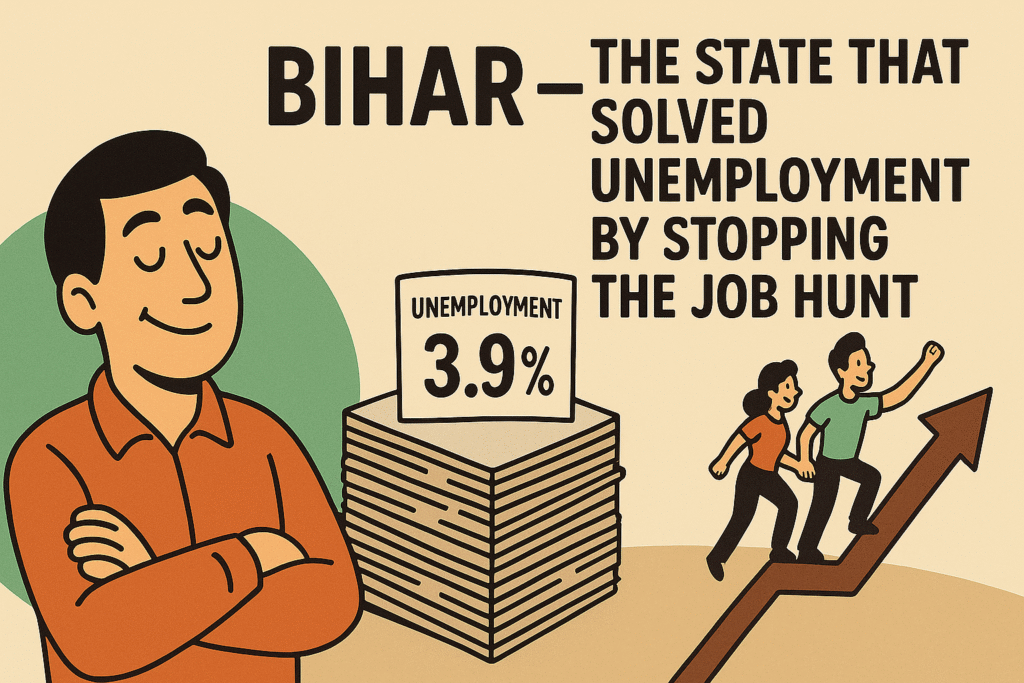
Bihar shows low unemployment rate because figures suggest people aren't looking for jobs (Image: AI generated)
While India frets over rising joblessness, Bihar appears oddly serene — on paper. With a 3.9% unemployment rate and half its working-age population no longer even looking for work, the state may have discovered the most effortless employment strategy of all.
The miracle in the numbers
Bihar — the land where miracles never cease. While most states struggle to keep joblessness down, Bihar has seemingly cracked the code: just make sure no one bothers looking for work in the first place.
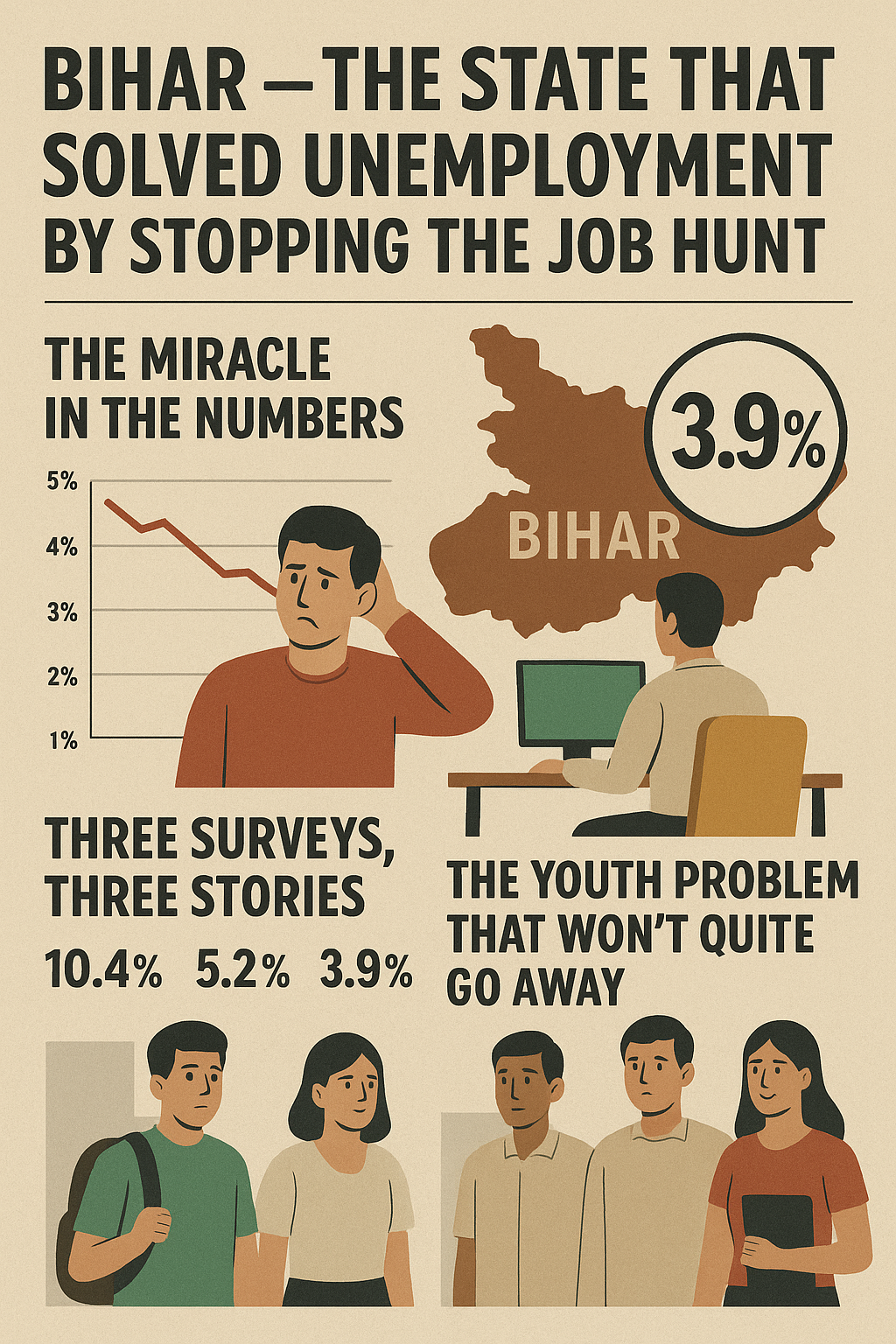
According to the Periodic Labour Force Survey (PLFS) 2022–23, Bihar’s unemployment rate stands at a modest 3.9%, only slightly above the national average of 3.2%. It is the sort of figure that looks remarkable on a PowerPoint slide. But peel back that glossy veneer and the picture changes.
Key labour figures:
- Labour force participation rate (LFPR): 51.6%
- Work participation rate (WPR): 46.2%
In plain English: nearly half of Bihar’s working-age population is not even in the job market. Economists call it the Discouraged Worker Effect; everyone else might simply call it realism.
Three surveys, three stories
Try pinning down Bihar’s unemployment rate and you will find a plurality of truths. The April–June 2025 quarter reports an unemployment rate of 10.4% — comfortably higher than the national figure. Another dataset, for those aged 15 and above, offers a more relaxed 5.2%. Meanwhile, NITI Aayog’s figure from 2022–23 keeps the classic 3.9% alive.
It is a statistical buffet: pick whichever number suits your argument, and someone will back you up.
The youth problem that won’t quite go away
The 15–29 age group once bore the brunt of Bihar’s joblessness, with unemployment peaking at 30.9% in 2018–19. By 2023–24 that number had fallen to 9.9% — progress of a sort.
But averages deceive. Urban Bihar still reports a bleak 22.2% youth unemployment rate, while rural areas sit at 8.8% — helped by subsistence farming and family-run work that passes as “self-employment”.
In much of Bihar, having a job often means having something — anything — to do between meals.
Educated, ambitious and unemployed
Bihar’s most curious trend is its education paradox: the higher you study, the harder it gets to find a job.
Unemployment by education level:
- Illiterate population: 0.8%
- Graduates: 14.7%
- Postgraduates: 19%
- Diploma / higher secondary: notably high unemployment (no favourable figures)
In most parts of the world, a degree is a ladder out of poverty. In Bihar it too often resembles a treadmill — plenty of effort, very little forward motion.
The shape of work: informal, insecure and unrelenting
Of those who are employed, stability is rare. Only 5.7% of Bihar’s workforce have regular salaried positions. Roughly 67.3% are casual labourers or self-employed, primarily in agriculture and the informal sector.
In effect, Bihar’s economy runs on survival work — essential but insecure, vital but invisible. The state also ranks among the lowest in India in both WPR and LFPR, an unwanted distinction it holds with the grim consistency of a side of the table that refuses to budge.
Promises and poetry
No employment story is complete without a promise. The Bihar government has pledged to create 12 lakh government jobs by 2025 — an ambitious target. Whether it materialises is another question; for now the announcement itself is the deliverable.
The calm that isn’t calm at all
So yes: Bihar’s unemployment rate is officially low. But that is largely because so many people have stopped looking for work. The problem is not merely a shortage of jobs — it is under-engagement, under-employment and a silent withdrawal from the formal labour market.
Bihar, then, has not solved joblessness; it has redefined it out of existence. A statistical miracle, achieved not through opportunity, but through omission. In the end, that may be the cleverest employment policy of all.