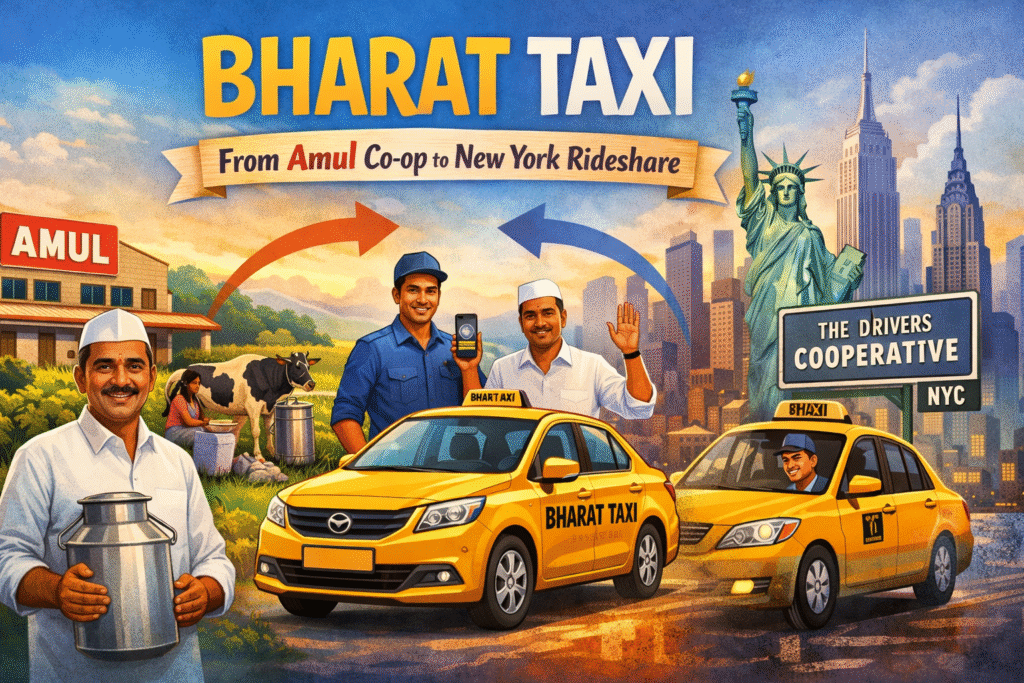
This article is about Bharat Taxi and how Amul’s cooperative model and a New York experiment inspired India’s new ride-hailing app. For decades, the Amul milk cooperative movement quietly transformed India’s rural economy. By removing middlemen and giving producers collective ownership, it ensured that dairy farmers—not private companies—controlled pricing, profits, and decision-making.
Now, that same cooperative logic is being applied to India’s congested city streets.
Launched on Thursday, Bharat Taxi is India’s newest ride-hailing app, but with a fundamental twist: it is owned and managed by drivers themselves. The platform positions itself as a direct challenge to commission-driven aggregators such as Ola and Uber, borrowing heavily from the Amul playbook while also drawing inspiration from a successful driver-led experiment in New York City.
At its core, Bharat Taxi asks a simple question: if milk producers could own Amul, why can’t taxi drivers own the app they drive for?
From milk producers to mobility workers
Amul’s success rested on a radical idea for its time—eliminate intermediaries and return control to producers. That model reshaped how value flowed in India’s dairy sector.
India’s taxi drivers argue they are trapped in the opposite system. App-based aggregators dominate pricing and algorithms, while drivers shoulder fuel costs, vehicle maintenance, and long working hours—often losing 20–30 per cent of each fare to commissions.
Bharat Taxi seeks to reverse that equation.
The core structure: for drivers, by drivers
Member ownership: Just as Amul is owned by millions of dairy farmers, Bharat Taxi is operated by Sahakar Taxi Cooperative Limited, a driver-run cooperative. Drivers are shareholders and co-owners, not “partners” bound by opaque platform rules.
Eliminating the middleman: Unlike Ola and Uber, Bharat Taxi follows a zero-commission model. Drivers keep nearly the entire fare, echoing Amul’s approach of maximising producer earnings by cutting out intermediaries.
How the app earns: Instead of taking a percentage cut, the platform charges drivers a flat, nominal daily fee to access the app. This makes earnings more predictable and ensures drivers benefit directly from higher demand rather than losing income to algorithm-driven commissions.
Implementation: cooperatives meet code
Bharat Taxi’s rollout is being backed by some of India’s most influential cooperative and development institutions—an unusual level of institutional support for a mobility app.
Strategic backing: The initiative has support from GCMMF, IFFCO, NCDC, and NABARD, reinforcing its cooperative credentials.
Leadership: The cooperative is chaired by Jayen Mehta, Amul’s managing director, signalling that this is not merely a branding exercise but a serious attempt to transplant the cooperative ethos into the gig economy.
Technology backbone: The app uses the backend developed for Namma Yatri and runs on the government-backed ONDC framework. The open-source approach is intended to prevent monopolistic control, mirroring the decentralised nature of cooperatives themselves.
What passengers get out of it
Although the platform is unapologetically driver-centric, Bharat Taxi also promises tangible consumer benefits.
No surge pricing: In keeping with Amul’s philosophy of fair and stable pricing, Bharat Taxi says it will not impose surge pricing during peak hours or emergencies.
Early traction: The cooperative claims that more than 50,000 drivers have already enrolled during the pilot phase, suggesting strong demand for alternatives to commission-heavy platforms.
Safety and welfare: Features include police-connect integration and health and accident insurance for drivers, reflecting the cooperative principle that members’ welfare is a shared responsibility.
The New York connection
Bharat Taxi’s approach is not entirely without precedent.
In the United States, The Drivers Cooperative has operated in New York City since 2021 as a driver-owned, non-profit ride-hailing service. While it has not displaced Uber or Lyft, it has demonstrated that cooperative ride-hailing can survive, improve driver earnings, and operate without venture capital-backed extraction.
India’s experiment, however, is unfolding at a much larger scale—and in a country already familiar with cooperatives as mass institutions thanks to Amul.
Why this experiment matters
Bharat Taxi represents more than a new app launch. It is a test case for whether cooperative ownership can coexist with platform technology in India’s gig economy.
Amul proved that producer ownership could build trust, stability, and scale. By applying that logic to urban mobility—and borrowing lessons from New York’s driver cooperatives—Bharat Taxi is attempting to rewrite how value is shared in India’s ride-hailing economy.
Whether it can meaningfully challenge entrenched players like Ola and Uber remains to be seen. But from milk cans to car dashboards, the cooperative idea is once again being put to the test—this time, one ride at a time.