Dipu Chandra Das, a 27-year-old Hindu garment worker in Mymensingh’s Bhaluka area of Bangladesh, was brutally beaten and lynched on the night of December 18, 2025, then left on fire by a mob. His death — widely blamed on alleged blasphemy — triggered national and international outrage. Below is a comprehensive account of events, grounded in eyewitness reports, local and international news, and official statements.
What Happened Before Dipu was Launched
Dipu Das worked as a floor manager at Pioneer Knit Composite Factory (BD) Ltd in Square Masterbari, Bhaluka. In the days before his death, co-workers said he had conflicts with colleagues over promotions and work targets. On December 18, Das took an internal examination to be promoted from floor manager to supervisor. His brother Apu Robi Das told reporters that Dipu had disputes with several colleagues over his position, and had long-standing quarrels about production targets, overtime and work conditions.
That afternoon, local media reported that factory supervisors forced Dipu to resign. According to RAB commander Naimul Hasan, the floor manager — identified as Alamgir Hossain — forced Dipu to resign and then handed him over to the mob. Apu Das corroborated that he was beaten and thrown out of the factory after being accused of insulting religion, despite apologising. This suggests the workplace conflict escalated on December 18: Das was dismissed after the promotion test, and immediately rumours began circulating that he had insulted Islam.
Rumours and Blasphemy Accusations
Shortly after Das’s exit from the factory, unverified blasphemy rumours spread rapidly. A local Bengali outlet reported that co-workers claimed Dipu made derogatory comments about Islam and the Prophet Muhammad during a factory event marking “World Arabic Language Day”. These claims, however, were hearsay. By evening, word-of-mouth allegations had circulated through the factory and adjoining areas.
Crucially, investigators later found no factual basis for these rumours. The Mymensingh Additional SP Abdullah Al Mamun and RAB investigators said all blasphemy claims were unverified hearsay. RAB Company Commander Md Shamsuzzaman told BBC Bangla that none of them personally heard or witnessed Dipu making blasphemous remarks, and that there were no social media traces either. Authorities have emphatically stated the blasphemy accusation was a baseless rumour.
The Lynching – Eyewitness Accounts and Timeline
According to multiple local reports and viral video footage, the violence erupted in the early evening of December 18. As hundreds of workers began leaving the factory, a crowd confronted Dipu. A chilling video shows Dipu being physically dragged out of the factory through a side gate, then brutally beaten by a mob on the road. Witnesses describe the attack beginning late afternoon, with RAB noting it began around 4:00 pm.
Relatives learned of the attack through frantic calls and social media posts. Dipu’s father recounted seeing news of the assault on Facebook before family members called to say he had been badly beaten and taken by a mob. His brother Apu received a call saying Dipu was being taken to the police station under blasphemy charges, then a second call shortly after saying he was dead. When the family rushed to the scene, they found his burned body.
The Anatomy of Radicalism: Assault, Lynching and Burning
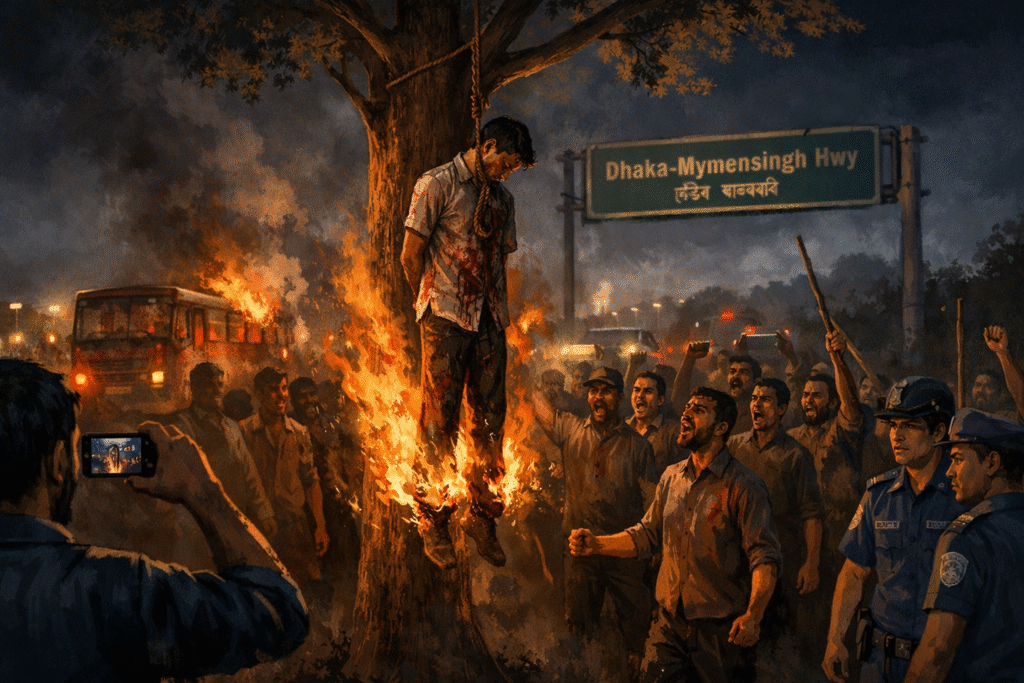
Reports paint a horrific picture of mob violence. Eyewitnesses say the mob beat Dipu to death on the open road about a kilometre from the factory. A local ward member stated that after being chased out, Dipu was beaten severely before being killed. The assailants then tied his corpse to a roadside tree on the divider of the Dhaka–Mymensingh highway at the Jamirdia Square Masterbari bus stand, where they poured kerosene over him and set him on fire.
Some witnesses said members of the crowd continued attacking the lifeless body while shouting slogans, then dragged it further along the highway and set it on fire again, blocking traffic and spreading panic. Dipu’s father described finding his son’s burned torso and head tied together, saying the mob poured kerosene on him and set his body ablaze. Authorities noted that traffic on both sides of the highway came to a standstill. In summary, Dipu was lynched by beating, then hung and burned in a public place.
Did the Police Try to Rescue Dipu?
Despite allegations that police may have handed Dipu to the mob, official sources rejected claims of police complicity. The Bhaluka police station officer-in-charge, Md Zahidul Islam, told BBC Bangla that the mob took Dipu directly from the factory, and that police were not involved at any stage prior to his death. He dismissed social media claims as completely false, stating authorities were informed much later.
RAB officials similarly said police only learned of the incident hours afterward. They noted that the attack occurred around 5:00 pm, but police were alerted only around 8:00 pm. Although one narrative suggested that police might have rescued Dipu and later returned him to the mob, investigators found no evidence to support this claim. Reports indicate that authorities arrived after the body had already been burned.
What Yunus Regime Did: Offic Statements
Following the killing, Bangladeshi authorities launched a formal investigation. The interim government condemned the lynching as an act that had no place in the country and vowed that perpetrators would not be spared. Police and RAB repeatedly stated they found no evidence of blasphemy. Additional SP Abdullah Al Mamun said the allegations were purely hearsay, and that investigators found no truth in them. The Bhaluka police chief also confirmed that no witness had heard Dipu insulting religion.
RAB Commander Shamsuzzaman confirmed investigators could not find any person who personally witnessed Dipu making insulting remarks, and found nothing online either. RAB described the blasphemy claim as extremely vague and based only on rumour, and said they were investigating whether workplace disputes — rather than religion — triggered the violence.
At a December 20 press briefing, RAB director Naimul Hasan detailed that Dipu was forced to resign around 4:00 pm and later handed to an enraged mob. He emphasised that the killing was unjustified, and that investigators were examining whether it was spontaneous mob violence or a planned attack.
Arrests and Legal Action
Within days, law enforcement began rounding up suspects. By December 20, ten people had been detained. RAB arrested seven suspects, while police apprehended three more. Those arrested included both factory officials and workers, among them floor manager Alamgir Hossain and quality in-charge Miraj Hossain Akon. By December 22, authorities had 12 suspects in custody, all placed under judicial remand.
Dipu’s younger brother Apu filed a murder case on December 19 against approximately 150 unidentified individuals. Police and RAB have relied on video evidence and eyewitness testimony to identify suspects. Investigators stated that the probe would continue, including parallel shadow investigations to uncover additional perpetrators.
What Yunus Said
Bangladesh’s interim government, headed by Chief Adviser Muhammad Yunus, publicly condemned the lynching. In a December 19 statement, it declared that there was no place for such violence in the new Bangladesh and promised that none of those responsible would be spared. The Ministry of Home Affairs assured the public of a thorough investigation.
However, Bangladesh’s Foreign Ministry later described the murder as an isolated attack and rejected claims that it represented broader systemic violence against minorities. This position came amid rising diplomatic tensions, particularly with India. Bangladesh also criticised what it called misleading propaganda surrounding protests and temporarily suspended certain visa services in response to diplomatic disruptions.
More Responses: From India and the World
The killing triggered major protests and diplomatic friction, especially between India and Bangladesh. In India, Hindu organisations held protests across several cities, including New Delhi, Hyderabad and Guwahati. Demonstrators accused Bangladesh of failing to protect Hindu minorities and demanded justice.
India summoned Bangladesh’s envoy to express concern over the killing, while Bangladesh summoned India’s High Commissioner to protest demonstrations and alleged damage to its mission premises. Both nations temporarily suspended some visa operations, reflecting heightened diplomatic tensions.
Internationally, U.S. lawmakers and human rights advocates strongly condemned the lynching, calling for accountability. The United Nations also expressed concern, urging Bangladesh to ensure protection of all citizens. Global media coverage highlighted both the brutality of the killing and its political implications, particularly regarding minority safety and mob violence in Bangladesh.