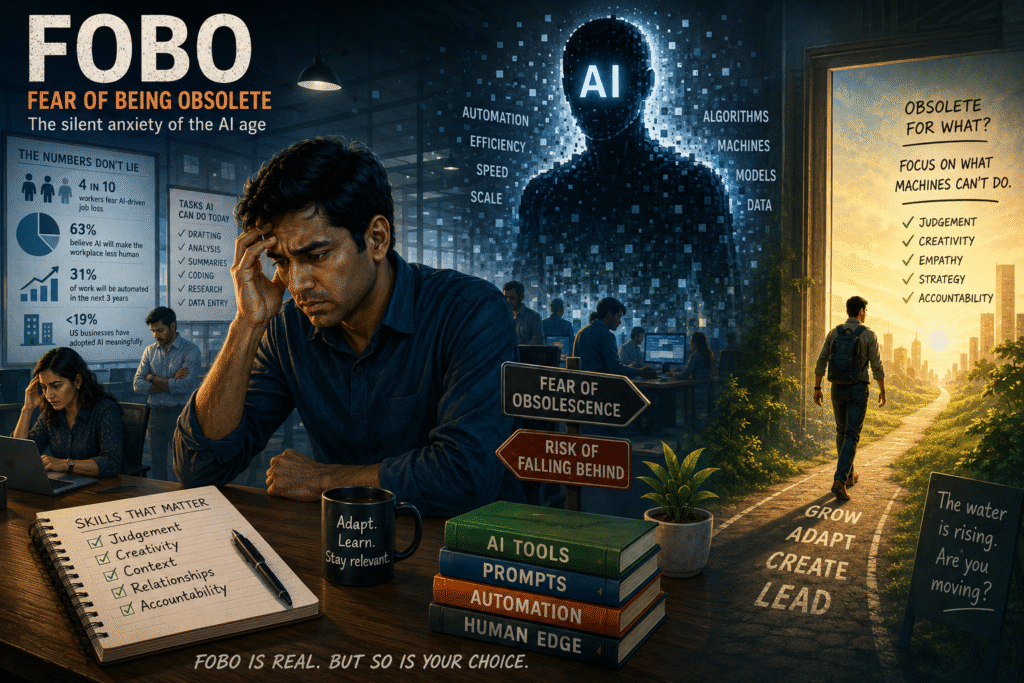
Let’s start with a word you’ve probably not heard yet, but will soon. FOBO. Fear of being obsolete.
You already know its cousin. FOMO — fear of missing out — has been part of our vocabulary for over a decade now. It’s the anxiety of not being invited, not being in the loop, not being where the fun is. FOBO is darker. It’s not the fear of missing a party. It’s the fear of missing your own relevance.
And in 2026, this isn’t some fringe internet term. Cambridge Dictionary added it to their new-words list this January, defining it simply as the worried feeling that your job could be done by AI. Fortune magazine went further, calling FOBO the defining psychological condition of the American workplace this year. That’s not a small claim. So let’s unpack why this word suddenly matters — and what it actually means for people watching AI reshape their careers in real time, including here in India.
Where the term came from
Interestingly, FOBO didn’t start on the shop floor. It started in the boardroom. JPMorgan coined the term late last year, and used it to describe something happening at the top of companies — the institutional fear of falling behind competitors on AI. That fear, JPMorgan said, was the single biggest force driving corporate AI spending.
Companies weren’t necessarily investing in AI because they’d worked out exactly how it would help. They were investing because they were terrified of being the company that didn’t.
But somewhere along the way, the term slipped downstairs. It stopped being just an executive suite anxiety and became a personal one — the quiet dread felt by an individual employee that the specific thing they’re good at, the thing they built a career around, might simply stop being needed.
That’s the FOBO most people are talking about now. Not “will my company survive AI” but “will I.”
The numbers behind the anxiety
This isn’t a vibe. The data backs it up.
According to KPMG, around four in ten workers now name AI-driven job loss as one of their primary fears — a share that has nearly doubled within a single year.
A separate industry study found that sixty-three per cent of workers believe AI will make the workplace feel less human. Willis Towers Watson’s 2026 Global Employee Experience study found that the share of work handled through automation is expected to more than double over the next three years, from fourteen per cent to thirty-one per cent.
And here’s the bit that surprises people — this fear isn’t concentrated where you’d expect. The easy assumption is that Gen Z, the newest and most vulnerable entrants to the workforce, are the most anxious.
A Gallup survey did find that around fifty-three per cent of adult Gen Z workers feel anxious about AI. But a separate survey found millennials were even more worried — eighty-two per cent feared AI would lower their pay, a higher share than any younger cohort. In other words,
FOBO isn’t just about people with the least to lose. It’s often worse among people who’ve spent a decade or more building expertise, and now watch that expertise get compressed into a chat prompt.
Two very different fears wearing the same name
Here’s where it gets interesting, and a little ironic. There are actually two FOBOs running in parallel inside most organisations right now, and they rarely talk to each other.
At the top, there’s institutional FOBO — the executive fear of the company falling behind. This is what’s driving the billions being poured into AI adoption, pilots, and transformation programmes.
At the bottom, there’s personal FOBO — employees quietly terrified that they are the very obsolescence their leadership is chasing. One Forbes contributor put it well: leaders are so focused on the institutional fear of falling behind that they completely overlook the personal fear paralysing their own teams.
Executives are chasing the technology. Employees are running from what it might mean for them. And because nobody’s naming that gap out loud, it festers.
Is the fear justified — or is it premature?
This is the part The Free Pen readers will actually want to know: is FOBO rational, or is it panic?
The honest answer, based on the most rigorous research available, is: a bit of both — but mostly, it’s premature rather than irrational.
MIT researchers studying AI’s labour market impact found something worth sitting with. Frontier AI models can already complete somewhere between fifty and seventy-five per cent of text-based labour tasks at a quality level a manager would accept without edits. That’s not a future projection — that’s already true today. And the trajectory is steep.
In under eighteen months, frontier models went from reliably completing three-to-four-hour human tasks to completing tasks that would take a person an entire working week.
That sounds alarming. But the same researchers added an important caveat: workers are likely to see these changes coming gradually, rather than being blindsided by sudden, discontinuous jumps in automation. The tide is rising — but it’s rising slowly enough that most people have time to move to higher ground, if they choose to.
And here’s the twist nobody expects: for all this capability, actual AI adoption inside companies remains surprisingly low. Goldman Sachs economists, citing Census Bureau data from their March 2026 tracker, found that fewer than nineteen per cent of American businesses have actually adopted AI in any meaningful way. The tools exist. The fear exists. But the deployment gap between the two is enormous.
The trap: how FOBO makes itself come true
This is the part that should genuinely worry people — not the AI, but how they respond to the fear of it.
When FOBO goes unmanaged, it doesn’t produce action. It produces protection. People stop sharing what they know, in case it makes them replaceable. They stop asking questions, in case it makes them look behind. They fake competence rather than admit confusion.
FOBO doesn’t just make you obsolete — it makes you behave as though you already are, hoarding instead of collaborating, hiding instead of learning, going through the motions instead of pushing forward.
There’s a genuinely strange finding buried in a 2026 workplace study — nearly forty-four per cent of young employees admitted to slowing down or quietly undermining their own company’s AI initiatives, out of fear that success would lead to their own redundancy. Think about that.
The fear of obsolescence is, in some workplaces, actively producing the sabotage of the very tools that might have made people more valuable, not less.
That’s the self-fulfilling loop at the heart of FOBO. The fear doesn’t just sit there. Left unaddressed, it quietly engineers the outcome everyone dreads.
The better question FOBO never asks
There’s a sharper way to think about all this, and it comes from a recent piece worth sitting with: instead of asking “will I become obsolete,” ask “obsolete for what?”
A typewriter became obsolete because the need it served — mechanically striking ink onto paper — disappeared entirely. That’s not what’s happening to most knowledge work right now.
The need for judgement, context, taste, relationships, and accountability hasn’t gone anywhere. What’s changing is which tasks within a role get automated, not whether the role’s underlying purpose still matters.
Put simply: a writer doesn’t become obsolete because AI can draft a paragraph. A writer who can’t use AI to draft faster, verify better, and focus more energy on judgement and structure becomes less competitive than one who can. That’s a capability gap — specific, learnable, closeable — not obsolescence, which is total and final.
FOBO collapses that distinction into a single, panicked binary: keep up, or become irrelevant. And panic, as it turns out, produces exactly the wrong response — chasing whatever skill is trending on LinkedIn that week, rather than strategically closing the actual gap that matters for your own work.
What this means going forward
So where does this leave things?
The honest, forward-looking picture is this: FOBO is not going away in 2026 — if anything, as AI capability keeps compounding roughly every few months, the fear is likely to intensify before organisations catch up with clarity.
But the underlying data suggests the fear is running ahead of the actual disruption, not behind it. Deployment is slow. Integration is messy. The “last-mile costs” of actually embedding AI into real workflows — organisational friction, liability, economics — remain a much bigger barrier than the raw capability of the models themselves.
What will separate people who thrive from people who quietly stagnate isn’t who panicked fastest or collected the most AI certificates. It’s who used this window of gradual, visible change to figure out precisely which of their own skills the machine still can’t touch — and doubled down there, instead of hiding.
FOMO used to be about missing a moment. FOBO is about missing a decade. The good news, if there is any: unlike most fears, this one comes with a fairly generous warning system. The question, if put rather bluntly, isn’t whether the water is rising. It’s whether you’re moving.